




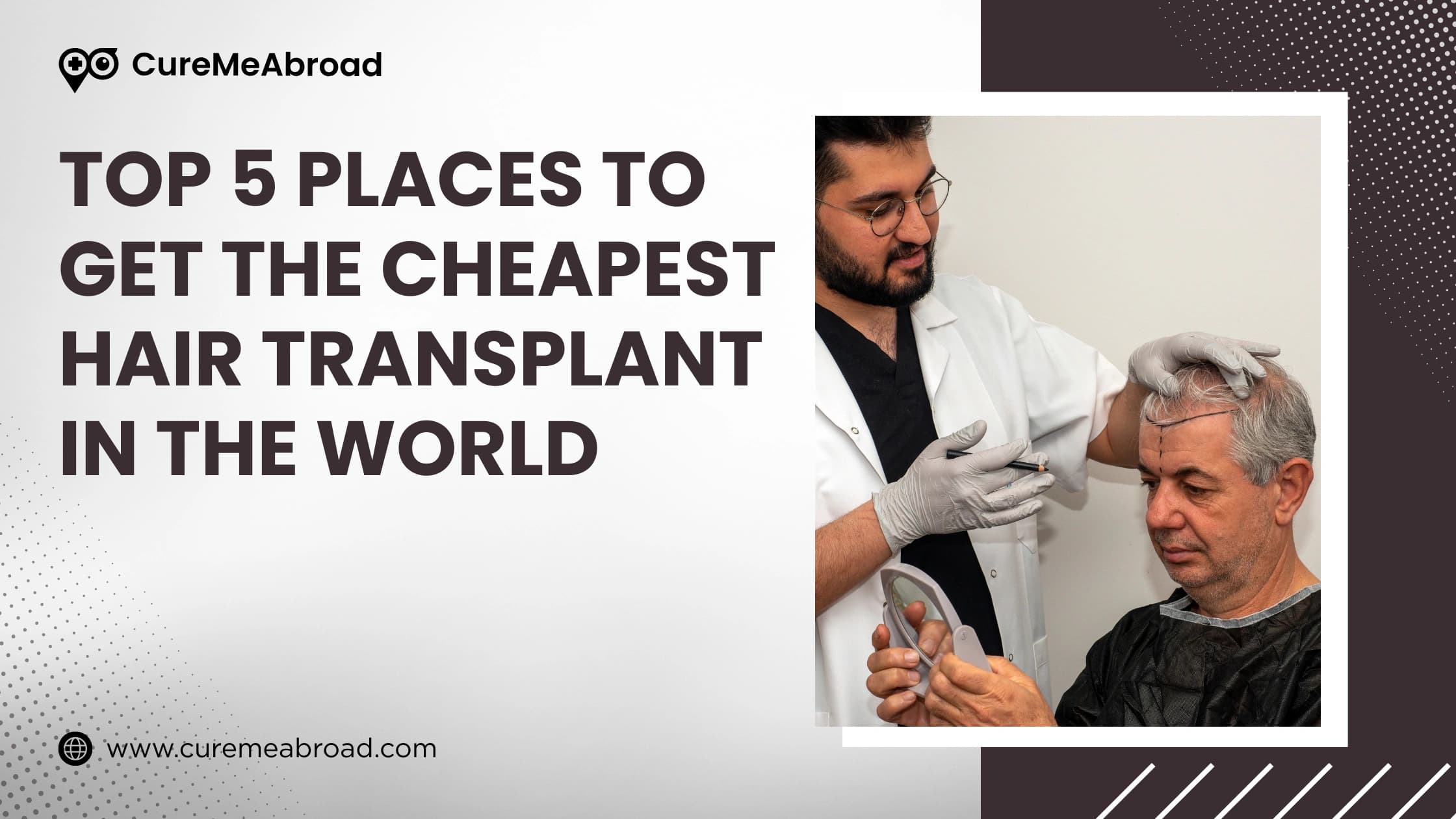
Hair loss happens to millions of individuals, yet treatment is wildly expensive in one nation compared to another. Fortunately, you don't have to have a celebrity's bank balance to get your hairline back. Cheap hair transplantation can be found at most of the world's popular medical tourism hubs, with highly qualified surgeons.
Discovering the best places to have a hair transplant can be difficult. Searching on the internet can provide you with lots of conflicting advice, when all you really want to do is discover the best hair transplant in the world. But as you'll discover from this guide, it's necessary to look at your own individual needs and characteristics to ensure you see the best doctor for you.
As hair transplants are becoming increasingly popular and readily available, people are now traveling overseas to look for a great surgeon at the lowest price. How do you get the cheapest country for hair transplant, then?
Types of Hair Transplant
There are two main forms of hair transplant surgery that are commonly used:
Follicular Unit Transplantation (FUT)
More simply called the strip method, FUT is where a strip of skin is surgically removed from the donor region with high density of hair growth. This strip is dissected under magnification to produce individual hair grafts each with one to several hair follicles. The grafts are later implanted in small incisions created in the recipient site resulting in a linear scar at the donor site, which may be hidden with surrounding hair.
Follicular Unit Extraction (FUE)
FUE is a newer and less painful hair transplant technique. Individual follicles are removed directly from the donor site by a small handheld punch-like tool or motorized extraction tool. The removed follicles are planted in the recipient area by making very small incisions like FUT. FUE results in small, dot-shaped scars on the donor site, lesser compared to linear scar resulting from FUT. Moreover, the wounds do tend to become less noticeable with the passage of time.
Both FUT and FUE can provide great outcomes when done by experienced surgeons. It is not a question of which is better, but rather depending on the patient's balding pattern, quality and density of donor hair, surgeon expertise, and personal choice.
Medical Tourism for Hair Transplant: Pros and Cons
Nearly all nations these days have high-quality hair transplant procedures. Many nations even have medical tourism facilities for those from all over the globe. Without a doubt, there are several benefits of getting hair transplants abroad. But as the saying goes, both sides of a coin, and there are certain downsides to going abroad for hair loss treatment.
Whereas regarding the benefits of going abroad for a hair transplant, there are just too many on offer for you.
Pros
- Cost Savings: Without any doubt, price is the driving factor in deciding where to have hair transplant surgery. There are already many countries providing affordable hair transplant, which makes it easier for more people to obtain.
- Qualified Surgeons: Most countries are already making the rounds for their very talented surgeons and medical centers. Surgeons in some countries have a lot of experience and training in the sector.
- State-of-the-art Facilities: Patients no longer have just a handful of options available to them for their treatments. Now, even developing nations are boasting world-class healthcare facilities, including hair transplant centers, attracting more and more patients from across the globe.
- Complete Packages: The majority of hair transplant clinics nowadays have complete packages for their foreign clients. Complete medical tourism packages normally consist of procedure cost, accommodation, transportation, and post-operative care.
- Chance to Have Enjoyable Vacation: Going abroad for hair transplantation offers individuals suffering from hair loss a chance to have a break from their hectic routine and enjoy their vacation without any stress.
Yet, there are also downsides to this. Let us now examine the negatives.
Cons
- Quality and Safety Issues: Sure, there are several well-established clinics overseas; yet, there are also risks involved with lower-quality clinics. Hence, it is crucial to carry out extensive research before selecting a trusted clinic in order to prevent complications.
- Communication Barriers: English is now the official language of nearly every nation in the world. Yet, there exist a few nations where business still operates in their native languages. In such a scenario, language can be a barrier to express your requirements with the hair transplant clinic.
- Legal and Regulatory Differences: Every country has a unique set of medical regulations. Make sure to note legal protections and available recourse in case things go amiss. Therefore, it is important to research legal and regulatory variations before traveling overseas for a hair transplant.
- Post-Operative Care: Post-operative care is not just what you are required to do following the surgery. Foreign travel can be complicated by follow-up visits and care. You might need to go back to the nation where the operation was held, which is often a considerable addition to their expenses and a hassle.
Top 5 Cheapest Places to Get the Affordable Hair Transplant in the World (2026)
Turkey
If you've been considering hair restoration treatment for some time now, then you've likely come across Turkey numerous times when researching. With so many good surgeons they have, it's no surprise that so many satisfied patients attest to the fact that Turkey is where you'll get the best hair transplant in the world.
Pros:
- Extensive selection of good clinics
- Numerous surgeons with experience in various modern techniques.
- The cost is perhaps the lowest. Very often it is the cheapest hair transplant destination, without cutting corners.
Cons:
- There is a huge selection, so the risk of having to keep an eye out for many less-skilled doctors is high.
- The weather gets extremely hot in Turkey, which may not be ideal for all patients.
India
More than 200,000 patients travel to India to receive treatment: a reflection of the high standard and excellence of the county's care. India's private hospitals are extremely well-equipped and advanced, with many of the doctors having undergone external training.
India is thus a safe and well-known destination for hair transplantation as well. It also works in your favor that you'll be getting one for around 80% less than you would in many other nations, without there being any loss of quality.
Pros:
- Throughout the nation, a lot of big and state-of-the-art hospital centers with large teams of experts provide the treatment.
- You'll be traveling to a nation renowned for its special culture and breathtaking scenery.
Cons:
- Not only is it a long-haul flight from Europe and America, but you will also have to endure a relatively lengthy visa application process first.
- The temperature in summer is occasionally above 45 degrees celcius.
Mexico
Mexico is a favorite choice for hair transplant surgery. Due to its well-established health infrastructure and affordability, you can easily find the best hair transplant surgeon who can fulfill your requirements and budget in Mexico.
For US and Canadian patients it's particularly convenient to access, not to mention the lowest-priced country on their continent for hair transplant surgery. But however they get there, patients seeking a holiday experience with their treatment should think of Mexico.
Pros:
- Even the best-qualified clinic doing the best hair transplant in Mexico won't cost half the price of in most other nations.
- You have a choice of a range of high-standard clinics operated by highly qualified, well-rated professionals.
- Mexico has more than 60 nations whose residents don't require a visa for a maximum stay of 180 days, such as most European nations and the USA.
Cons:
- Mexico can be extremely hot and humid, and some patients may find that unpleasant.
- For Europeans, the flight will take approximately 12 hours or more, and on top of that, you might have to take a connecting flight depending on which city you arrive in.
Thailand
One of the advantages of getting a hair transplant in Thailand is that you can turn your trip into an extended holiday. Most patients from the US, Australia, and the UK travel to Thailand annually to enjoy the numerous doctors who carry out high-quality procedures for a small fraction of the cost they'd incur at home.
Pros:
- Incredibly cheap prices for unrealistically high quality - usually the situation with Thailand's plastic surgery.
- Travel to a country with a distinctive culture, great views, mandatory cities and tasty cuisine.
- Take advantage of a well-developed medical system with available private hospitals and clinics.
Cons:
- Thailand is distant for many, and patients from the UK have to endure a 12 hour flight and a significant time difference.
Poland
When researching the top countries to have a hair transplant, Poland does always come to mind too. Its medical system has become one of the best European providers of good quality service and sophisticated medical technology. The cost for a hair transplant is remarkably low considering the high level of qualification of its physicians.
If you are coming from the UK, there are plenty of low-cost airlines that offer plenty of cheap flights each day.
Pros:
- Poland generally has a good reputation for plastic surgery in general with a lot of Polish surgeons having hair transplantation as a specialist area too.
- You'll be able to find high quality at a low cost.
- It's a simple, brief trip to Poland for individuals within the rest of Europe.
Cons:
- The selection of skilled professionals is not so large as in some other nations, such as Turkey.
- Temperatures in Poland become extremely cold during the winter, which might discourage some individuals.
The table below highlights the average cost of FUT and FUE in different countries.
| Country | FUT Average Cost (USD) | FUE Average Cost (USD) |
|---|---|---|
| Turkey | $1,500 – $3,000 | $2,000 – $4,000 |
| India | $1,000 – $3,500 | $1,200 – $3,000 |
| Mexico | $2,500 – $5,000 | $2,500 – $5,000 |
| Thailand | $4,000 – $6,000 | $3,000 – $6,000 |
| Poland | $4,000 – $7,000 | $5,500 – $8,000 |
Selecting an affordable hair transplant overseas can make you feel confident again without breaking your bank. Turkey and India still remain the cheapest hair transplant nations while delivering great medical care.
Make inquiries, compare the clinics thoroughly, and select a destination that offers both skill, safety, and affordability.
Frequently Asked Questions
Which is the cheapest hair transplant country in the world?
India and Turkey are now the most affordable hair transplant options with good results.
Is an affordable hair transplant safe?
Yes. Provided you use licensed surgeons and clinics with good reputations. Always ask for certifications and past case outcomes.
What is the ideal age for a person to have a hair transplant?
As per hair experts, the ideal age for a hair transplant is 40 and over. If you get a transplant when you are too young it will be difficult to ascertain which portions of your head go bald.
How long does a hair transplant last?
Hair transplanted from donor sites are immune to the hormone dihydrotestosterone (DHT) which causes destruction of hair follicles. If the hair transplant is properly executed then due to this resistance the implanted hair must grow permanently.
References
Waddell, Emily. The 10 Best Countries for a Hair Transplant - in 2025. 25 Feb. 2025
www.qunomedical.com/en/blog/best-countries-for-a-hair-transplantGlobalmedik. “Where Is the Best Place to Do Hair Transplant in the World.” GlobalMedik, 19 Mar. 2025
globalmedik.com/en/where-is-the-best-place-to-do-hair-transplant-in-the-worldD, Erin. “Hair Transplant Cost: 16 Countries Compared (2025).” Medihair, 28 Feb. 2025
medihair.com/en/hair-transplant-cost