



Relief From Shoulder Pain After Laparoscopic Surgery: Causes, Remedies, and Recovery Tips
Your surgery was performed in your abdomen, so shoulder pain afterward can feel unexpected. Yet many patients experience shoulder discomfort within hours of waking up, sometimes finding it more uncomfortable than the incision pain itself. This happens because of a specific response inside your body involving the gas used during laparoscopic surgery and the nerves that carry pain signals.
Understanding why this happens can help you find the right ways to manage the discomfort. Getting relief from shoulder pain after laparoscopic surgery starts with understanding what causes it and how you can ease it during recovery.
Why Does Shoulder Pain Occur After Laparoscopic Surgery?
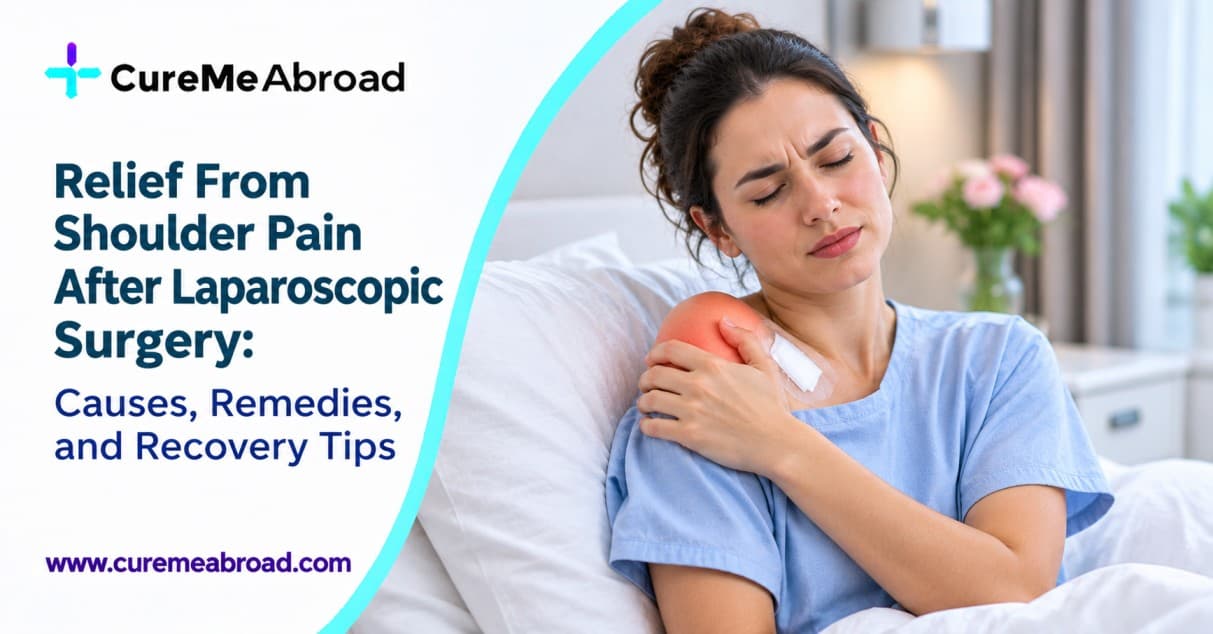
Anyone looking for relief from shoulder pain after laparoscopic surgery usually starts by checking the shoulder. It makes sense, since that’s where it hurts. But the real source is the diaphragm, and the shoulder only feels the pain. Doctors call this referred pain.
The Role of Carbon Dioxide Gas
To give the surgeon space to work, the belly is inflated with carbon dioxide (CO₂). Most of the gas is released at the end of the surgery. A little can stay behind under the diaphragm, which is the muscle below your lungs. The gas can create an acidic environment there and stretch the diaphragm, which may irritate the phrenic nerve. The exact cause of this pain isn’t fully established.
The Phrenic Nerve Connection
The phrenic nerve controls the diaphragm and starts in the neck. The phrenic nerve and the nerves that supply the shoulder share overlapping spinal cord levels, so irritation near the diaphragm can be felt in the shoulder. The Center for Endometriosis Care explains it in a similar way.
Other Contributing Factors
Leftover gas is thought to be the main cause, though a few other things can add to the pain.
Positioning: Being tilted head down during surgery can strain the shoulders and move gas toward the diaphragm.
Trapped fluid or small clots: When these collect under the diaphragm, they can irritate the nerve. If they sit near the liver, the pain may be felt more on the right side.
Drains: A drain placed close to the diaphragm may make the nerve more sensitive.
Longer surgery and higher gas pressure: Pressure settings vary by procedure and surgeon, and shoulder pain may be more noticeable after longer procedures.
How Long Does Shoulder Pain Last After Laparoscopic Surgery?
For most people, relief from shoulder pain after laparoscopic surgery comes within a few days. This is how it usually goes.
| Timeframe | What Usually Happens |
|---|---|
| Day of surgery | The shoulder is often fine or only a little sore. |
| 12-24 hours after | Most people first notice the ache around now. |
| Day 1-2 | The pain tends to be at its strongest. |
| Days 3-4 | It starts to fade for many people. |
| Days 5-7 | Most feel much better, and some feel nothing at all. |
| After 1 week | Small twinges can show up, mostly after longer surgeries. |
A 2021 study in the Journal of the Society of Laparoendoscopic Surgeons (JSLS) followed 442 patients who had gynecological laparoscopic surgery and looked at post-laparoscopic shoulder pain (PLSP). Over 90% of the patients who had it felt it the day after surgery, and the pain often peaked within the first 12-24 hours. If it lasts beyond a week or keeps getting worse, let your surgeon know.
Bigger operations can make recovery a bit slower. Antireflux surgery, for example, is done close to the diaphragm, so the shoulder may stay sore longer than after a short diagnostic procedure.
Recovery isn't always a steady process. Some people feel better every day, while others feel worse for a short while before improving. Both patterns are seen often, so a slow day doesn’t mean something has gone wrong. Relief from shoulder pain after laparoscopic surgery simply runs on a different schedule for each person.
How to Get Relief From Shoulder Pain After Laparoscopic Surgery
If you want relief from shoulder pain after laparoscopic surgery, the good news is that most of it comes from small things you can do at home. You don’t need to try everything. Start with what feels easiest and go from there.
1. Gentle Movement and Walking
Once your surgical team clears you, walk to the end of the hallway and back. That’s a perfectly good first outing.
Gentle walking supports circulation and may make you feel more comfortable.
Add a little more each day. If the pain picks up afterward, ease off and rest.
2. Heat Therapy
A heating pad on your shoulder and upper back for 15-20 minutes can ease the tightness. Think of it as a comfort measure.
Keep a thin towel between the pad and your skin.
A trial in women who had gynecological laparoscopy looked at heating pads combined with early walking, and it pointed to less shoulder pain.
3. Positioning Adjustments
Lots of people find lying on their side easier than lying flat.
A couple of pillows behind your back can help if you’re mostly in bed.
Change position now and then, as hours in one spot rarely feel good.
4. Deep Breathing Exercises
Breathe in through your nose for four counts, then let it out slowly through your mouth.
5 or 6 rounds is plenty, and you can repeat them whenever you think of it.
It also keeps your lungs working while you’re resting more than usual.
5. Over-the-Counter and Prescribed Pain Relief
Ibuprofen and acetaminophen (Tylenol) are common choices, and some care teams have patients alternate them.
Take only what your surgeon approved and mention any stomach, kidney, or bleeding problems first.
Strong opioids can slow digestion and add to the bloating, so ask your doctor whether they make sense for you.
6. Hot Showers and Warm Fluids
When your doctor says showers are fine, warm water can loosen stiff muscles.
Herbal tea or warm broth is gentle on the stomach and helps you keep drinking fluids.
7. Gentle Shoulder Exercises
Slow shoulder rolls and light neck stretches can keep the area from tightening up.
If a movement hurts more, skip it.
Save heavy lifting and hard overhead reaching for later.
What Activities Should You Avoid During Recovery?
In the first week or two after your operation, a few habits are best avoided. Most of these limits exist to protect your incisions and the tissue that is still healing, rather than to treat shoulder pain itself. The right timing depends on the type of operation you had, so your surgeon’s instructions always come first.
| Activity to Avoid | Why It Matters | How Long to Hold Off |
|---|---|---|
| Intense exercise like running, cycling, or aerobics | It raises pressure inside your belly and strains tissue that is still healing. | Until your surgeon clears you, often in a few weeks. |
| Picking up heavy things | It strains your abdominal muscles and the healing incisions. | Usually a couple of weeks or more, depending on your procedure. |
| Lying flat for hours at a time | Some people find the shoulder ache feels worse when lying flat, so sitting up or lying on your side may be more comfortable. | As comfort allows, mainly the first few days. |
| Driving, particularly long journeys | Sitting for long periods and the seatbelt across your body can be uncomfortable over the incisions, and some painkillers affect your alertness. | Until you are comfortable and no longer need prescription painkillers. |
| Swimming or sitting in a bathtub | Water can carry germs into the small wounds and cause an infection. | Often 2 weeks or more, as your surgeon advises. |
| Jumping or any bouncy, jarring movement | The impact puts stress on the incision sites and your abdominal wall. | Often several weeks, as your surgeon advises. |
| Sleeping face down | It can press on your belly and make the area around the incisions sore. | Often the first week or two, depending on your surgery and comfort. |
| Staying in bed and barely moving | Recovery can feel slower, and your risk of blood clots goes up. | Rest only when you truly need it. |
Everyone heals at their own pace. The type of surgery, how complicated it was, your body weight, and how well the CO₂ was drained before the cuts were closed all play a part in how quickly you get relief from shoulder pain after laparoscopic surgery. Your surgical team knows your case best, so if their advice differs from these timelines, follow theirs.
When Is Shoulder Pain After Laparoscopic Surgery a Cause for Concern?
Shoulder pain after surgery usually comes from the gas that was pumped into your belly, and it fades on its own. Now and then, though, it hints at a problem that needs treatment. If you know what normal soreness feels like, you will spot the odd one out sooner.
Call Your Doctor or Get Help Right Away If
The pain gets worse after day 2 or 3. Gas pain should ease a little more each day. If it builds up again after its first peak, contact your surgeon.
You run a fever above 101°F (38.3°C). Shoulder pain along with a rising temperature may mean an infection or inflammation inside your body.
You struggle to breathe or feel pain in your chest. Together with shoulder pain, this can be a sign of a blood clot in the lung. It is uncommon, but it is dangerous.
One side hurts a lot, and nothing helps. Gas can make just one side ache. Pain that turns sharper and refuses to settle down needs to be looked at.
The incisions are red, puffy, or oozing. This points to an infection in the wound, which can make your pain harder to manage.
The shoulder pain only starts after day 5-7. Gas pain tends to appear on the first day. Pain that turns up this late is less likely to be gas, so tell your surgeon.
You can’t keep fluids down. Constant nausea or vomiting with shoulder pain can signal a serious problem after the operation.
The pain is sudden, severe, or unusual. Shoulder pain can sometimes spread to the neck or arm, so that alone isn’t always a warning sign. Get help quickly if the pain comes on suddenly, feels much worse than expected, or arrives with chest pain, trouble breathing, sweating, dizziness, or weakness.
When you are unsure, it is always safer to phone your surgical team. A check that ends with “it’s nothing” costs you very little, while a missed warning sign can cost a lot. Reporting changes early also keeps your healing on track and gives you the best chance of real relief from shoulder pain after laparoscopic surgery.
Does the Type of Laparoscopic Surgery Affect Shoulder Pain?
It can, but pain varies a great deal between patients and procedures. The kind of surgery you had, how involved it was, and which part of the belly the surgeon worked on may all play a part in how strong the shoulder pain feels and how long it lasts. If your discomfort feels out of proportion, tell your surgical team. These factors can also influence how quickly you find relief from shoulder pain after laparoscopic surgery.
| Type of Laparoscopic Surgery | Factors That May Affect Shoulder Pain |
|---|---|
| Diagnostic (exploratory) laparoscopy | These procedures are often shorter, so gas may be in the abdomen for less time. |
| Gallbladder removal | The surgeon works in the upper right abdomen, close to the diaphragm. |
| Antireflux or hiatal hernia surgery | The operation is done close to the diaphragm. |
| Gynecological surgery (endometriosis, cysts) | The head-down position used in some operations may move gas toward the diaphragm. |
| Appendix removal | These operations are often shorter, so gas may be in the abdomen for less time. |
| Colorectal surgery | The operation can take longer, and gas pressure may be set differently depending on the case. |
| Bariatric (weight-loss) surgery | Operating time can be long, and much of the work is done in the upper abdomen. |
A 2021 study in JSLS followed 442 patients who had gynecological laparoscopic surgery. On a scale of 10, the average shoulder pain score was 2.62 after a day and 1.69 after 2 days. Shoulder pain after antireflux surgery, which is done close to the diaphragm, has also been studied in its own trial.
Body size may matter as well. A 2021 study in Scientific Reports found that a lower BMI was associated with a greater likelihood of shoulder pain after laparoscopic surgery for infertility.
Conclusion
For most people, shoulder pain after laparoscopic surgery gradually improves over a few days as the body gradually absorbs and eliminates the remaining CO₂. Gentle walking, a warm compress, and pain medication recommended by your doctor may help make this period more comfortable. Getting enough rest and following your surgeon's recovery instructions can also support healing.
However, if the pain becomes more severe instead of improving or is accompanied by other concerning symptoms, contact your surgeon for medical advice. Finding relief from shoulder pain after laparoscopic surgery starts with understanding what causes the discomfort, knowing how to manage it, and recognizing when additional medical attention is needed.
If you are considering laparoscopic surgery abroad, CureMeAbroad can help you connect with trusted hospitals and qualified doctors so you can review suitable treatment options and make informed decisions about your care.
Frequently Asked Questions
1. Can I use a cold pack instead of heat to manage post-laparoscopic shoulder pain?
You can, though many people find heat more comforting. Cold works well when a part of the body is swollen, but that isn’t the problem here. The pain starts with a nerve near the diaphragm that the leftover gas has irritated. Heat can soothe the area and relax tight muscles, so it is best seen as a comfort measure. Cold won’t hurt you. Most people just say a warm pad feels better.
2. Why does my right shoulder hurt more than my left after laparoscopic surgery?
This pain can affect either shoulder or both. Some people notice it more on the right, and one possible reason is that the right side of the diaphragm sits next to the liver, where gas or fluid may irritate the nerve. It isn’t a rule, though. Mild shoulder pain that is slowly improving is common, but severe, worsening, or unusual pain on either side should be discussed with your surgical team.
3. Does walking after surgery help with shoulder pain?
It often does, which is the reason you are asked to walk soon after surgery. Gentle walking supports circulation, helps your breathing, and may improve your comfort and overall recovery. The leftover gas is taken up by your body and breathed out through your lungs, and this happens at its own pace. The gas doesn’t pass through your gut, so tablets for bowel gas such as simethicone aren’t expected to help.
4. Is post-laparoscopic shoulder pain related to the carbon dioxide itself or the pressure used during surgery?
Both may contribute, and the exact cause isn’t fully established. CO₂ can create an acidic environment in the abdomen, and the pressure used to inflate the belly can stretch the diaphragm. Either may irritate the phrenic nerve. Pressure settings vary between surgeons and procedures, and lower-pressure techniques have been studied as a way to reduce shoulder pain.
5. I had a laparoscopic procedure two weeks ago and still have mild shoulder discomfort. Should I be worried?
Most of the time you don’t need to be. Mild discomfort that comes and goes and is slowly improving is usually fine, especially after a longer or more complex operation. Call your surgeon if it isn’t getting better, is getting worse, or comes with a fever, shortness of breath, nausea, or changes around the incisions. It is uncommon to still be waiting for relief from shoulder pain after laparoscopic surgery at 2 weeks, so a conversation with your care team can help rule out other causes.
References:
- Time Characteristics of Shoulder Pain after Laparoscopic Surgery. JSLS: Journal of the Society of Laparoendoscopic Surgeons (PubMed Central / NCBI): 2021
https://pmc.ncbi.nlm.nih.gov/articles/PMC8249218 - The Risk of Shoulder Pain After Laparoscopic Surgery for Infertility Is Higher in Thin Patients: Scientific Reports (Nature Publishing Group / NCBI): 2021.
https://www.ncbi.nlm.nih.gov/pmc/articles/PMC8238963/ - Shoulder Pain After Laparoscopic Antireflux Surgery: A Single-Center, Randomized, Open-Label Trial. NCBI / PubMed Central: 2025
https://www.ncbi.nlm.nih.gov/pmc/articles/PMC12287184/ - Post-Surgical Shoulder Pain: Center for Endometriosis Care, ongoing patient education resource
https://www.centerforendo.com/news-education/post-surgical-shoulder-pain - Shoulder Pain After Endometriosis Surgery: Seckin Endometriosis Center: Patient Resource: 2023
https://drseckin.com/shoulder-pain-after-endometriosis-surgery/ - Laparoscopy: What to Expect at Home. MyHealth Alberta (Government of Alberta / Alberta Health Services): 2026
https://myhealth.alberta.ca/Health/aftercareinformation/pages/conditions.aspx?hwid=zc2174 - Post-laparoscopic Shoulder Pain Management: A Narrative Review. Current Pain and Headache Reports (PubMed Central / NCBI): 2025
https://pmc.ncbi.nlm.nih.gov/articles/PMC11711571/