



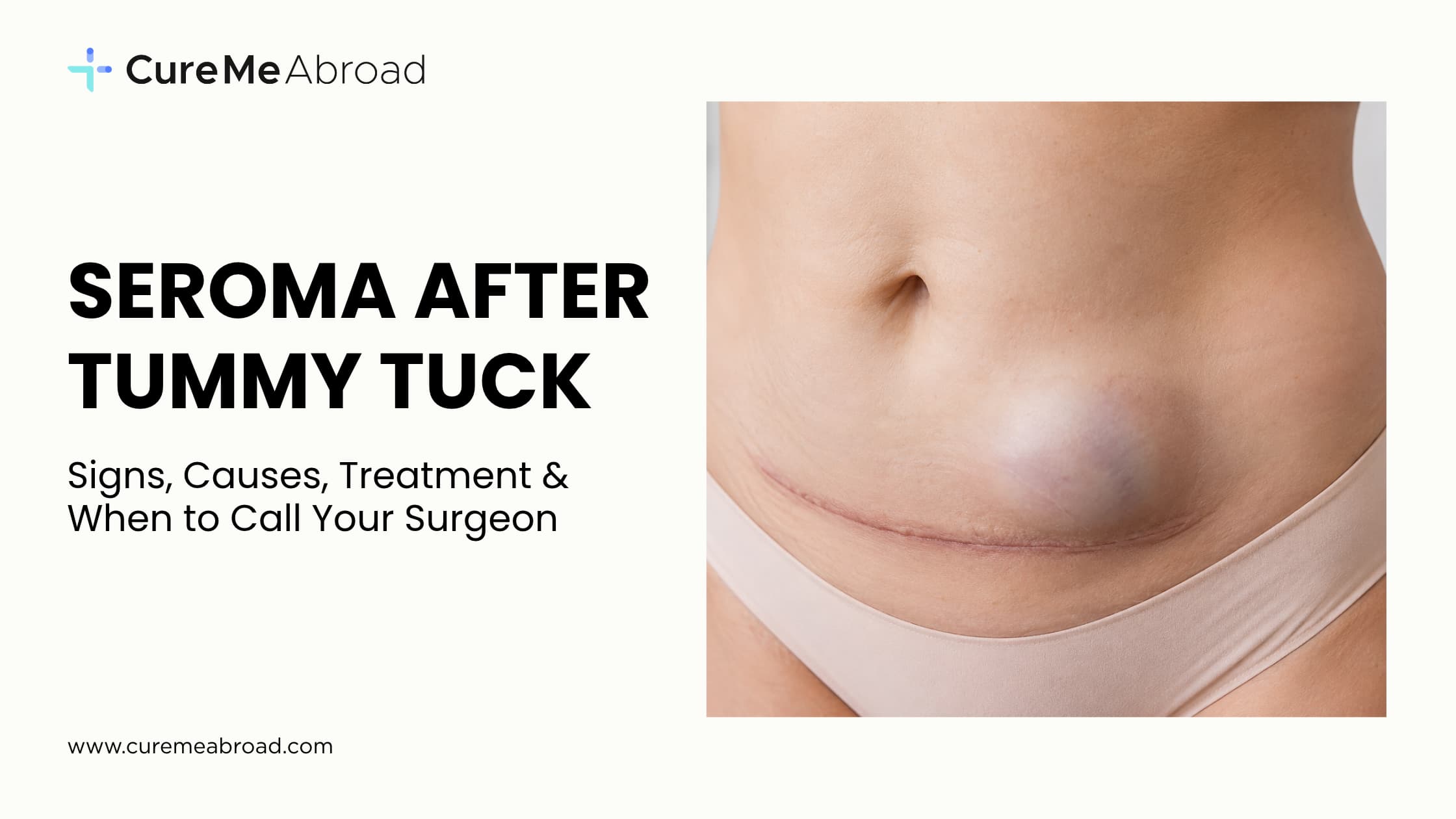
If you have had a tummy tuck and the drains have come out, you may become concerned if you notice a soft bulge in the lower part of your abdomen. Sometimes, pressing on it feels as though there is something moving or sloshing around. This is a very common question asked by patients following tummy tuck surgery, is it a seroma?
Seroma means a pocket of fluid that collects under the skin. It is a common problem, usually manageable and rarely dangerous when picked up early.
In this guide you’ll learn and understand why it happens, what the symptoms look like, how it’s treated and which signs mean you should call your surgeon or get urgent help.
Quick Answer: What Is a Seroma After a Tummy Tuck?
A seroma is a build-up of clear or pale-yellow fluid in the space under your skin where tissue was lifted during surgery. It usually shows up as a soft, swollen area in the lower belly, often in the first few weeks after surgery.
Seroma After Tummy Tuck at a Glance
| Question | Quick answer |
|---|---|
| What is it? | A pocket of fluid under the skin |
| When does it appear? | Usually within the first 1 to 6 weeks |
| What does it feel like? | A soft, squishy or sloshing bulge |
| Is it common? | Yes, it’s one of the most common tummy tuck complications |
| How is it treated? | Watching it, draining it with a needle or, rarely, surgery |
| Is it dangerous? | Usually not, but it can become infected if ignored |
Most seromas are small and can be managed in your surgeon’s office. The important thing is to tell your surgical team as soon as you notice one, rather than waiting and hoping it goes away.
Why Seromas Happen After a Tummy Tuck
During a tummy tuck, your surgeon lifts the skin and fat away from the muscles underneath to remove extra skin and tighten your stomach. This creates a raw space inside, and your body naturally fills that space with fluid while it heals.
Dead Space & Fluid Collection
The gap between the lifted skin and the muscle wall is often called “dead space.” When this gap stays open, fluid from small blood and lymph vessels can collect there.
Here’s what happens inside your body:
- Tissue is separated: The skin and fat are lifted off the muscle wall during surgery.
- Small vessels are cut: Tiny lymph vessels that normally carry fluid away are disrupted.
- Fluid fills the space: Your body releases fluid as part of healing, and it can pool in the gap.
- Movement makes it worse: Rubbing between the layers can irritate the tissue and cause more fluid.
Over time, the skin should stick back down to the muscle and the space closes. A seroma after abdominoplasty forms when the fluid builds up faster than your body can absorb it.
Liposuction, Extended Procedures & Other Risk Factors
Some people are more likely to get a seroma than others. Your surgery type, body weight and health history can all play a role.
| Risk factor | Why it may raise seroma risk |
|---|---|
| Liposuction added to the tummy tuck | More tissue is disturbed, which can increase fluid |
| Extended or combined procedures | A larger area of lifted skin means more dead space |
| Higher body weight (BMI) | More tissue and a larger surgical area |
| Major weight loss or bariatric surgery | Loose tissue may heal more slowly |
| Too much activity too soon | Movement can stop tissue from sticking back down |
| Not wearing compression as advised | Less pressure to keep the layers together |
Having one or more of these risk factors doesn’t mean you’ll definitely get a seroma. It simply means you and your surgeon may plan extra steps to lower the risk.
Seroma Symptoms: How to Recognize One
Tummy tuck seroma symptoms can look a lot like normal swelling at first. The key difference is that a seroma often feels like a defined pocket of fluid rather than general puffiness.
The Fluid Wave: A Soft, Sloshing Bulge
One of the most typical signs is a soft bulge, usually in the lower belly near the incision. When you gently press one side, you may feel the fluid move to the other side, like a water balloon. This is sometimes called a “fluid wave.”
| What you may notice | What it may mean |
|---|---|
| A soft, squishy bulge | Fluid collecting under the skin |
| Sloshing or movement when pressed | A pocket of free fluid, typical of a seroma |
| A bulge that grows over a few days | Fluid is building up faster than it’s absorbed |
| Firm, hard swelling | May be normal swelling, a hematoma or scar tissue |
Because the skin on your lower belly can feel numb after a tummy tuck, you may notice the bulge before you feel any pain. If you spot this kind of swelling, take a photo and contact your surgeon so they can check it.
Pressure, Tightness & Leaking Incision Fluid
A seroma can also cause a feeling of pressure or fullness in your lower stomach. Some people describe it as feeling “full of water” or tight, especially when standing up.
Other signs to watch for include:
- Tightness or heaviness in the lower belly.
- Mild discomfort that gets worse as the day goes on.
- Clear or yellowish fluid leaking from the incision or old drain site.
- A bulge that shows through your compression garment.
Clear, thin fluid is typical of a seroma. Fluid that’s cloudy, thick or smelly may be a sign of infection and should be checked right away.
Typical Timing: Weeks 1–6, Often After Drain Removal
Seromas usually show up within the first few weeks after surgery. Many people first notice one a few days after their drains are removed, when fluid has nowhere else to go.
| Time after surgery | What may happen |
|---|---|
| First 7 to 10 days | Symptoms often start to appear |
| After drain removal | Fluid may start to collect under the skin |
| Weeks 2 to 6 | Most seromas are found and treated in this window |
| After 6 weeks | Less common, but a long-lasting seroma can still develop |
Keep all your follow-up visits, even if you feel fine, because your surgeon can often spot a seroma early. If swelling suddenly increases after your drains come out, let your surgical team know the same day.
Seroma vs Hematoma vs Infection vs Normal Swelling
It can be hard to tell what’s normal during recovery. Here’s a simple way to compare seroma vs. hematoma, infection and normal swelling.
Seroma vs. Hematoma vs. Infection vs. Normal Swelling
| Feature | Seroma | Hematoma | Infection | Normal swelling |
|---|---|---|---|---|
| What it is | A pocket of clear fluid | A pocket of blood | Bacteria in the wound or fluid | Expected healing response |
| Usual timing | Weeks 1 to 6, often after drains come out | Often in the first 24 to 72 hours | Usually after the first few days | Throughout early recovery |
| How it feels | Soft, squishy, sloshing | Firm, tight and painful | Warm, tender and sore | Puffy and mildly tender |
| Skin color | Usually normal | Purple or dark bruising | Red and spreading | Normal or mild bruising |
| Other signs | Clear or yellow leaking fluid | Swelling that grows quickly | Fever, chills, pus or bad smell | Gets better slowly over weeks |
| What to do | Call your surgeon | Call your surgeon right away | Call your surgeon right away | Keep following aftercare |
A seroma usually feels soft and fluid-filled, while a hematoma is often firm, painful and comes with dark bruising. If you’re ever unsure which one you have, it’s always safer to call your surgeon and let them check.
Warning Signs: When to Call Your Surgeon or Seek Urgent Care
Most seromas aren’t an emergency, but some symptoms need fast attention. Knowing these signs can help you act quickly and protect your recovery.
Fever, Redness, Heat or Pus: Possible Infected Seroma
A seroma can sometimes become infected, especially if it isn’t treated or if it’s drained in an unclean way. An infected seroma may turn into an abscess, which is a pocket of pus.
Call your surgeon right away if you notice:
- Fever of 101°F (38.3°C) or higher, or chills.
- Redness that spreads around the bulge or incision.
- Warmth or heat over the swollen area.
- Thick, cloudy or smelly fluid leaking from the incision.
- Pain that gets worse instead of better.
An infected seroma usually needs drainage and antibiotics. Getting treated early can help prevent the wound from opening and protect your tummy tuck results.
Rapid, Painful Swelling or Dark Bruising: Possible Hematoma
A hematoma is a collection of blood under the skin. It usually happens in the first few days after surgery and can grow quickly.
| Sign | What to do |
|---|---|
| Swelling that grows quickly over hours | Call your surgeon right away |
| One side of your belly is much bigger than the other | Call your surgeon right away |
| Dark purple bruising that keeps spreading | Contact your surgical team the same day |
| Severe, tight pain | Seek urgent care if you can’t reach your surgeon |
A large hematoma may need to be drained in surgery, so don’t wait for your next appointment. Quick treatment can protect the skin and lower the risk of further problems.
Chest Pain, Shortness of Breath or Calf Pain: Call 911
These symptoms aren’t caused by a seroma, but they can be signs of a blood clot, which is a serious risk after any major surgery. A clot in the leg (deep vein thrombosis) can travel to the lungs (pulmonary embolism).
Call 911 or go to the nearest emergency room if you have:
- Sudden chest pain or pain that gets worse when you breathe in.
- Shortness of breath or fast breathing.
- Coughing up blood.
- Pain, swelling, warmth or redness in one calf or leg.
Don’t wait to call your surgeon first in these situations. A blood clot is a medical emergency, and getting help fast can save your life.
How Seromas Are Diagnosed
Your surgeon can often tell if you have a seroma just by examining your belly. In some cases, they may use an ultrasound to confirm it and see how large it is.
How Your Surgeon Checks for a Seroma
| Step | What happens |
|---|---|
| Talking about your symptoms | Your surgeon asks when the swelling started and how it has changed |
| Physical exam | They press gently on the area to feel for a fluid wave |
| Ultrasound | A quick, painless scan shows the size and location of the fluid |
| Checking the fluid | If fluid is drained, its color and smell can show signs of infection |
An ultrasound is especially helpful when the swelling is deep or hard to feel. It also helps your surgeon guide the needle safely if the seroma needs to be drained.
Seroma Treatment After a Tummy Tuck
Seroma treatment after a tummy tuck depends on how large the seroma is, how long it has been there and whether it keeps coming back. Most people only need simple, in-office treatment.
Watchful Waiting for Small Seromas
Small seromas that aren’t painful may go away on their own as your body slowly absorbs the fluid. In these cases, your surgeon may simply keep an eye on it.
What watchful waiting usually involves:
- Regular check-ups to see whether the seroma is shrinking.
- Wearing your compression garment as directed.
- Limiting strenuous activity that may cause more fluid.
- Watching for warning signs like redness, fever or rapid growth.
Small seromas may shrink within a week or two, while larger ones can take up to six weeks. If the seroma grows or becomes uncomfortable, your surgeon may recommend draining it.
Needle Aspiration: What Happens in the Office
Seroma aspiration after tummy tuck surgery is the most common treatment. Your surgeon uses a needle and syringe to draw the fluid out, usually in the office.
| Step | What to expect |
|---|---|
| Cleaning the skin | The area is cleaned to lower infection risk |
| Inserting the needle | A thin needle goes into the fluid pocket, sometimes guided by ultrasound |
| Drawing out fluid | Fluid is pulled into a syringe until the pocket is empty or nearly empty |
| After the procedure | A bandage is applied and compression is put back on |
| How it feels | Often little pain, since the lower belly skin is usually numb |
Many people need more than one aspiration, sometimes spaced about a week apart, because the fluid can come back. Each time, your surgeon checks the amount and color of the fluid to make sure healing is on track.
Drains, Sclerosants & Surgery for Persistent Seromas
If a seroma keeps coming back after several aspirations, your surgeon may suggest other options.
- Placing a new drain: A small tube may be placed for a few days to let fluid drain out continuously.
- Sclerosants: A medicine is placed inside the fluid pocket to irritate the walls, so they stick together and stop making fluid.
- Surgery: In rare cases, the surgeon removes the lining of the seroma pocket and closes the space with stitches.
Surgery is usually a last resort, saved for seromas that have formed a thick wall or haven’t responded to other treatments. Your surgeon will explain which option makes the most sense for you.
What Not to Do: Never Drain a Seroma at Home
It can be tempting to try to relieve the pressure yourself, especially when the bulge feels uncomfortable. Please don’t.
| Don’t do this | Why it’s risky |
|---|---|
| Poke the bulge with a needle | Can cause serious infection |
| Squeeze or press hard on it | May irritate the tissue and cause more fluid |
| Reopen the incision | Can lead to wound problems and scarring |
| Ignore it and hope it goes away | A seroma can grow, harden or become infected |
Draining a seroma safely requires clean equipment and medical training. Always let your surgeon or their nurse handle it, so you lower the risk of infection and protect your results.
Can a Seroma Come Back? Persistent Seromas & the Capsule
Yes, a seroma can come back, especially in the first few weeks. If a seroma lasts a long time, your body may build a thin wall or capsule around it, sometimes called a pseudobursa. This capsule can keep producing fluid, so the seroma keeps refilling.
Signs of a Persistent Seroma
| Sign | What it may mean |
|---|---|
| Fluid comes back after several drainings | The pocket hasn’t sealed yet |
| A firm edge around the bulge | A capsule may be forming |
| Swelling lasts beyond several weeks | The seroma may be becoming long-term |
| A lump or uneven contour | Fluid or a capsule may be changing the shape of your belly |
A seroma with a capsule usually won’t go away on its own and may need surgery to remove the capsule. Treating a seroma early is the best way to stop this from happening in the first place.
How to Lower Your Seroma Risk
You can’t always prevent a seroma after tummy tuck surgery, but you and your surgeon can lower the risk. It starts with surgical technique and continues with how you recover at home.
Drains, Progressive-Tension Sutures & Surgical Technique
Surgeons use different methods to help close the dead space and limit fluid build-up.
| Technique | How it helps |
|---|---|
| Surgical drains | Thin tubes remove fluid during the first days or weeks |
| Progressive-tension sutures | Stitches attach the lifted skin to the muscle to close the dead space |
| Careful tissue handling | Protecting lymph vessels may reduce fluid |
| Preserving some tissue over the muscle | Some techniques leave a thin layer of tissue to lower fluid build-up |
Research has found that adding progressive-tension sutures to drains can lower seroma rates compared with drains alone. Ask your surgeon which technique they use and why it suits your body.
Compression Garments & Activity Limits
Your aftercare at home matters just as much. A compression garment helps keep the skin pressed against the muscle so the layers can heal together.
To lower your risk:
- Wear your compression garment as long and as often as your surgeon recommends.
- Avoid heavy lifting and strenuous exercise until you’re cleared, often for around 4 to 6 weeks.
- Walk gently each day to support circulation without straining your belly.
- Look after your drains and record the fluid amounts if asked.
- Keep a stable weight and follow your surgeon’s diet advice.
Doing too much too soon can make the layers rub and produce more fluid. It’s better to ease back into your routine slowly than to set back your recovery.
Do Lymphatic Massage or Other Therapies Help a Seroma?
Lymphatic drainage massage may help reduce general swelling, but there is limited evidence that it treats an established seroma.
Therapies People Ask About for Seromas
| Therapy | What we know |
|---|---|
| Lymphatic drainage massage | May help with general swelling; limited proof it treats a seroma |
| Compression garments | Helps lower the risk of fluid build-up |
| Ultrasound or other spa treatments | Not a substitute for medical treatment |
| Heat packs | Not recommended without your surgeon’s approval |
| Needle aspiration by your surgeon | The standard treatment for seromas that need draining |
If you want to try a lymphatic drainage massage, ask your surgeon first. Only have a massage from someone trained in post-surgery care. A massage will not clear up a defined pocket of fluid. Therefore, do not use it in place of seeing your surgeon.
Seroma Risk After a Tummy Tuck Abroad: Planning Safe Aftercare
Many people from the US travel abroad for a tummy tuck to save on costs. That can be a good option, but because seromas often appear after drains come out, you need a clear aftercare plan for the weeks after you return home.
Aftercare Checklist for a Tummy Tuck Abroad
| What to plan | Why it matters |
|---|---|
| Stay long enough before flying home | Allows early checks, drain care and fluid monitoring |
| Ask about drain removal timing | Seromas often appear after drains come out |
| Find a local surgeon or clinic at home | Someone nearby can drain a seroma if needed |
| Keep your surgical records | Helps local doctors understand what was done |
| Plan virtual follow-ups | Lets your surgeon review photos and symptoms |
| Ask about blood clot prevention for your flight | Long flights raise clot risk after surgery |
Before you book, ask your hospital how they handle seromas once you’re back in the US. A well-organized plan means you won’t be left without help if fluid builds up a few weeks after surgery.
Final Thought
Although concerning, a seroma after tummy tuck can usually be managed when it is identified early. We have outlined the typical symptoms of this condition, why fluid collects, how your surgeon will diagnose and treat it, as well as measures that may reduce the risk. Do not attempt to drain the fluid yourself. If the swelling keeps getting bigger do not ignore it, but contact your surgical team. In particular, seek medical attention if you are experiencing pain, fever or spreading redness.
Looking to take the next step with your tummy tuck? Please visit the CureMeAbroad website to find a suitable hospital for tummy tuck surgery and arrange a consultation with an experienced plastic surgeon today.
FAQs
1. How common is a seroma after a tummy tuck?
A seroma is one of the most common complications after a tummy tuck. How often it happens varies widely between studies, depending on the surgical technique, whether liposuction was added, and the patient’s body weight.
2. How long does a seroma last after a tummy tuck?
Small seromas may go away within one to two weeks, while larger ones can take up to six weeks or longer. Some need several drainings, and a seroma that forms a capsule may last until it is treated surgically.
3. Can a seroma go away on its own?
Yes, small seromas often go away on their own as your body absorbs the fluid. Larger or growing seromas usually need to be drained by your surgeon.
4. Does a drainless tummy tuck increase seroma risk?
Not necessarily. Many drainless tummy tucks use progressive-tension sutures to close the dead space, and research suggests this can be about as effective as drains at reducing seroma risk. The result also depends on your surgeon’s skill and technique.
5. Is a seroma dangerous if left untreated?
Usually not right away. However, a seroma that is left alone can become infected, form a capsule or put pressure on your incision, so it is best to have it checked early.
6. How many times can a seroma be drained?
There is no fixed number. Some people need only one drainage, while others need several over a few weeks. If the seroma keeps coming back, your surgeon may suggest a drain, a sclerosant or surgery.
Reference
American Society of Plastic Surgeons. Tummy tuck safety.
https://www.plasticsurgery.org/cosmetic-procedures/tummy-tuck/safetyCleveland Clinic. Seroma.
https://my.clevelandclinic.org/health/diseases/seromaJabbour, S., Awaida, C., Mhawej, R., Habre, S. B., & Nasr, M. (2017). Does the addition of progressive tension sutures to drains reduce seroma incidence after abdominoplasty? https://academic.oup.com/asj/article/37/4/440/2354563
Mayo Clinic. Tummy tuck.
https://www.mayoclinic.org/tests-procedures/tummy-tuck/about/pac-20384892