



After a tummy tuck, it’s completely normal to feel swollen, tight and a little puffy for weeks. Many people start searching for ways to feel more comfortable, and one treatment comes up again and again: lymphatic massage. Friends recommend it, med spas advertise it and social media is full of before-and-after videos.
But is lymphatic massage after tummy tuck surgery actually safe, and does it really help? In this guide, we’ll explain what it is, when you can start, how many sessions people usually have, what a session feels like and the warning signs that mean you should wait. We’ll also look at costs and how it compares with other ways to manage swelling.
Quick Answer: Is Lymphatic Massage Safe and Helpful After a Tummy Tuck?
For many people, yes, as long as your surgeon clears you and the massage is done gently by a trained therapist. Lymphatic massage after a tummy tuck may help ease swelling and tightness, but it’s an add-on to your recovery, not a replacement for compression garments or your surgeon’s aftercare plan.
Lymphatic Massage After Tummy Tuck at a Glance
| Question | Quick answer |
|---|---|
| Is it safe? | Usually, with your surgeon’s approval and a trained therapist |
| Does it help? | It may reduce swelling and tightness, though research is still limited |
| When can you start? | Anywhere from a few days to a few weeks after surgery, based on your surgeon’s advice |
| How many sessions? | Often several sessions over a few weeks |
| What pressure is used? | Very light, gentle strokes |
| Is it required? | No, it’s optional for most people |
| When should you skip it? | If you have a blood clot, infection, fever or an untreated fluid collection |
Think of lymphatic massage as a comfort tool that may help your recovery feel a little smoother. The most important steps are still wearing your compression garment, keeping up with follow-up visits and listening to your surgeon.
What Is Lymphatic Drainage Massage, and Why Is It Used After a Tummy Tuck?
The lymphatic system consists of small vessels which carry excess fluid away from tissues in the body and back into the bloodstream. During a tummy tuck, some of these vessels are disrupted meaning that excess fluid builds up causing swelling in the belly, hips and pubic area.
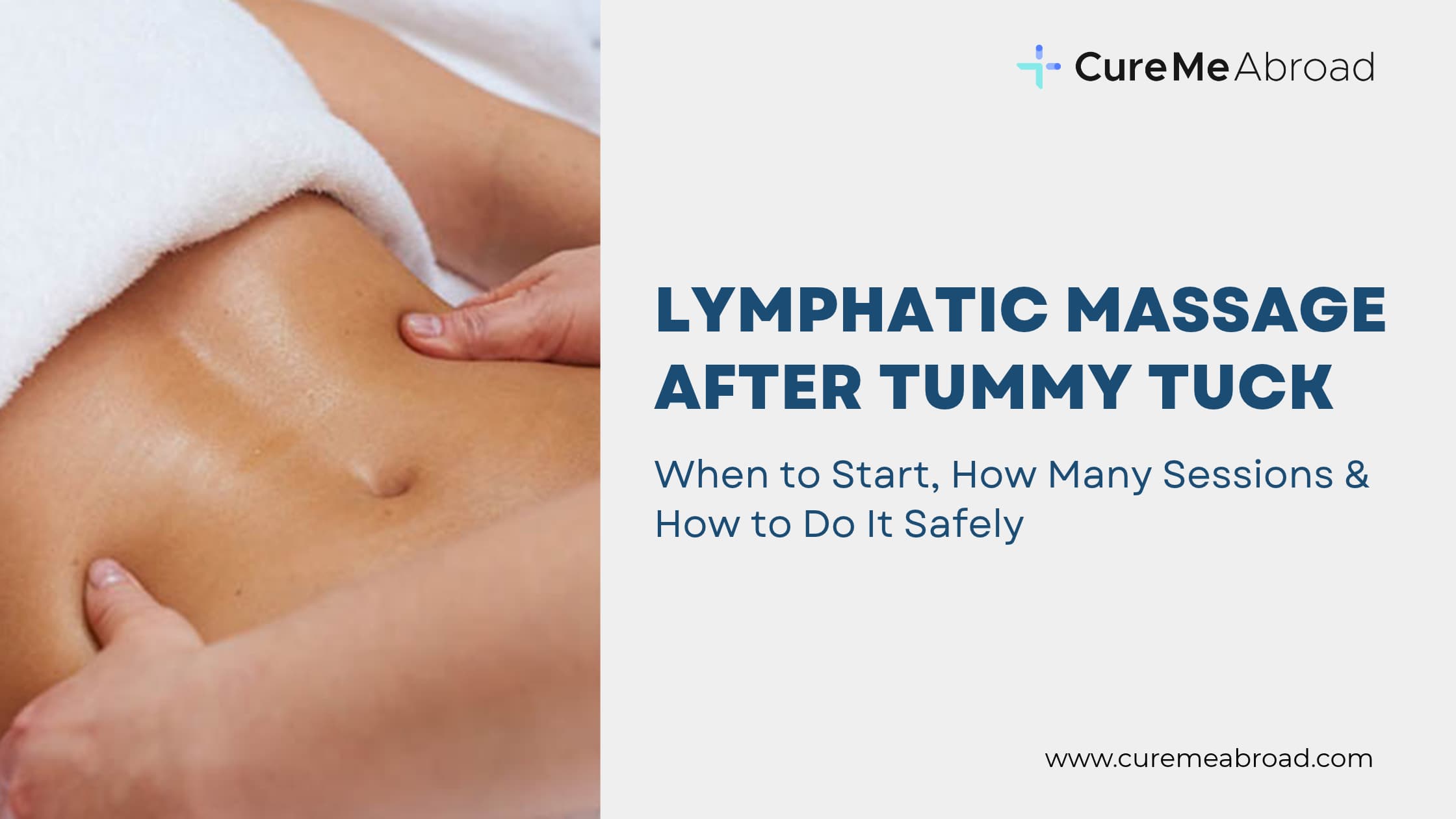
After tummy tuck surgery, lymphatic drainage massage can help move the excess fluid by using slow, light, rhythmic strokes. This helps direct fluid to healthy lymph nodes, usually found in the groin and armpits. Unlike regular massage, this form of massage focuses on the surface of the skin rather than deep muscles.
How Lymphatic Massage Differs From a Regular Massage
| Feature | Lymphatic drainage massage | Regular or deep-tissue massage |
|---|---|---|
| Pressure | Very light, like stretching the skin | Firm to deep |
| Goal | Move extra fluid out of swollen tissue | Relax or loosen muscles |
| Strokes | Slow, rhythmic and in a set direction | Kneading, pressing and rubbing |
| Safe soon after surgery? | Often, with surgeon approval | No, it can damage healing tissue |
| Who should do it | A trained lymphatic therapist | A general massage therapist |
And this is a very gentle technique, it is suitable for healing tissue. However, a firm or deep massage could do more harm than good on a fresh tummy tuck. Therefore, it is very important to have the correct type of massage.
Benefits of Lymphatic Massage After a Tummy Tuck
People often say they feel lighter and less tight after a session. While the research is still growing, there are a few reasons surgeons and therapists recommend it.
Swelling, Bruising & Tightness
Lymphatic massage may help move some of the swelling fluid out of the tummy. This can make it easier to see the results of your tummy tuck, because swelling can hide them, and it can make your stomach feel less hard and tight.
People commonly report:
- Less swelling: The belly may look and feel less puffy after a series of sessions.
- Faster fading of bruises: Moving fluid may help bruising clear more quickly.
- Less tightness: The skin and tissue can feel softer and less stretched.
- Better comfort: Many people simply feel more relaxed and comfortable.
Results vary from person to person. Swelling may come and go in your tummy for several months after surgery. However, this is normal and does not mean that the treatment has not been effective.
Comfort & Fibrosis Prevention: What the Evidence Says
Fibrosis is a build-up of firm scar tissue under the skin that can feel lumpy or hard. Many therapists say lymphatic massage helps prevent it, but the research is still fairly small.
| What’s claimed | What the evidence shows |
|---|---|
| Reduces swelling | Small studies suggest it may help |
| Eases pain and tightness | Some patients report improvement |
| Prevents or softens fibrosis | Early studies show promise, but more research is needed |
| Speeds up recovery | Not clearly proven |
| Improves final results | No strong proof yet |
For example, a small 2014 study of women recovering from liposuction and lipoabdominoplasty (a tummy tuck combined with liposuction) found that a course of manual lymphatic drainage combined with ultrasound reduced pain, swelling and fibrosis. Because studies like this are small, it’s best to see lymphatic massage as a helpful extra rather than a guaranteed fix.
When Can You Start Lymphatic Massage After a Tummy Tuck?
It depends on your surgeon and how you are healing, so it is best to check with your surgeon first. This will help you avoid beginning too early, or missing a helpful window.
Surgeon Clearance Comes First
Before you book any session, speak to your surgeon to find out what was done during your surgery, how well your incision has healed and if there are any drains or fluid collections.
Ask your surgeon:
- When can I start? Some surgeons prefer you wait until drains are out.
- Who should I see? Many surgeons have therapists they trust.
- Which areas are safe? Your therapist may need to avoid the incision or certain spots.
- Should I keep wearing my garment? In most cases, yes.
Once you have clearance, it is a good idea to share your surgeon’s instructions with your therapist. This helps everyone work together and keeps your recovery on track.
Typical Starting Windows: Why Advice Ranges From Days to Weeks
You may see very different advice online, from starting a couple of days after surgery to waiting several weeks. That’s because surgeons have different preferences, and every recovery is different.
| Starting window | Why some surgeons choose it |
|---|---|
| A few days after surgery | Some surgeons like to start early to manage swelling sooner |
| After drains are removed | Avoids disturbing drains and the healing area |
| 1 to 2 weeks after surgery | Gives the incision time to start healing |
| 3 weeks or later | A more cautious approach, or for slower healing |
There’s no single right answer, so follow the timeline your surgeon gives you. Starting slightly later is usually safer than starting before your body is ready.
Signs You’re Not Ready Yet
Even with a general timeline, your body may need more time. Watch for these signs before you book a session.
- Your incision is open or still leaking.
- You have a fever or feel unwell.
- There’s spreading redness, heat or pus near the incision.
- You have new, painful swelling on one side of your belly.
- One calf is swollen, painful or warm.
- Your surgeon hasn’t cleared you yet.
If you notice any of these, hold off and call your surgeon. A short delay is much better than risking a complication.
How Many Lymphatic Massage Sessions Do You Need?
There’s no fixed number for everyone. How many lymphatic massages after tummy tuck surgery you’ll need depends on how much swelling you have, the type of surgery and how quickly your body heals.
Typical Course: Frequency & Session Length
Many people start with more frequent sessions, then space them out as swelling improves.
| Recovery stage | Typical frequency | Session length |
|---|---|---|
| Early recovery (after clearance) | 2 to 3 times a week | About 45 to 60 minutes |
| A few weeks in | 1 to 2 times a week | About 45 to 60 minutes |
| Later recovery | Once a week or as needed | About 45 to 60 minutes |
Many people have somewhere between 6 and 12 sessions in total, though some need more and others need fewer. Your therapist can suggest a plan based on how your swelling responds, and your surgeon can confirm it’s right for you.
When You Can Taper or Stop
You don’t need to keep going forever. Most people start cutting back as swelling settles.
Signs you may be ready to taper:
- Swelling has gone down and stays down between sessions.
- Your belly feels softer and less tight.
- Bruising has cleared.
- You feel comfortable in your normal daily routine.
Some swelling can last for several months after a tummy tuck, so don’t expect it to disappear completely before you stop. Talk with your therapist about tapering slowly rather than stopping all at once.
What Happens During a Session
If you’ve never had a lymphatic massage before, it can help to know what to expect. Most sessions feel calm and relaxing.
Gentle Strokes, Not Deep Pressure
Your therapist will usually start near the lymph nodes, such as in your groin or armpits, to “open up” the drainage paths. Then they’ll use slow, light strokes to move fluid from your belly toward those areas.
| What to expect | What it feels like |
|---|---|
| Light, rhythmic strokes | A gentle stretching of the skin |
| Work on lymph nodes first | Light touches in the groin, armpits or sides |
| Strokes in a set direction | Slow, repeated movements toward the lymph nodes |
| Avoiding the incision | The therapist works around healing areas |
| Pain level | Usually mild or no pain |
A lymphatic massage shouldn’t hurt. If it feels painful or the therapist is pressing hard, speak up, because gentle pressure is what works best for lymphatic drainage.
Wearing Your Garment Around Sessions
Your compression garment and lymphatic massage work together. The massage moves fluid, and the garment helps stop it from building back up.
Here’s how to handle your garment:
- Bring it to your session so you can put it back on right away.
- Take it off only during the massage, unless your surgeon says otherwise.
- Put it back on straight after, as advised by your surgeon.
- Keep wearing it for as long as your surgeon recommends.
Skipping your garment after a session can undo some of the benefits. Treat the two as a team, not as a choice between one or the other.
Professional vs At-Home Lymphatic Massage
You may wonder whether you need a professional or can do it yourself. Both can play a role, but at different stages of your recovery.
Hiring a Qualified, Certified Therapist
Not every massage therapist is trained in lymphatic drainage after surgery. Look for someone with specific training and experience with post-surgery patients.
| What to look for | Why it matters |
|---|---|
| Certification in manual lymphatic drainage | Shows specific training in the technique |
| Experience with post-surgery patients | Knows how to work safely around incisions |
| Willingness to follow your surgeon’s plan | Keeps your care consistent |
| A licensed massage or physical therapist | Adds professional standards and accountability |
| Clear communication | Explains what they’re doing and why |
Ask your surgeon for a recommendation, as many work with therapists they trust. A good therapist will ask about your surgery, your clearance and any symptoms before they start.
Learning Safe Self-Massage
Some people learn a simple self-massage routine to use between professional sessions. This should be taught by your therapist and approved by your surgeon first.
If you’re cleared to try it:
- Use very light pressure, just enough to gently move the skin.
- Start near the lymph nodes your therapist showed you.
- Move slowly in the direction you were taught.
- Avoid the incision and any tender or swollen lumps.
- Stop if it hurts or you notice new swelling.
Self-massage can be a helpful way to stay comfortable between appointments. It works best as an extra step, not a replacement for professional sessions in early recovery.
Lymphatic Massage Safety: Who Should Wait or Skip It
Post-op lymphatic massage is gentle, but it isn’t right for everyone, especially in certain situations. Knowing the warning signs can help you stay safe.
Suspected Blood Clot, Infection or Fever
Massage should be avoided if you might have a blood clot or an infection. Moving fluid around in these situations can be dangerous.
| Warning sign | What to do |
|---|---|
| Calf pain, swelling, warmth or redness in one leg | Don’t have a massage; call your surgeon right away |
| Chest pain or shortness of breath | Call 911 or go to the emergency room |
| Fever of 101°F (38.3°C) or higher | Skip the session and call your surgeon |
| Spreading redness, heat or pus at the incision | Skip the session and call your surgeon |
Lymphatic massage should also be avoided if you have certain health problems, such as heart disease or kidney failure, unless your doctor approves it. When in doubt, check with your surgeon before every session.
Fluid Collection (Seroma) or Hematoma: Ask Your Surgeon First
A seroma is a pocket of clear fluid under the skin, and a hematoma is a pocket of blood. Both can happen after a tummy tuck and both need your surgeon’s attention.
- A seroma may feel like a soft, sloshing bulge, often after drains are removed.
- A hematoma may feel firm, painful and come with dark bruising.
- Massage won’t drain these pockets, and pressing on them may irritate the area.
If you notice a new bulge or one-sided swelling, cancel your session and let your surgeon check it first. They may need to drain it before massage can safely continue.
The Risks of Aggressive “Fibrosis” or Deep-Tissue Massage
Some therapists offer deep, forceful massage to “break up” fibrosis, sometimes using tools or heavy pressure. This can be risky on healing tissue.
| Aggressive technique | Possible risk |
|---|---|
| Deep-tissue pressure | Can damage healing tissue and increase swelling |
| Hard tools or scraping | May cause bruising or skin injury |
| Painful “breaking up” of lumps | Can cause more inflammation and scar tissue |
| Heavy pressure near the incision | May affect wound healing |
Lymphatic massage should always feel gentle, even when it targets firm areas. If a treatment is painful or leaves you more bruised than before, stop and talk with your surgeon.
What Does Lymphatic Massage After a Tummy Tuck Cost?
As lymphatic massages are generally not covered by most health insurance providers following cosmetic surgery, they are usually paid for out of pocket. Costs will depend on where you live, the experience of the therapist and the length of each session.
Estimated Cost of Lymphatic Massage After Tummy Tuck in the US
| Option | Approximate cost |
|---|---|
| Single session | Often around $75 to $150 or more |
| Package of 5 to 10 sessions | May offer a discount per session |
| Full course of 6 to 12 sessions | Often several hundred to over $1,000 in total |
| Self-massage at home | Free once you’ve learned the technique |
| Bundled with your surgery | Some clinics include sessions in the surgery price |
These are approximate ranges. In larger cities costs may be higher. Check with your surgeon to see if any massage sessions are included in your package. You can also check if your HSA or FSA may cover treatment that is medically recommended.
Lymphatic Massage vs Other Swelling Treatments: Compression, Devices & Ultrasound
Lymphatic massage is only one way to manage swelling after a tummy tuck. Here’s how it compares with other common options.
Comparing Swelling Treatments After a Tummy Tuck
| Treatment | How it helps | Things to know |
|---|---|---|
| Compression garment | Applies steady pressure to limit fluid build-up | The most important step for most people |
| Lymphatic massage | Gently moves extra fluid toward lymph nodes | Helpful add-on with surgeon approval |
| Walking and light activity | Supports circulation | Easy and free, but avoid strain |
| Compression devices | Inflatable sleeves or wraps that squeeze in cycles | Mostly used for leg swelling or clot prevention |
| Therapeutic ultrasound | Uses sound waves on tissue | Sometimes used with massage; evidence is limited |
| Staying hydrated and limiting salt | Helps reduce fluid retention | Supports overall healing |
For most people, compression and gentle activity remain the foundation of swelling control. Lymphatic massage can sit on top of that foundation, but it shouldn’t replace it.
Final Thought
Before booking a session, Speak to your surgeon to determine a suitable timing for a lymphatic massage and ensure that the right type of massage is used. A lymphatic massage after a tummy tuck may help to reduce swelling and discomfort. You may need several sessions, and care should be taken to keep the pressure on the skin very light. However, this treatment should not be used as a substitute for wearing compression garments and seeing a medical professional. Choose a therapist trained in post-surgery care and seek medical advice if you notice unusual swelling, pain or signs of infection.
Ready to plan your recovery with the right support? Visit the CureMeAbroad website to explore accredited hospitals, connect with experienced plastic surgeons and book your consultation today.
FAQs
1. Is lymphatic massage necessary after a tummy tuck?
Not necessarily. Many people will make a good recovery with compression garments and light activity alone. However some people may find that lymphatic massage after a tummy tuck helps with comfort and swelling.
2. How soon after a tummy tuck can I get a lymphatic massage?
This is dependent on what your surgeon says. Some people will be able to start a few days after their surgery, however others may ask that you wait until your drains are removed, or even a few weeks. Always get clearance from your surgeon before having a lymphatic massage.
3. Does lymphatic massage hurt after a tummy tuck?
Lymphatic massage should not be painful. It uses very light pressure so it usually feels gentle. If it is painful please let your therapist know immediately.
4. Can lymphatic massage cause a complication?
As long as the lymphatic massage is gentle and performed by a trained professional, with permission from your surgeon, it is usually safe. There is more risk of complications from deep or aggressive massage or if you have an untreated blood clot, infection or fluid collection.
5. Can I do lymphatic massage on myself?
Yes, once your surgeon approves it and a therapist has shown you the right technique. Keep the pressure very light and avoid massaging over the incision site.
6. How long do I need a lymphatic massage after a tummy tuck?
Many people have massage sessions for a few weeks to a couple of months. However usually as the swelling reduces and the tummy becomes softer, you can taper off the sessions.
Reference
Cleveland Clinic. Lymphatic drainage massage.
https://my.clevelandclinic.org/health/treatments/21768-lymphatic-drainage-massageCleveland Clinic. How to do lymphatic drainage massage at home.
https://health.clevelandclinic.org/lymphatic-drainage-self-massageMasson, I. F. B., de Oliveira, B. D. A., Machado, A. F. P., Farcic, T. S., Júnior, I. E., & Baldan, C. S. (2014). Manual lymphatic drainage and therapeutic ultrasound in liposuction and lipoabdominoplasty post-operative period. Indian Journal of Plastic Surgery, 47(1), 70–76.
https://pubmed.ncbi.nlm.nih.gov/24987208/Mayo Clinic. Tummy tuck.
https://www.mayoclinic.org/tests-procedures/tummy-tuck/about/pac-20384892MedlinePlus. (Current). Deep vein thrombosis.
https://www.medlineplus.gov/deepveinthrombosis.htmlMedlinePlus. (Current). Pulmonary embolism.
https://www.medlineplus.gov/pulmonaryembolism.htmlPubMed. (2026). Efficacy of manual lymphatic drainage in reducing postoperative complications after cosmetic plastic surgery: A systematic review.
https://pubmed.ncbi.nlm.nih.gov/42840808/Cleveland Clinic. (2024, September 19). Lymphatic drainage massage: What it is & benefits.
https://my.clevelandclinic.org/health/treatments/21768-lymphatic-drainage-massageCleveland Clinic. (2025, March 13). How to perform a lymphatic drainage self-massage.
https://health.clevelandclinic.org/lymphatic-drainage-self-massage