


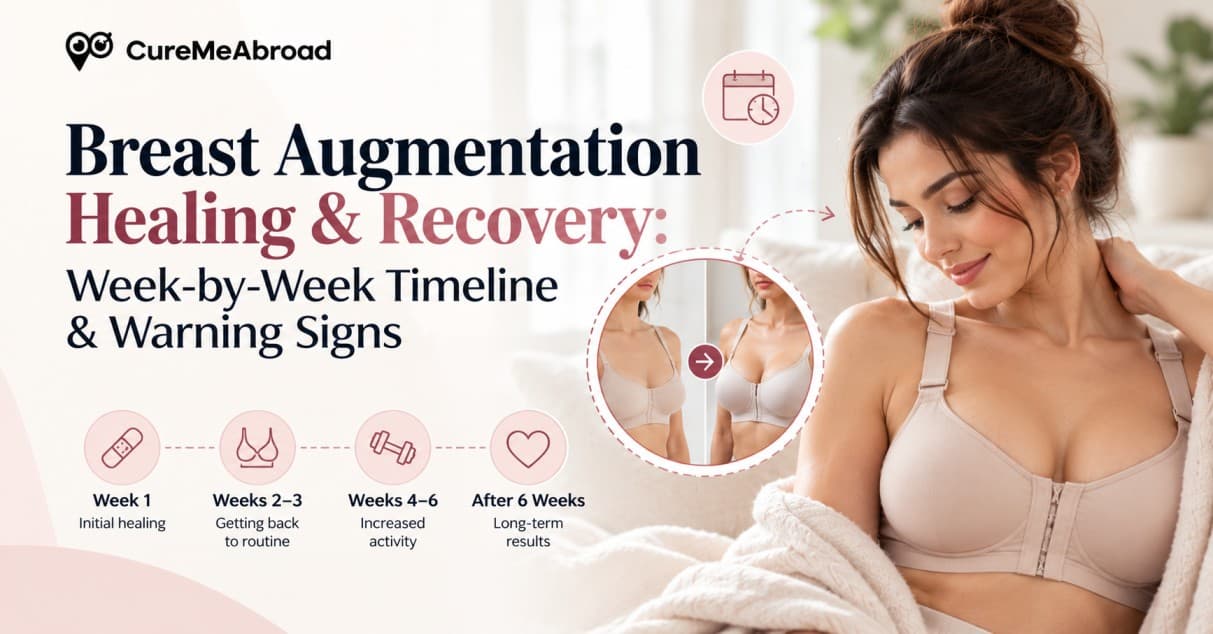
Breast Augmentation Healing & Recovery: Week-by-Week Timeline & Warning Signs
Feeling unsure about what is normal after breast augmentation can make recovery confusing, especially when swelling, tightness or breast shape keeps changing. A clear breast augmentation recovery timeline helps you know what to expect and where you should slow down or contact your surgeon.
Knowing the breast implant healing stages can also help you plan work, exercise and daily activities without rushing your recovery. Along with this understanding the warning signs after breast augmentation helps you recognise changes which may need medical attention.
In this guide, we will cover the healing timeline, normal recovery vs warning signs, activity restrictions, long-term implant safety and practical tips for a smoother recovery.
Quick Answer: How Long Does Breast Augmentation Healing Take?
Breast Augmentation Healing usually takes around 6 to 8 weeks for substantial physical recovery but your breasts may continue changing for several months. Many patients can return to light daily activities within 1 to 2 weeks, while swelling, firmness, and implant position keep improving.
And also, the recovery time can change depending on implant placement, implant size, surgical technique and whether you had a breast lift along with augmentation. For this, you should follow your surgeon’s timeline rather than treating these weeks as a fixed deadline.
Breast Augmentation Healing Timeline at a Glance
| Recovery stage | What you may experience |
|---|---|
| First 24 hours | Soreness, tightness, swelling and tiredness |
| Days 2–3 | More swelling, pressure and limited arm movement |
| Days 4–7 | Pain starts easing and movement becomes easier |
| Week 2 | Light daily activities may become possible |
| Weeks 3–6 | Gradual return to normal activities |
| Months 3–6 | Implants continue settling and softening |
| Months 6–12 | Scars and breast shape continue to mature |
Breast Augmentation Recovery Timeline: Day by Day, Week by Week
The first thing is that breast augmentation recovery does not happen all at once. Actually, the pain may improve before swelling disappears. And then your breasts can still look high or uneven while the tissues are healing.
The First 24–72 Hours: Peak Swelling & Pain
During the first two to three days, you may notice chest tightness, soreness, swelling, bruising and tiredness from anesthesia. And also some patients may have reduced arm movement or a pulling feeling around the chest.
And then your main focus should be rest and gentle movement around the home and also you should take your prescribed medicines as directed. Along with this keep your recovery area comfortable and avoid lifting, pushing, pulling or reaching overhead which can put extra strain on your healing tissues.
Meanwhile you should keep watch for warning signs after breast augmentation which can appear during recovery. For symptoms like rapidly increasing swelling, heavy bleeding, fever, worsening pain or foul-smelling drainage when it appears you should immediately contact your surgical team and then symptoms like severe chest pain or shortness of breath emergency medical care are required.
Days 4–7: Early Healing Milestones
By days four to seven the discomfort usually starts becoming easier to manage. And also you may walk more comfortably and feel less tired but swelling, tightness, bruising and limited arm movement can still remain.
Some people with desk jobs may return to work around this stage or within the first week which depends on how they feel and what their surgeon allows. And along with this, if your work involves lifting or physical activity you may need longer and then you should plan accordingly.
And also your implants may look unusually high, firm, uneven or more rounded during the first week. This is often temporary where the surrounding tissues are still tight, so for that you should not judge the final breast shape too early.
Weeks 2–6: Returning to Normal Activity
During weeks two to six where your energy usually improves, and normal daily activities become much easier. Along with walking and light household tasks some patients return to desk work but heavy lifting, running, chest exercises and strenuous activity still need surgeon clearance.
By weeks three and four, you may feel much better, which can make it tempting to exercise normally again. And for this you should increase activity slowly because the deeper tissues and implant pocket can still be healing even when the incision looks fine.
Around weeks five and six, many uncomplicated patients are getting closer to normal activity. And then your surgeon may check incision healing, implant position, swelling and breast symmetry before allowing upper-body workouts or higher-impact activities.
Months 3–12: Implants “Drop and Fluff” Into Final Position
The breast implant healing stages continue even after you feel physically better. “Drop and fluff” describes how implants can gradually move into a more natural position while the lower breast becomes softer and fuller as the surrounding tissues relax.
Between months three and six where the breasts may look more natural and the implants can continue becoming softer. Where the implant is placed under the muscle or the surgery includes a lift or revision this settling process may take longer.
By six to twelve months scars and breast shape can continue to mature but this does not mean every patient reaches the same final result within this period. And also changes can continue with aging, pregnancy, weight changes or future implant-related issues. So for that you should keep following your surgeon’s advice.
Normal Healing vs Warning Signs: What Requires Immediate Care
During breast augmentation healing you can expect swelling, bruising, tightness and soreness which usually improve gradually. Along with this temporary numbness or implants that look high and firm can also happen during the early breast implant healing stages.
Then the main thing is to watch how your symptoms are changing and especially the swelling that slowly improves is usually less concerning whereas sudden swelling, worsening pain or major changes in one breast need medical attention.
What's Normal During Breast Implant Healing
Firstly the early recovery can look a little uneven which does not always mean something is wrong. And then your breasts may feel tight or firm and the implants can sit higher than expected while the surrounding tissues relax.
| Usually normal | What you should know |
|---|---|
| Mild swelling and bruising | Should gradually improve |
| Tightness or soreness | Can be stronger with muscle placement |
| Temporary numbness | Sensation may return gradually |
| High or firm implants | Can settle during “drop and fluff” |
| Mild asymmetry | May change as swelling reduces |
So their will be a mild itching, fatigue and limited arm movement can happen during the first days and for this you should follow your surgeon’s care instructions clearly instead of trying to massage or reposition the implants yourself.
Signs of Infection, Hematoma & Blood Clots to Watch For
Some warning signs after breast augmentation which need quicker attention. Because they can indicate infection, a hematoma or a blood clot.
- Infection: Fever, chills, increasing redness, warmth, worsening pain or foul-smelling drainage can be concerning. And also you should contact your surgeon when these symptoms are getting worse.
- Hematoma: One breast suddenly becoming larger, firm or tense along with increasing pain or heavy bruising can indicate bleeding around the surgical area. And for this you should contact your surgeon immediately where this happens.
- Blood clot: One-sided leg swelling, calf pain or warmth can be signs of Deep Vein Thrombosis (DVT). And then sudden shortness of breath, chest pain or fainting where it may indicate a pulmonary embolism and for this need emergency care.
When to Call Your Surgeon Right Away
Call your surgeon or surgical team promptly if you notice:
- Fever or chills which are persistent or worsening
- Increasing redness, warmth or foul-smelling drainage
- Rapid swelling in one breast
- Severe or worsening pain
- Sudden breast asymmetry
- Bleeding that soaks the dressing
- Wound separation or increasing swelling
And then if you develop severe shortness of breath, sudden chest pain, coughing blood, fainting or uncontrolled bleeding. For that you should seek emergency medical care immediately rather than waiting for your surgeon to respond.
Recovery can look different from person to person where implant placement, surgical technique and other procedures affect healing. And moreover your surgeon’s instructions should always take priority over a general breast augmentation recovery timeline.
Activity Restrictions During Recovery
After breast augmentation you need to stay in gentle activities which can support your recovery without putting too much strain on the healing tissues. And then walking is usually encouraged early where it supports circulation, while heavy lifting, chest workouts and activities that cause breast movement need more time.
As the breast implant healing stages progress then you can slowly increase your activity where your recovery is going well. The exact timing depends on implant placement, surgical technique, whether you had a breast lift and your surgeon’s instructions.
When Can I Exercise Again?
Firstly the short gentle walks can usually begin soon after surgery as tolerated. And then you should avoid brisk cardio, running, lifting and repeated pushing or pulling during the first days.
Around week 2 you may be able to increase walking and try light lower-body movement if your surgeon approves. And also you should reduce the activity when it causes new pain, swelling, breast throbbing or pressure.
By weeks 4 to 6 some patients can gradually return to more demanding exercise. Chest exercises such as push-ups, bench presses and chest flies often need specific clearance and may take longer based on where the implants are placed under the muscle.
Sleeping Position, Showering & Driving Timelines
| Activity | General timeline | What you should do |
|---|---|---|
| Sleeping | Back sleeping for 1–2 weeks or longer | Keep your upper body slightly elevated and avoid pressure on the breasts |
| Showering | Often around 24–48 hours if cleared | Follow dressing and drain instructions and avoid soaking |
| Driving | Around 5–14 days for some patients | Wait until you have full arm control and are off sedating medicine |
These are only general breast augmentation recovery timeline ranges. For this you should follow your surgeon’s instructions because showering and sleeping advice can change depending on your incisions, drains and healing.
Returning to Work: What to Expect
Returning to work depends more on what your job involves than simply counting the days and especially a desk job may be possible within about 5 to 14 days while physical work can require several weeks.
| Work type | General planning range | What to consider |
|---|---|---|
| Remote or desk work | 5–14 days | Keep movement light and take breaks |
| Light physical work | 2–3 weeks | Avoid lifting and repeated arm movement |
| Heavy physical work | 4–6 weeks or longer | Avoid heavy lifting, pushing and pulling |
| Childcare or caregiving | Often longer | Arrange help with lifting and transfers |
And then you should not return simply because the calendar says you can. When pain, swelling or wound problems are increasing you should contact your surgeon before resuming normal work.
Long-Term Implant Safety: What to Monitor After You've Healed
Even after breast augmentation healing is complete your implants still need some attention because breast implants are not considered lifetime devices. Along with routine breast care you should keep your implant details and watch for new swelling, pain, firmness, lumps or changes in breast shape.
And then regular breast examinations and age-appropriate breast cancer screening still matter. When silicone implants are used you should also follow the current imaging advice for checking silent rupture.
Capsular Contracture: Signs & When It Needs Treatment
Capsular contracture happens when the scar tissue that naturally forms around an implant becomes unusually tight or firm. It can develop months or even years after breast augmentation which means a breast that becomes harder later should not simply be ignored.
| What you may notice | What it can mean |
|---|---|
| Increasing firmness | The capsule may be tightening |
| Pain or pressure | Needs clinical assessment |
| Higher or distorted breast | Implant position may have changed |
| Increasing asymmetry | One side may be affected more |
| Hard and painful breast | More severe contracture may be present |
Firstly mild cases may only need observation while more significant cases can require procedures such as capsulotomy, capsulectomy or implant exchange. And for this you should not assume massage will fix established capsular contracture because treatment depends on the cause and severity.
Implant Rupture or Leak: What to Watch For
Implant rupture can look different depending on the implant type. Saline implants usually deflate when the shell breaks while silicone implant rupture can sometimes be silent where you may not notice an obvious change.
- Saline implants: Look for sudden or gradual loss of volume, a deflated appearance, wrinkling or new asymmetry.
- Silicone implants: Watch for changes in breast shape, firmness, swelling, pain, tenderness or a new lump.
- Imaging: Ultrasound or MRI may be needed because a physical examination cannot reliably rule out a silent silicone rupture.
And also FDA guidance recommends the first ultrasound or MRI for silicone implants around 5 to 6 years after placement and repeat imaging every 2 to 3 years after that. And then you should still continue normal breast cancer screening because implant imaging does not replace mammograms.
BIA-ALCL and Breast Implant Illness
BIA-ALCL
| Category | Details |
|---|---|
| What is it? | Breast Implant-Associated Anaplastic Large Cell Lymphoma (BIA-ALCL) is a rare type of lymphoma that develops around a breast implant. It is not breast cancer. |
| Which implants have higher risk? | The risk is higher with textured implants than smooth implants. The exact risk can vary by implant type and manufacturer. |
| Why can it happen? | It is associated more strongly with textured implant surfaces, although the exact reason is not fully established. |
| What are the signs? | Persistent swelling, sudden breast enlargement, fluid around the implant, a lump, pain, new firmness or breast asymmetry. |
| When can symptoms appear? | It can develop years after breast implantation which means a new late change should not be ignored. |
| What should you do? | When you notice persistent swelling, a lump or unexplained breast changes you should contact a qualified healthcare professional for evaluation. |
Breast Implant Illness (BII)
| Category | Details |
|---|---|
| What is it? | Breast Implant Illness (BII) is a term some patients use for a group of symptoms they associate with their breast implants. |
| Is there one confirmed cause? | No single biological cause has been established for all symptoms described as BII and there is no single test that confirms it. |
| What symptoms can occur? | Fatigue, brain fog, memory or concentration problems, muscle or joint pain, headaches, sleep problems, mood changes, rashes and general discomfort. |
| Why can these symptoms be difficult to identify? | These symptoms can overlap with other health conditions including autoimmune, hormonal, nutritional and sleep-related problems. |
| What should you do? | First you should discuss persistent symptoms with a qualified healthcare professional. And also you should check for other possible causes instead of assuming the implants are responsible. |
| Does removing implants always solve BII? | Not necessarily. Some patients report improvement after removal while others may continue to have symptoms which is why proper medical evaluation is useful. |
And also having a textured implant does not mean that you will develop BIA-ALCL. And then routine implant removal is not recommended for people who have no symptoms solely because of concern about BIA-ALCL.
Tips for a Smoother, Safer Recovery
A smoother recovery starts with following the small things consistently. And your breast augmentation recovery timeline can vary depending on the procedure and your health so you should use your surgeon’s instructions as the main guide.
Recovery Checklist
| Stage | What you should do |
|---|---|
| Before surgery | Choose an experienced qualified surgeon and understand your implant options |
| First days | Follow wound care instructions and walk gently as advised |
| Early healing | Avoid lifting and exercise until cleared |
| Follow-up | Attend scheduled appointments and report unusual changes |
| After healing | Keep implant records and continue recommended breast screening |
| Long term | Follow silicone implant imaging guidance where applicable |
| Any warning signs | Report swelling, pain, fever, lumps or sudden asymmetry |
Along with these steps you should avoid nicotine during healing where it can effect your recovery. And also keep your implant manufacturer, model, size and serial number. These details can help if you ever need imaging, revision or another doctor later.
Final Thought
After breast augmentation the healing is a gradual process where swelling, tightness and implant position which will change over several weeks and months. We covered the breast augmentation recovery timeline, activity restrictions, warning signs and the long-term changes you should continue watching.
Along with following your surgeon’s instructions, you should give your body enough time to heal and avoid rushing back into exercise or normal activities. And at the same time keep your implant records and attend follow-ups where they are recommended.
For this you should take the next step carefully and choose a qualified surgeon and facility which you feel comfortable with. Find the best hospital for breast augmentation on CureMeAbroad and book your consultation today with the best hospital doctor.
FAQs
1. How painful is breast augmentation recovery?
Breast augmentation recovery can cause discomfort which is often strongest during the first 24 to 72 hours. Along with the pain tightness and soreness may continue for several weeks and gradually become easier to manage as healing progresses.
2. Can I sleep on my side after breast augmentation?
For a few days the side sleeping is usually avoided during early healing which is a stage where pressure on the breasts can increase discomfort or swelling. So for this reason start by sleeping on your back and then return to side sleeping after your surgeon confirms that it is safe.
3. When will my breasts look and feel normal?
The breasts may look high, firm, swollen or uneven during the early stages where the implants are still settling. The breast augmentation recovery timeline can vary and also the breasts often settle over the next three to six months while the final shape may take longer.
4. What’s the most dangerous complication to watch for?
For serious complications after breast augmentation which include pulmonary embolism, severe bleeding or infection urgent medical attention may be needed. And for this sudden shortness of breath, chest pain, fainting or uncontrolled bleeding should be treated as an emergency rather than waiting for a routine appointment.
5. Does recovery take longer with implants under the muscle?
For implants placed under the muscle which include submuscular or dual-plane implants recovery can sometimes take longer. And also the pectoral muscle can cause more chest tightness during early healing which may delay the return to upper-body exercise.
6. How often will I need follow-up appointments?
Follow-up visits are often scheduled during the first week and then around two weeks and four to six weeks after surgery. And also later visits may take place at three, six and twelve months where slower healing or complications require additional monitoring.
Reference
American Society of Plastic Surgeons. Breast augmentation recovery.
https://www.plasticsurgery.org/cosmetic-procedures/breast-augmentation/recoverySalemy, S. (2018, October 12). Breast augmentation recovery—What you need to know. American Society of Plastic Surgeons.
https://www.plasticsurgery.org/news/blog/breast-augmentation-recovery-what-you-need-to-knowAmerican Society of Plastic Surgeons. (2020, July 28). How long is the recovery for a breast augmentation?
https://www.plasticsurgery.org/news/blog/how-long-is-the-recovery-for-a-breast-augmentationAmerican Society of Plastic Surgeons. (2023, May 16). Back to active: Returning to exercise after breast augmentation recovery.
https://www.plasticsurgery.org/news/articles/back-to-active-returning-to-exercise-after-breast-augmentation-recoveryAmerican Society of Plastic Surgeons. (2022, July 5). What does “drop and fluff” mean after breast augmentation?
https://www.plasticsurgery.org/news/blog/what-does-drop-and-fluff-mean-after-breast-augmentationCleveland Clinic. (2023, August 30). Breast implants: Types, surgery, recovery, and risks.
https://my.clevelandclinic.org/health/treatments/21724-breast-implantsCleveland Clinic. (2023, August 31). Breast augmentation: What it is, types, surgery, and recovery.
https://my.clevelandclinic.org/health/treatments/11024-breast-augmentationMayo Clinic. (2024, September 10). Breast augmentation.
https://www.mayoclinic.org/tests-procedures/breast-augmentation/about/pac-20393178UMass Memorial Health. (2025, February 20). Care after breast implants.
https://www.ummhealth.org/health-library/care-after-breast-implantsMemorial Sloan Kettering Cancer Center. (2025, September 22). Caring for yourself after your breast implant surgery.
https://www.mskcc.org/cancer-care/patient-education/self-care-after-insertion-permanent-breast-implantAlberta Health Services. (2024, October 1). Breast enlargement surgery: What to expect at home.
https://myhealth.alberta.ca/Health/aftercareinformation/pages/conditions.aspx?hwid=tw12671Mayo Clinic. (2026, September 4). Breast reconstruction.
https://www.mayoclinic.org/tests-procedures/breast-reconstruction/about/pac-20606468American Society of Plastic Surgeons. Breast implant safety.
https://www.plasticsurgery.org/patient-safety/breast-implant-safetyAmerican Society of Plastic Surgeons. BIA-ALCL resources: Patient advisory.
https://www.plasticsurgery.org/patient-safety/breast-implant-safety/bia-alcl-summary/patient-advisory