

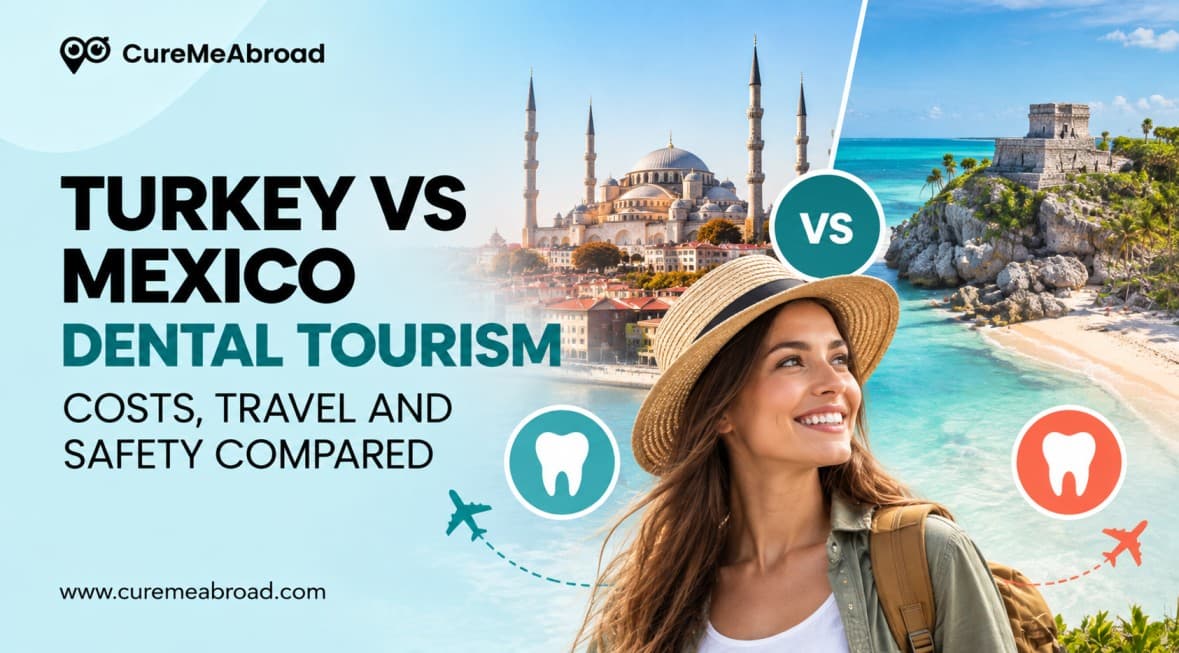
Turkey vs Mexico for Dental Tourism
Over the past twenty years, traveling to another country for dental care has grown from a simple way to save money into a major global business. Many patients from the United States and Canada face very high costs or long wait times at home. For them, traveling abroad has become a smart choice to get major dental work done.
Today, Turkey and Mexico are two of the most popular places for dental travel. Both countries offer huge savings compared to normal prices in the US and Canada, but they work in very different ways. To choose the right place, you need to look past marketing ads and look closely at estimated costs, local rules, clinic styles, and travel steps.
Turkey vs Mexico Dental Tourism: Quick Comparison
The table below shows the main differences in costs, travel time, and rules between the two countries.
| Travel Factor | Turkey Dental Pathway | Mexico Dental Pathway |
|---|---|---|
| All-on-4 Full Arch Cost | $6,000 – $12,000 per arch (Estimate) | $8,000 – $15,000 per arch (Estimate) |
| Single Dental Implant Cost | $400 – $1,400 (Estimate) | $600 – $1,800 (Estimate) |
| Average Savings vs. US Fees | Around 50% to 70% lower average costs | Around 50% to 70% lower average costs |
| Transit Time from North America | Long flight, usually 10 or more hours | Short travel, often 2 to 4 hours |
| Primary Regulatory Oversight | Ministry of Health, USHAS approval | COFEPRIS (Federal Health Authority) |
| Standard Package Design | Often sold as a bundle (hotel, rides, translator) | Separate bills (depends on the clinic) |
| Language Support Infrastructure | Patient helpers are common | English-speaking staff are widely available |
| Average Length of Stay | Usually 5–10 days per trip | Varies from 2–7 days depending on how close you live |
Both countries offer good alternatives to high prices at home. The best choice for you depends on the type of treatment you need, where you live, your budget, and how easily you can go back for follow-up care.
Dental Treatments Available in Turkey vs Mexico
While basic cleanings and checkups are available in both countries, the actual clinic designs, treatment speeds, and medical styles are completely different.
Advanced Dental Implants and Full-Mouth Restorations
The Turkey Pathway: High-Speed Digital Surgeries
- High-Volume Surgical Units: Walk into a major dental center in Istanbul or Antalya, and you will find they run like fast-paced, high-tech surgical hubs. These big facilities specialize in mapping out and finishing massive smile overhauls in a very compressed window of time.
- Computer-Guided Placement: Doctors lean heavily on smart software programs and 3D digital mouth maps. By using these virtual blueprints, the surgical team can precisely place multiple titanium screws in a single session. This high-speed tech setup means you end up spending far less time sitting under the surgical lamps.
- All-in-One Delivery: Since most international travelers fly in from long distances, these offices put all their energy into wrapping up the bulk of your heavy structural mouth work during one highly organized, intense visit.
The Mexico Pathway: Step-by-Step Biological Healing
- Breaking Up the Treatment Plan: Dentists who treat travelers in Mexico generally take a completely different path, favoring a slower, multi-trip approach. Because North American patients live close enough to hop on a short flight or simply drive across the border, local doctors prefer to stretch out complex oral surgeries over a few separate appointments.
- Letting Your Jaw Recover Naturally: Spreading your treatments out leaves an intentional, multi-month gap between major procedures. This strategy prioritizes your body's natural healing timeline after intense preparatory bone surgeries. We are talking about steps like bone grafting (where doctors use new bone material to reinforce a weak jaw) or sinus lifts (gently raising the sinus membrane to clear space for upper-jaw bone grafts). Moving forward slowly gives your jaw plenty of time to fuse and become solid before anyone attaches your final permanent teeth.
- Teeth-in-a-Day Options: Despite this slower pace, specific Mexican practices do offer immediate-loading setups. This option lets doctors attach temporary, functional teeth to your new implant screws during your very first surgery. Whether you qualify for this depends entirely on your initial bone thickness, how firmly the screw locks into place on day one, and your overall health.
Crowns, Veneers, and Smile Makeovers
The Turkey Pathway: On-Site Manufacturing Lines
- In-Clinic Dental Labs: Top cosmetic facilities in Turkey house industrial CAD/CAM milling machines (digital computer design and high-speed tooth carving units) right inside the clinic building.
- Expedited Turnaround: By keeping the entire manufacturing loop on-site, technicians can design, cut, polish, and glue an entire set of crowns or veneers in just five to seven days for standard cases, eliminating external shipping delays.
The Mexico Pathway: Custom Hand-Layered Artistry
- Specialized Lab Networks: Rather than rushing teeth through automated on-site carvers, many Mexican practices choose to collaborate with independent, boutique laboratory partners.
- Hand-Crafted Texturing: Sending your cases to an outside master technician can extend your necessary length of stay, but it gives the ceramist time to perform detailed, hand-layered porcelain adjustments for a highly personalized look.
- Optimizing Occlusion: This unhurried timeline allows the dentist to perform multiple clinical trial fittings. Taking this extra time is vital for making sure your upper and lower teeth meet perfectly and comfortably when you chew or bite down.
Root Canals, Fillings, and Routine General Care
The Turkey Pathway: Preparatory Steps Only
- High Travel Overhead: Traveling across an ocean just for basic dental care is rarely worth the money because long-distance plane tickets are too expensive.
- Restricted Scope: Because of this logistical barrier, basic fillings, deep cleanings, or endodontic treatments (root canals) are only performed in Turkey as initial preparatory steps to clean up underlying infections before a much larger, expensive restoration plan.
The Mexico Pathway: The Day-Tripper Pipeline
- Massive Local Volume: Mexico sees a steady, massive flow of international patients traveling exclusively for basic general care.
- Same-Day Border Access: Highly accessible towns right along the US border cater extensively to weekend day-trippers seeking same-day root canals, white composite fillings, or simple porcelain crown repairs at a fraction of domestic costs, allowing patients to drive home the same afternoon.
Price Comparison: Turkey vs Mexico Dental Treatment Costs
To find the true cost of dental travel, you must look past the price of the treatment alone and add in all your travel expenses.
| Dental Category | Specific Treatment or Procedure | Estimated Turkey Price | Estimated Mexico Price |
|---|---|---|---|
| Implant Diagnostics | Dental Implant (Single Hardware Screw) | $400 – $1,400 | $600 – $1,800 |
| Cosmetic Veneers | Zirconia Crown or Veneer (Per Tooth) | Generally the lower of the two | Competitive average prices |
| Clinical Endodontics | Specialized Root Canal Therapy | $80 – $180 | $180 – $450 |
| Full-Mouth Reconstruction | All-on-4 Full Arch Implant Bridge | $6,000 – $12,000 | $8,000 – $15,000 |
Note: These prices are estimates from clinic lists and medical travel data, not fixed government prices. Your final cost will depend on your exact needs and mouth structure.
On paper, Turkey’s prices for the dental work are often lower, especially for large cosmetic packages and full-mouth implant sets. However, because Mexico is so close to the US and Canada, it changes the total cost. For a single implant or a small treatment plan, the cost and stress of a long flight to Europe can easily wipe out any money you saved on the dental bill. But for large, full-mouth makeovers, the lower prices in Turkey can easily cover the cost of the long flight.
Hidden Costs of Dental Travel
The first price you get in an email quote is rarely the final amount you will pay. Complex mouth surgeries often require extra steps that the doctor can only see during an in-person exam and 3D scans.
- Special 3D Scans: High-quality X-rays used to check bone depth and nerve spots.
- Bone Reinforcement: Bone grafts needed to make the jaw stronger before an implant can be put in.
- Sinus Lifts: A surgery that adds bone to the back of the upper jaw.
- Temporary Teeth: Plastic teeth you wear while the lab makes your permanent set.
- Sleep Medicine Fees: The cost of medicines used to keep you relaxed or asleep during surgery.
- Prescriptions for Healing: Antibiotics, pain pills, and special mouthwashes needed to heal safely.
Rides and hotels are another factor. Many packages for Turkish clinics choose to include your hotel and airport rides in one price. Clinics across Mexico often stick to standalone billing models, meaning transport and hotel booking fall entirely on you. Before locking anything in, request a complete, itemized breakdown so you see precisely what the base surgical rate covers and what lands as a separate charge.
Time Needed Abroad: Turkey and Mexico Dental Timelines Compared
The layout of a practice and how its lab runs directly dictates how long you need to set aside for an overseas trip.
The Digital Plan in Turkey
To accommodate long-distance travelers, prominent Turkish practices generally run on highly condensed, fast-moving schedules.
- Day One (Morning): Technicians run 3D diagnostic scans, reshape your target teeth, and build your new smile layout using on-site design computers.
- Day One (Afternoon): Because these centers keep digital carving blocks inside the building, temporary teeth can be manufactured and fitted in a single afternoon.
- Days Two to Five: For normal, straightforward cosmetic plans, small shape adjustments, ceramic tooth polishing, and final cement bonding wrap up entirely within five consecutive days.
The Multi-Visit Plan in Mexico
Since Mexico sits so close to the US and Canada, local practices typically favor a deliberate, multi-visit treatment arc.
- Verifying the Fit: For multi-unit transformations, dentists take advantage of nearby lab partners to check your bite and alignment across several brief sessions.
- A Real-World Test: This relaxed timing allows you to try out temporary teeth in everyday scenarios for a few days first.
- Natural Adaptation: Allowing your jaw joints and muscles to grow accustomed to the change guarantees that your final permanent restorations line up comfortably before they are fixed into position.
Travel and Recovery
The length of your journey home acts as a massive factor in how comfortably your mouth heals after extensive surgery and sedation.
Long Flights After Surgery (Turkey)
- Physical Toll: Sitting through a ten-to-fifteen-hour international flight right after an invasive oral surgery places a heavy burden on your recovery.
- Cabin Pressure Issues: Shifting air pressure during long-haul flights can expand soft oral tissues, which occasionally worsens facial swelling or triggers a throbbing ache along your fresh incisions.
- Bundled Comforts: To soften this travel fatigue, international Turkish dental packages normally embed nice hotel bookings and private van transfers directly into the total fee.
- Monitored Anesthesia: Intravenous sedation or sleep options are widely available for major reconstructions, but a trained professional must always track your vital signs based on your physical medical background.
Short Trips and Border Crossings (Mexico)
- Low-Stress Transit: Commuting via a short flight or walking directly through a regional border gate leaves your initial healing window incredibly basic.
- Protected Medical Zones: Most border practices operate within highly accessible medical corridors designed solely for visiting tourists, and security teams keep these areas actively monitored.
- Soothing Nerve Anxiety: Dentists along the border rely on deep local numbing options and an unhurried, reassuring clinical approach to comfort patients dealing with intense dental fear.
Managing Aftercare and Communication
The first forty-eight hours following extractions or implant placement demand vigilant monitoring to catch infections or early bleeding.
Coordinated Care Networks in Turkey
- All-Inclusive Systems: Many Turkish dental groups oversee your recovery through structured, deeply organized patient tracking channels.
- Complete Healing Packs: You exit the facility with a pre-packed kit containing your exact antibiotics, a clear pain schedule, and healing mouthwashes.
- Direct App Channels: Staff members assign you an individual point of contact on apps like WhatsApp, enabling you to snap and send images of your gums for review at any hour.
- Pre-Flight Evaluations: Quality centers always require an in-person diagnostic check before you depart to make sure your wounds look safe for air travel.
Direct Dentist Access in Mexico
- A Localized Approach: Post-operative monitoring in Mexico relies on a far more immediate, personal setup.
- Convenient Pharmacy Runs: Doctors write out standard medical scripts that you can easily fill at pharmacies right next to the office or pack across the border back home.
- Direct Access Lines: Rather than talking to a remote support desk or translator, you usually get the direct cell phone number of the surgeon who performed your care.
- Easy Fixes: If a stitch happens to unravel or you need a microscopic bite adjustment, the logistical stakes are tiny, since you can simply drive back over for a rapid check.
Dental Warranties and Long-Term Follow-Up
Keeping your smile intact over the coming decade requires routine cleanings, consistent bite checks, and authentic manufacturer guarantees.
Long-Distance Warranties (Turkey)
- Material Promises: A broad range of Turkish clinics offer ten-year or lifetime structural coverage on specific premium implant models and zirconia prosthetics.
- Logistical Challenges: Even so, utilizing a long-distance material guarantee requires significant travel prep.
- Bone Integration Issues: If an implant screw struggles to integrate properly—a natural biological risk where the bone fails to fuse with the metal in a tiny percentage of international cases—the clinic replaces the actual hardware without billing you for the parts.
- Out-of-Pocket Transit Costs: The catch is that you must still cover your own transcontinental airfare and hotel bills to go get that free replacement, which can eat into your original savings.
Rules and Dispute Systems (Mexico)
- Official Channels: For international patients, Mexico runs an established accountability network via COFEPRIS (the agency checking office sanitation and licensing) and CONAMED (the national medical arbitration council).
- Mediation Outside of Court: CONAMED steps in to review official medical disagreements, offering an alternative path to resolve issues without standard legal battles, though the bureaucracy takes time.
- Inexpensive Maintenance: Furthermore, traveling back to a border zone for a bi-annual clean, a minor tweak, or a warranty adjustment is exceptionally cheap for North Americans.
- Seamless Data Sharing: A large percentage of border practices work alongside local dentists in the US or Canada, sharing charts and digital scans back and forth without hassle.
Dental Accreditations and Patient Safety Standards
Protecting your physical health means thoroughly checking out individual provider credentials and histories rather than trusting broad country reputations.
Cosmetic Styles and Over-Prepping Risks
- The Danger of Over-Filing: A known complaint pattern highlighted across international media involves high-volume centers filing healthy, intact enamel down into tiny pegs to slide crowns over them quickly.
- The "Turkey Teeth" Label: While social platforms use the phrase "Turkey Teeth" for this look, the trend belongs to cheap cosmetic discount factories. It does not mirror traditional, ethical Turkish dentistry.
- Conservative Care Options: While highly rated clinics across Turkey prioritize conservative methods (like zero-prep, ultra-thin porcelain veneers), low-tier operations choose speed over your natural tooth structure.
- Asking the Hard Questions: You need to explicitly ask your primary dentist exactly how much tooth material they intend to shave away before signing a clinical consent form.
Government Verification Systems
- USHAS Registration: Every single Turkish clinic taking on foreign medical travelers must hold a distinct health tourism license issued directly by the Ministry of Health and managed by an agency called USHAS. This document tracks whether a practice meets administrative standards for international guests, though it cannot guarantee a specific surgical outcome.
- Cédula Profesional Lookups: Dentists legally practicing in Mexico are required to possess proper credentials, and you can verify their cédula profesional (medical license number) directly through the government's official online portal, the Registro Nacional de Profesionistas.
- Verifying Local Rules: Remember, these official lists are good signs of quality, but they cannot remove every risk. You should still ask about your specific doctor's training history, past success records, and how they clean their tools.
Implant Brands and Materials
Private clinics in both countries use the exact same, world-famous dental parts.
- Global Brands: Top international clinics routinely stock premium implant brands like Straumann, Nobel Biocare, Osstem, and Megagen.
- Metal Posts and Crown Types: You should always ask exactly what brand of titanium implant and what specific material (like solid zirconia or E.max porcelain) will be used for your teeth.
- Teeth Strength Over Time: Checking these details early on decides how long your new teeth will last.
- Finding Parts at Home: Using globally recognized systems means a local dentist back home can easily find matching parts if you ever need an adjustment later.
Dental Implant Success Rates
How long an implant lasts depends mostly on the skill of your surgeon, a careful plan, and your personal health, not on the country you visit.
- Your Risk Factors: Health issues like smoking, uncontrolled diabetes, active gum disease, weak jawbone thickness, and poor brushing heavily impact how well the bone bonds to the implant screw.
- Scientific Facts: Dental success rates in medical studies remain very high over the long term when doctors use good surgical steps, quality materials, and patients follow all care rules.
- Evaluating Your Doctor: Instead of looking at country averages, check your specific doctor's training, their multi-year success history, and how they prevent infections.
How Many Visits Will You Need?
The total number of trips you need to make depends entirely on the type of dental work you are getting done.
- Single-Trip Work: Veneers, crowns, simple bridges, fillings, and root canals can usually be finished completely in one single visit lasting five to ten days.
- Multi-Trip Implant Work: Even though some places advertise same-day implants, standard plans usually require two separate trips. On the first trip, the doctor pulls old teeth, adds bone if needed, and places the titanium screw. You then go home for three to six months to allow the bone to grow around the screw before making a second trip to attach the permanent crown.
- Full-Mouth Implant Windows: Large treatments like All-on-4 can sometimes be fitted with a temporary set of fixed teeth during a slightly longer initial visit, followed by a return trip a few months later for your final permanent teeth.
Who Is a Good Candidate for Dental Tourism?
Traveling abroad for complex mouth surgery offers great financial relief, but the travel steps are not right for everyone's health.
Good Candidates for Dental Travel
- People with thick, strong jawbones, healthy gums, and stable, well-managed health.
- Patients who need a lot of teeth replaced, where the huge savings easily cover the cost of plane tickets and hotels.
- Travelers with open schedules who can easily add extra buffer days to their trip if the lab needs more time to fix the fit.
Who Should Reconsider
- People dealing with uncontrolled diabetes, bleeding issues, active mouth infections, or complex heart conditions that need constant checks by a local doctor.
- Heavy smokers or those who cannot commit to strict, daily teeth brushing and cleaning, as these habits cause a lot of early implant failures.
- Anyone who cannot physically handle long flights or long road trips right after a painful mouth surgery.
Turkey vs Mexico: Which Country Is Right for You?
The better choice depends entirely on the specific dental care you need, where you live, your budget, and how easily you can travel back for a checkup.
Turkey is usually a strong choice if you:
- Need a large, full-mouth smile makeover or multiple implant sets where the lower prices maximize your total savings.
- Want an easy, fully managed trip where your hotel, private rides, and dental visits are all handled on one single bill.
- Are traveling from European areas or eastern regions where flight times are short and direct.
Mexico is usually a strong choice if you:
- Are looking for basic dental care, a single implant, or just one crown where the price of a long-distance flight would wipe out your savings.
- Live in the US or Canada and want to completely avoid long, tiring plane trips across the ocean after a major surgery.
- Want a clear medical rule system with cheap, easy access for regular 6-month cleanings or warranty fixes.
Final Verdict: Turkey vs Mexico Dental Tourism
There is no single winner in the debate between Turkey and Mexico. The choice comes down to finding a highly skilled dentist, a properly licensed clinic, and a plan that fits your safety needs and travel budget.
If you need full-mouth implant work or a complete set of zirconia crowns, certain Turkish clinics with on-site digital labs and low prices often give the best financial result. On the other hand, for basic dental care, single implants, or situations where being close to home brings peace of mind, Mexico offers easy border travel, direct talk with your dentist, and a clear safety system. Patients planning their research may also want to read our clear consumer guides on All-on-4 dental implants, dental implant costs, and how long implants last to build a safe foundation.
The line dividing an excellent medical trip from a bad one always traces back to your own planning. Make it a priority to independently verify professional licenses, pick certified surgical facilities, allocate ample time for post-op rest, and head home with your entire folder of medical charts. When you approach your trip with this level of care, international care becomes an incredibly smart health move.
With CureMe Abroad, you can seamlessly bridge this planning gap. With CureMeAbroad, you can connect with accredited hospitals and experienced doctors in Mexico and Turkey for your treatment needs.
Frequently Asked Questions
Is Turkey or Mexico cheaper for dental implants?
Turkey generally has lower prices for the actual procedure, making it cheaper for large, full-mouth implant sets. Mexico is often cheaper overall for North American patients when fixing small cases like a single implant, because low travel costs keep total spending down.
What is the "Turkey Teeth" issue, and does it happen in Mexico?
"Turkey teeth" means filing down healthy teeth into small pegs to fit standard crowns quickly. While this bad habit happens at high-volume discount places, quality dentists in both Turkey and Mexico use safe, minimal-prep rules to protect your teeth.
How do I independently verify a dentist is legitimate in Mexico?
Every legal Mexican dentist holds a unique cédula profesional number. You can check this medical license directly on the government’s public Registro Nacional de Profesionistas website before you book an appointment.
What happens if a dental implant fails after I return home?
A small percentage of dental implants fail to bond with the bone due to natural body variations. Good international clinics will replace the metal part for free under their warranty rules, but you have to travel back to the clinic, making a return journey geographically closer and less expensive for North Americans if they chose Mexico.
Does travel insurance cover dental tourism complications?
Many standard travel insurance policies exclude complications stemming from elective, planned medical tourism trips. They only cover regular travel emergencies. Patients should look for special medical tourism insurance plans built to cover dental issues abroad.
References
- Medical Tourism. CDC Yellow Book, 2026 Edition. Centers for Disease Control and Prevention.
https://www.cdc.gov/yellow-book/hcp/health-care-abroad/medical-tourism.html - International Health Tourism Authorization. USHAŞ (International Health Services Inc.), Turkish Ministry of Health.
https://www.ushas.gov.tr/en/ - COFEPRIS (Comisión Federal para la Protección contra Riesgos Sanitarios). Government of Mexico.
https://www.gob.mx/cofepris - CONAMED (Comisión Nacional de Arbitraje Médico). Government of Mexico.
https://www.gob.mx/conamed - American Dental Association.
https://www.ada.org - Long-term (10-year) dental implant survival: A systematic review and sensitivity meta-analysis. Howe MS, et al. Journal of Dentistry, 2019. National Library of Medicine, PubMed.
https://pubmed.ncbi.nlm.nih.gov/30904559/