




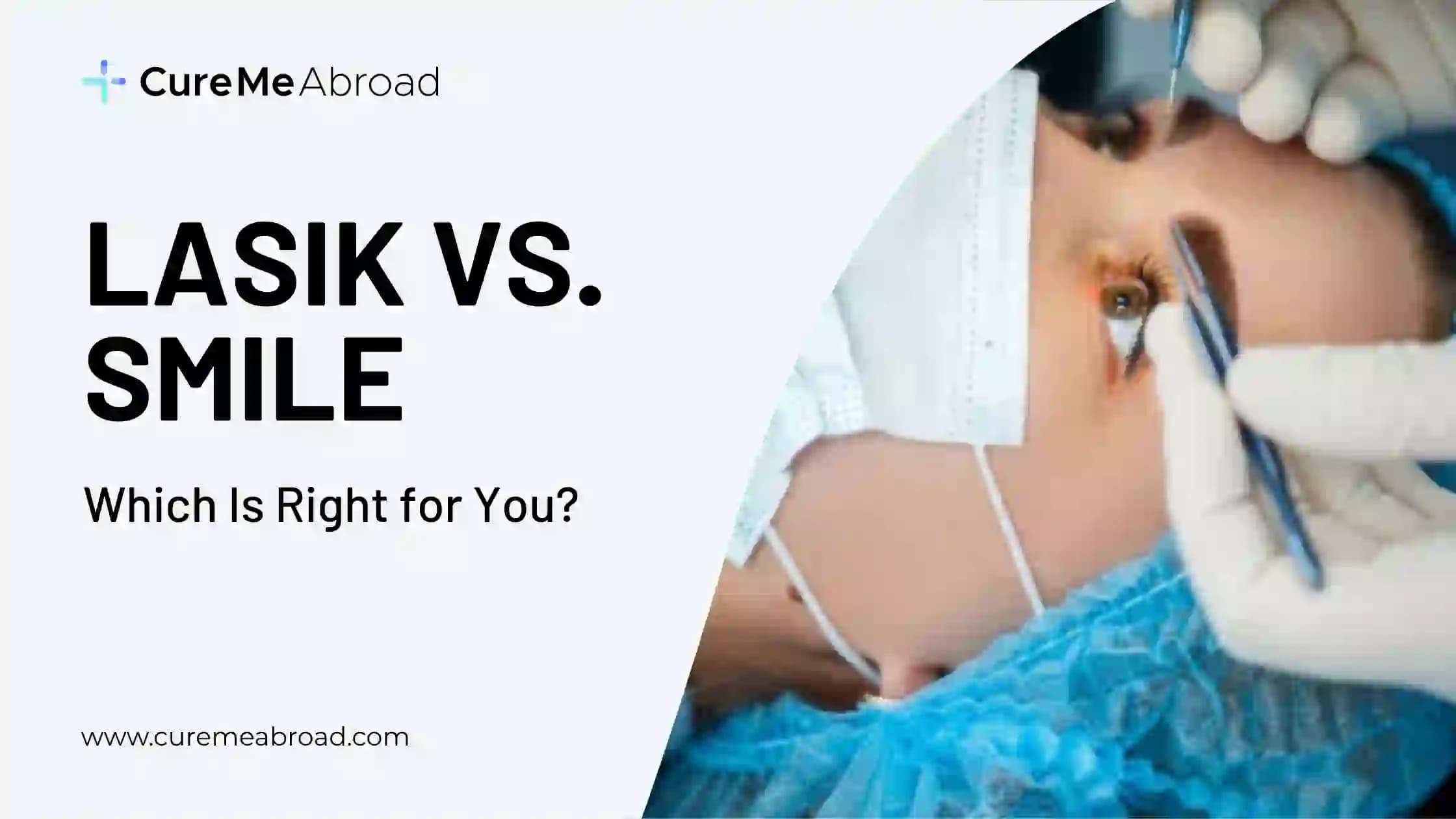
Having Blurry vision can be really annoying, it will be frustrating when you wear glasses or contacts every day and still don't see clearly. That is why many people seek LASIK and SMILE laser surgeries which help you to see clearly without glasses or contacts.
LASIK and SMILE treatments are quick. Both the treatments are mostly painless, and give fast results, but they differ in how they work and who they suit best. The cost of LASIK in USusually around between $2,200 to $3,000 per eye and for SMILE cost in US is usually between $2,500 to $3,000 per eye. The cost will be differ depending on the clinic and where you live.
In this blog, we will cover what LASIK and SMILE are, how they work, key differences, benefits, costs, recovery, risks, and who is the right candidate for each.
What Is LASIK Eye Surgery?
LASIK eye surgery is a laser surgery by reshaping the surface of your eye, the cornea. That helps you see clearly without needing glasses or contact lenses and it helps your eye focus properly on the retina. The retina is where clear vision really begins.
People choose LASIK eye surgery because it makes things easier. For example, driving and working on screens become easier. It also makes it easier to wake up and see the clock. LASIK eye surgery is a fix for vision. Many adults prefer LASIK eye surgery once their eye power has stopped changing at least for a year. The procedure is also fast and mostly painless. You can see results quickly within a day or two.
How LASIK Works Step-by-Step
• Firstly you will go through a detailed eye check where the doctor maps your eye and confirms the LASIK is right for you or not.
• On the day of the surgery the doctor uses numbing drops. so you do not feel pain, and slight pressure for a few seconds.
• Then the doctor creates a flap on the cornea and gently lifts it. This is like opening a page.
• Next a precise laser reshapes the cornea based on your vision needs and this part takes less than a minute.
• Finally the flap is placed back. It settles naturally without stitches. Your vision starts improving after.
LASIK Procedure Timeline
• Before surgery, around 1 to 4 weeks, you complete eye tests and stop wearing contact lenses so your eye shape settles properly.
• On the procedure day, the visit takes about 30 to 60 minutes. Most of it is spent on preparation and the actual laser work is just a few minutes per eye.
• In the first 24 hours your vision gets better. But it may feel slightly blurry or watery.
• Within a few weeks, your vision becomes stable. Then you can return to your daily life routine without much difficulty.
What Is SMILE Eye Surgery?
SMILE eye surgery is a modern laser vision procedure by correcting your eyesight without creating a flap on the eye surface. Instead the doctor makes a tiny cut to take out a piece of tissue from the cornea. This helps the cornea get the shape so that light can focus on the retina. That is where you get vision.
People choose SMILE because it is easy on the eye and it makes your eye less dry compared to older methods, and recovery feels smoother for many and it is also useful for people with active lifestyles, like gym or sports, where flap-related issues are not ideal and at the same timeThe procedure is quick, mostly painless, and vision improves within a short time, often by the next day.
How SMILE Works Step-by-Step
• Firstly you will go through a detailed eye check where the doctor will measure your eye shape and confirm whether the LASIK is right for you or not.
• On the day of surgery they put numbing drops on your eye. So you do not feel pain, and slight pressure for a few seconds.
• Then a laser creates a small piece of tissue inside your cornea along with a tiny opening and no flap is made here.
• Next the doctor removes that small piece of tissue through the opening, which helps your vision get better.
• Finally your eye heals on its own without any stitches. You start to see soon after.
SMILE Procedure Timeline
• Before surgery, around 1 to 2 weeks, you complete eye tests and stop using contact lenses.
• On the procedure day, the visit takes around 30 to 60 minutes but the laser part takes only a few minutes.
• Around 24 to 48 hours you start to see but things might look fuzzy at first.
• It takes a week for your vision to become stable and then you can go back to your normal daily routine easily.
LASIK vs SMILE: Key Differences
| Feature | LASIK | SMILE |
|---|---|---|
| Basic Idea | Uses two lasers and creates a thin flap on the eye surface | Uses one laser and works through a very small opening, no flap |
| How It Feels Overall | Feels similar in terms of quick procedure and fast recovery | Also quick and smooth recovery, quite similar experience |
| Flexibility | More flexible, can treat different vision problems and mixed cases | More focused, mainly used for specific conditions like myopia |
| Dry Eye Chances | Slightly higher chance of dryness after surgery | Usually less dryness, feels more comfortable for many people |
| Eye Strength After | Flap area heals but slightly affects surface strength | Eye structure stays stronger since no flap is created |
| Touch Up Option | Easier to do small corrections later if needed | Touch ups are possible but not as simple as LASIK |
| Best For Lifestyle | Good for general use and wider vision needs | Better for active people like gym, sports, outdoor work |
| Overall Result | Clear vision for most people with high success rate | Also gives clear vision with similar success rates |
| Full Form | Laser Assisted In Situ Keratomileusis | Small Incision Lenticule Extraction |
Conditions Treated
| Feature | LASIK | SMILE |
|---|---|---|
| Nearsightedness | Treats mild to very high numbers | Treats mild to high numbers |
| Astigmatism | Works well even in higher or mixed cases | Works for lower levels with myopia |
| Farsightedness | Can treat this condition | Not used for this |
| Age and Use | Suitable from 18+ with stable number | Usually preferred 22+ with stable number |
Incision Size and Flap
| Feature | LASIK | SMILE |
|---|---|---|
| Eye Surface | Creates a thin flap on the cornea | No flap is created |
| Opening Size | Larger flap area | Very small opening |
| Impact on Eye | Slightly more disturbance to surface nerves | Less disturbance, eye feels more natural after |
| Best For | General use cases | Active lifestyle, sports |
Laser Technology Used
| Feature | LASIK | SMILE |
|---|---|---|
| Laser Type | Uses two lasers for flap and reshaping | Uses a single laser only |
| Method | Reshapes the outer surface of the eye | Removes a small piece from inside the eye |
| Flexibility | More customizable for complex cases | More focused for specific cases |
Treatment Range Limits
| Feature | LASIK | SMILE |
|---|---|---|
| Vision Range | Covers wider range of eye power | Slightly limited range |
| Cornea Thickness | Needs moderate thickness | Can work better in thinner corneas |
| Touch Up Option | Easier to adjust later if needed | Slightly limited for re-treatment |
| Overall Use | More versatile option | More specific and gentle option |
Benefits of LASIK Over SMILE
• LASIK has been used for many years, and because of that it is more widely available and there is a lot of information about it.
• Most of the eye surgeons are trained to do LASIK, so access is easier in many places.
• It offers more flexibility in treatment, especially when your vision problem is not simple.
• It also allows easy touch ups later, which means the same flap can be lifted again if needed.
• For people who want quick results and less waiting time. LASIK is a good choice and more practical for daily life.
Faster Visual Recovery
• Firstly, LASIK gives faster clear vision after surgery.
• Many people can see well enough to drive the next day, sometimes even within hours.
• Around 90 percent or more reach usable vision very quickly.
• The flap acts like a natural cover and healing feels so faster and smoother.
• This is a great choice if you need to return to work or routine without delay.
Broader Correction
• LASIK can treat a lot of vision problems..
• It works for people who're nearsightedness, farsightedness, and higher levels of astigmatism.
• SMILE is mainly used for nearsighted cases with limited range.
• LASIK can also handle mixed vision issues, such that more people qualify for it.
• It allows options like monovision for age-related vision changes if needed.
Benefits of SMILE Over LASIK
• SMILE is a new method. It is designed to be easier on the eye, so that the eyes do not get disturbed much during the procedure.
• It does not create a flap so the eye structure stays more natural and stable after surgery.
• Because the opening is small the eye does not get as stressed on the eye tissues.
• Some people are not suitable candidates for LASIK with dry eyes or thin corneas are suitable for SMILE.
• It is also preferred by people with active lifestyles and where eyes are safer in daily routine.
Lower Dry Eye Risk
• First thing SMILE reduces dry eye issues compared to LASIK.
• It affects few nerves so the eyes can still make tears naturally.
• Many people feel less dryness and irritation after the surgery.
• The eyes feel comfortable again quickly usually in a few weeks.
• This makes SMILE a better choice if you already have mild dry eyes or feel discomfort with contact lenses.
Better for Active Lifestyles
• SMILE is often chosen by people with active routines.
• Because there is no flap so you no need to worry later.
• This makes it safer for people who do sports, working out and jobs that are physically demanding.
• The eye remains slightly stronger after healing, which adds long term safety.
• Many people return to light activities within a few days and full routine soon after.
Ideal Candidates
• When it comes to deciding between LASIK and SMILE your eye health is a deal.
• It also matters what your daily routine is like and how your vision has been over time.
• Generally people who are candidates have had the same eye power for at least one year and they should not have eye problems like keratoconus or cataracts.
• Doctors also check cornea thickness, tear quality, and overall eye health before giving approval.
• Around 1 in 5 people may not qualify after proper testing, and the reason is understandable, safety comes first.
LASIK Qualifications
• First qualification is people should be 18 years or older and have stable vision for at least one year.
• LASIK can treat nearsightedness, farsightedness, and higher levels of astigmatism.
• Cornea thickness should be adequate, usually above a safe limit.
• People with severe dry eyes or very thin corneas may not qualify.
SMILE Qualifications
• SMILE is usually recommended for people who are 22 years or older with stable vision.
• It mainly treats nearsightedness and some level of astigmatism.
• It can work better for people with slightly thinner corneas.
• It is not used for farsightedness or very high astigmatism.
LASIK vs SMILE Cost Comparison in the US
• For LASIK and SMILE the price varies depending on location and surgeon.
• LASIK costs are between $2,200 to $3,000 per eye.
• SMILE costs are around between $2,500 to $3,000 per eye.
• For both eyes people usually pay between $4,000 and $7,000.
• LASIK is a bit cheaper because many clinics offer it.
• SMILE costs more because of limited centers and it needs specific equipment.
Recovery Timeline: LASIK vs SMILE
| Time | LASIK Recovery | SMILE Recovery | What You Should Do |
|---|---|---|---|
| Day 1 | Most people can see clearly and return to work | Vision is usable but slightly blurry | Rest, use drops, avoid bright light |
| Week 1 | Vision becomes sharp and stable | Vision improves steadily | Avoid swimming, limit screen time |
| Month 1 | Near full clarity for most people | Vision becomes stable | Resume most activities |
| 3 to 6 Months | Full healing and stable vision | Full healing usually completed earlier | Regular eye check ups |
Risks and Complications
• LASIK and SMILE both have a strong safety record.
• Most people go through the procedure without any major issues.
• Serious problems are rare.
• Side effects are usually mild and temporary.
Common Side Effects
• Dry eye is the most common side effect after both procedures.
• More common in LASIK and less in SMILE.
• Halos or glare at night may occur temporarily.
• Mild irritation or light sensitivity in early days.
Final thoughts
• LASIK is flexible and gives faster results.
• SMILE is gentler and better for active lifestyles.
• The right choice depends on your eye condition and routine.
• Always consult a qualified doctor before deciding.
FAQs
1. Is SMILE Safer Than LASIK?
• Both are very safe, with serious risks less than 1 percent.
2. LASIK vs SMILE: Which Has Faster Recovery?
• LASIK gives faster clear vision.
• SMILE improves gradually.
3. How Much Does LASIK vs SMILE Cost in the US?
• Around $2,000 to $3,500 per eye.
4. How Long Does SMILE Last Compared to LASIK?
• Both are long lasting.
5. Can SMILE Treat Farsightedness or Astigmatism Like LASIK?
• SMILE mainly treats nearsightedness.
• LASIK covers more vision problems.
Reference
Cleveland Clinic. (2021). LASIK Eye Surgery.
U.S. Food and Drug Administration. (2023). What is LASIK?
NVISION Eye Centers. (2025). How Does LASIK Work?
Dr. Holzman. (2026). LASIK Recovery Timeline.
Cleveland Clinic. (2023). SMILE Eye Surgery.
Mass Eye and Ear. SMILE Eye Surgery.
American Refractive Surgery Council. (2026). SMILE Eye Surgery.
Clearview Institute. (2025). SMILE Recovery.
Kraff Eye Institute. (2022). SMILE vs LASIK.
Modern Optometry. (2026). Pros and Cons.
American Refractive Surgery Council. (2025). LASIK Cost.
American Refractive Surgery Council. (2025). LASIK Complications.