



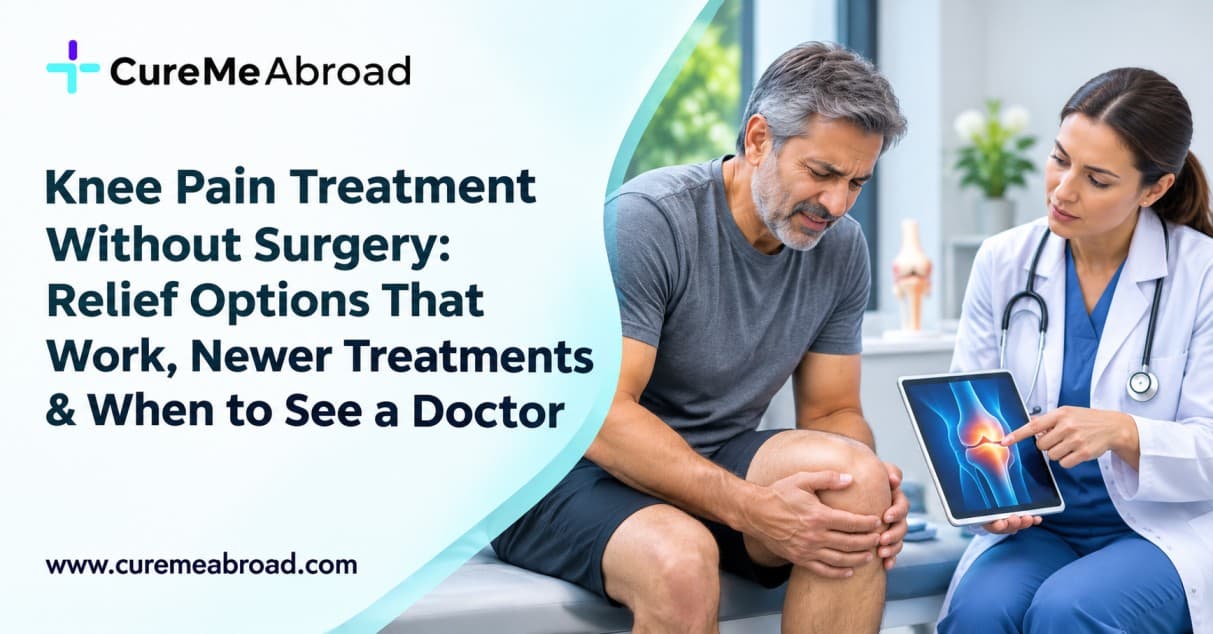
Knee Pain Treatment Without Surgery: Relief Options That Work, Newer Treatments & When to See a Doctor
Living with knee pain can be frustrating, especially when walking, climbing stairs or getting up from a chair becomes difficult. If you're looking for knee pain treatment without surgery, understanding your options can help you manage discomfort, improve movement and make informed decisions with an orthopedic specialist.
In this guide, we'll cover safe home remedies, strengthening exercises, physical therapy, weight management and medicines or injections for pain relief. We'll also explore newer treatments such as nerve ablation and artery embolization, complementary options like acupuncture and TENS, treatment safety, and the warning signs that mean you should see a doctor. You'll also learn how treatment differs for knee arthritis, runner's knee and bursitis.
Quick Answer: What Is the Best Treatment for Knee Pain Without Surgery?
The best Knee Pain Treatment Without Surgery depends on what is causing your pain. For knee arthritis, a meniscus problem or pain after an injury the treatment can be different, but gentle movement, strengthening exercises and controlling swelling are common starting points.
Along with physical therapy, weight management where needed and suitable pain relief can help you move more comfortably. And also you should avoid complete bed rest for long periods because gentle movement helps maintain knee mobility.
Best Nonsurgical Treatments by Knee Problem
| Knee problem | Treatment to start with | When to get medical advice |
|---|---|---|
| Knee arthritis | Strengthening, physical therapy and weight management | Pain affects walking, sleep or daily activities |
| Recent injury with swelling | Relative rest, ice and elevation | Severe swelling or difficulty bearing weight |
| Meniscus irritation | Activity changes and guided exercises | Knee locking or repeated giving way |
| Runner’s knee | Hip and thigh strengthening | Pain continues despite rehabilitation |
| Knee stiffness | Gentle movement and heat | Pain worsens or does not improve |
There is no single treatment that works for everyone. You should get the cause checked if the pain keeps returning or limits your normal activities.
Start Here: Safe Knee Pain Remedies You Can Try at Home
For mild knee pain, simple home care may help reduce swelling and make everyday movement easier. Firstly, reduce activities that make the pain worse, and then gradually return to gentle movement as your knee allows.
Rest, Ice, Heat & Elevation: What Each One Does
Rest means reducing painful activities, not keeping your knee completely still for days. Ice can help with new swelling, while heat is often more useful for stiffness without significant swelling.
| Remedy | When it may help | How to use it |
|---|---|---|
| Rest | Pain after activity or a recent injury | Reduce painful movements but keep gentle motion |
| Ice | New swelling or sharp pain | Wrap in a towel and apply for 15 to 20 minutes |
| Heat | Stiffness or muscle tightness | Apply a warm pack for 15 to 20 minutes |
| Elevation | Knee swelling | Lie down and support your leg on pillows |
For this you should avoid placing ice directly on your skin and do not use heat on a newly swollen or hot knee.
Over-the-Counter Pain Relievers & Topical Creams: What to Try First
Topical gels such as diclofenac may help some people with knee arthritis and localised pain. Along with these, menthol creams can provide temporary relief, but they do not repair damaged cartilage or heal every knee injury.
Oral medicines such as ibuprofen or naproxen may reduce pain and inflammation, while acetaminophen helps with pain but does not reduce inflammation. You should ask a pharmacist or clinician before using them if you have kidney or liver problems, stomach ulcers, high blood pressure, take blood thinners or use other medicines.
Compression, Footwear & Everyday Movement Changes
A knee sleeve may provide mild support and help with swelling, but it should not feel tight enough to cause numbness or tingling. Supportive shoes and small changes in daily movement can also reduce pressure on the joint.
- Firstly choose cushioned shoes with a stable heel and replace worn-out footwear.
- Then avoid deep squats, repeated kneeling and sudden twisting when your knee hurts.
- And also try short walks, gentle cycling or water exercise as tolerated instead of pushing through pain.
If your knee locks, gives way, becomes very swollen or you cannot put weight on it, seek medical assessment promptly. A hot, red knee with fever needs urgent care. Home remedies should suit your condition and medical history.
Exercises & Physical Therapy: The Foundation of Long-Term Knee Pain Relief
When your knee hurts, even getting up from a chair or climbing a few steps can feel harder than it should. You might be tempted to rest until the pain disappears, but avoiding movement for too long can make your muscles weaker. With the right Knee Pain Treatment Without Surgery, you can gradually build strength, improve movement and get back to daily activities. The exercises need to match your condition, though. What works for mild arthritis may not suit a recent injury.
Strengthening Exercises for Knee Pain
You don't have to start with difficult workouts. Gentle exercises that strengthen the muscles around your knee, hips and thighs can help you move with better control.
| Exercise | How it may help |
|---|---|
| Quad sets | Tighten the front thigh muscle while keeping your leg straight. Hold for 5 seconds, then relax. |
| Straight-leg raises | Strengthen your thigh without repeatedly bending the knee. Lift slowly and lower it with control. |
| Glute bridges | Build strength in your buttock muscles, which help control hip and knee alignment. |
| Clamshells | Help strengthen the hip muscles that support leg movement. |
| Mini squats | Build strength for standing and sitting, but only bend as far as feels comfortable. |
| Step-ups | Practice the movement used when climbing stairs. Start with a low step. |
Before starting, warm up for 5 to 10 minutes with gentle walking or stationary cycling, if comfortable. Sharp pain, new swelling, locking or a knee that gives way means you should stop and seek clinical advice.
Low-Impact Cardio & Mobility Work
You can still stay active without repeatedly putting heavy impact through your knees. Walking on flat ground, cycling with low resistance, swimming and water walking are options that may suit you, depending on your symptoms.
Gentle stretching can also help if stiffness makes walking or bending uncomfortable. Try a calf stretch, hamstring stretch or standing quadriceps stretch, but don't force your knee into a painful position. Along with mobility work, balance exercises such as tandem walking may help you feel steadier.
This kind of treatment for knee pain without surgery should progress gradually. If your pain is worse the next day, reduce the intensity rather than pushing through it.
What a Physical Therapist Adds
Following an online exercise video might seem like an easy start, but it can't tell you whether you're putting too much pressure on an injured knee. A physical therapist can adjust your exercises based on your condition and how your knee responds.
Here's how they can help:
- Check your movement: Assess your muscle strength, balance and range of motion to understand what needs attention.
- Choose suitable exercises: Build a plan around your diagnosis, daily activities and recovery goals.
- Guide your progress: Show you when to increase exercise intensity and when to ease back.
- Improve movement habits: Help you manage activities such as walking, climbing stairs and sitting down.
- Adjust your routine: Change the plan if pain or swelling increases during recovery.
For some people, supervised rehabilitation becomes the main non surgery knee treatment, while others may need additional care. If you're considering a new treatment for knee pain without surgery, ask how it works alongside physical therapy rather than assuming it can replace exercise.
The aim is to find a knee pain remedy without surgery that suits your condition and supports knee pain relief without surgery. If your knee keeps swelling, gives way or becomes more painful, your treatment plan may need reassessment.
Weight Management & Lifestyle Habits That Lower Knee Pain
Extra body weight puts more pressure on your knees during walking, climbing stairs and standing for long periods. Losing even a modest amount of weight may help reduce knee pain and make daily movement easier, especially if you have osteoarthritis.
Lifestyle Habits That Can Help
| Habit | How it helps | What you should do |
|---|---|---|
| Gradual weight loss | Reduces pressure on the knee joints | Choose steady eating habits instead of crash diets |
| Low-impact exercise | Improves movement without too much joint stress | Try cycling, swimming or walking as tolerated |
| Strengthening exercises | Supports the knee and improves stability | Follow a suitable home or physiotherapy plan |
| Activity pacing | Helps prevent painful flare-ups | Break longer activities into shorter sessions |
| Supportive footwear | May reduce impact during movement | Replace worn shoes with stable and cushioned footwear |
| Sleep and recovery | Helps manage pain and daily activity | Maintain a regular sleep schedule |
And also your diet can support weight management when you include vegetables, fruit, lean protein, fibre and healthy fats. For this you should focus on changes you can maintain over time rather than expecting a quick knee pain remedy without surgery.
Medical Nonsurgical Treatments: Prescription Medications & Injections for Pain
When exercise and lifestyle changes are not enough, medicines or injections may help control symptoms. However, these options can reduce pain and inflammation but they do not regrow cartilage or cure arthritis, so you should discuss the right treatment with a qualified clinician.
Prescription Anti-Inflammatory & Pain Medications
Medicines such as diclofenac gel or oral anti-inflammatory drugs like ibuprofen and naproxen may help reduce knee pain and swelling. Topical medicines are often considered first for knee osteoarthritis because less medicine enters the bloodstream.
Common options include:
- Diclofenac gel: A topical anti-inflammatory medicine that may help reduce knee pain and swelling.
- Ibuprofen and naproxen: Oral anti-inflammatory medicines that can reduce both pain and inflammation.
- Acetaminophen: May help ease pain but does not reduce inflammation.
Along with this, oral anti-inflammatory medicines can affect your stomach, kidneys and blood pressure and may interact with blood thinners. For this you should check with a clinician or pharmacist before using these medicines regularly.
Corticosteroid Injections: Fast Relief, Limited Use
Corticosteroid injections, also called cortisone shots, can reduce inflammation during a painful arthritis flare. Relief may begin within a few days and can last for several weeks, but the effect is temporary.
What you should know:
- Short-term relief: They may reduce pain and inflammation during a flare.
- Temporary effect: Relief can last for several weeks but does not permanently treat the underlying arthritis.
- Repeated injections: Frequent use needs careful consideration because it may affect joint tissues.
- Blood sugar: Corticosteroid injections can temporarily raise blood sugar in people with diabetes.
And then you should discuss how often an injection may be suitable for your condition with your clinician instead of repeating injections whenever the pain returns.
Hyaluronic Acid Injections: Who They May Help
Hyaluronic acid injections are sometimes called gel injections because they add a gel-like substance to the knee joint. They may provide temporary relief for some people with mild to moderate osteoarthritis, although research results are mixed and they are not recommended routinely for everyone.
Before choosing this treatment, consider:
- Severity of arthritis: They may be less helpful when arthritis is severe.
- Expected benefit: These injections may provide temporary symptom relief but do not repair damaged cartilage.
- Cost: You should check the treatment cost before deciding.
- Insurance: Coverage can vary, so check whether your insurance plan covers the injections.
And then you should ask your clinician whether this non surgery knee treatment fits your symptoms, arthritis severity and other available options.
Newer Nonsurgical Treatments for Knee Pain: Nerve Ablation & Artery Embolization
When knee pain continues despite physical therapy, medicines or injections, you may start looking for other options. knee pain treatment without surgery now includes procedures that target pain signals or inflammation around the joint. They may help selected patients, but neither procedure repairs damaged cartilage or cures arthritis.
Genicular Nerve Ablation: Heat-Based Pain Blocking
If your knee pain keeps coming back, even after trying other treatments, your doctor may discuss genicular nerve ablation. This procedure uses radiofrequency energy to heat small nerves around the knee and interrupt pain signals travelling to the brain.
Here's what you should know:
- Before treatment: Your doctor usually performs a diagnostic nerve block first. If it provides meaningful pain relief, you may be considered for ablation.
- What it may help: People with chronic knee osteoarthritis pain, especially when exercise, medicines and physical therapy haven't helped enough.
- How long relief lasts: Pain relief often lasts several months, sometimes around 6 to 18 months, but the nerves can grow back and pain may return.
- What it cannot do: It doesn't regrow cartilage, repair a meniscus tear or stop arthritis from progressing.
This form of treatment for knee pain without surgery may also help some people who aren't ready for knee replacement. However, results vary, and not everyone experiences meaningful relief.
Genicular Artery Embolization: Promising but Still Being Studied
You may hear about genicular artery embolization (GAE) if inflammation is contributing to your knee pain. During this image-guided procedure, an interventional radiologist identifies small abnormal blood vessels around the knee and injects tiny particles to reduce blood flow to inflamed tissue.
What the current evidence suggests:
- Possible benefit: Some studies report less pain and better knee function in people with mild to moderate osteoarthritis.
- A major limitation: Results from controlled trials have been mixed, so it's still unclear how much benefit comes directly from the procedure.
- Potential risks: Bruising, bleeding, swelling, infection or unintended damage to nearby tissue can occur.
- Long-term results: More research is needed to understand how well it works and how long the benefits last.
GAE is a new treatment for knee pain without surgery, but it shouldn't be presented as a proven way to rebuild cartilage or avoid knee replacement.
Who Qualifies for These Procedures?
Not everyone with knee pain is a suitable candidate. Your doctor will usually review your diagnosis, previous treatments and imaging before recommending either procedure.
You may be considered if you:
- Have persistent knee osteoarthritis pain that affects walking, sleep or daily activities.
- Have tried conservative care, including exercise, physical therapy and suitable medicines.
- Experience meaningful pain relief after a diagnostic nerve block, if you're considering nerve ablation.
- Have mild to moderate osteoarthritis and persistent inflammation-related pain, if GAE is being considered.
- Understand the possible risks and that neither procedure guarantees lasting relief.
An active infection, a bleeding problem or major knee instability may make treatment unsuitable. Severe joint damage may also require a different approach.
If you're exploring non surgery knee treatment, ask your specialist about the evidence, risks, expected duration of relief and insurance coverage. These procedures may offer knee pain relief without surgery for selected patients but a knee pain remedy without surgery should always match the actual cause of your pain.
Complementary Options: Do Acupuncture, TENS & Massage Help?
When knee pain keeps bothering you, you may want to try something beyond medicines and exercise. Acupuncture, TENS(Transcutaneous Electrical Nerve Stimulation) and massage may help with discomfort but they work differently and don't repair damaged cartilage or cure arthritis. They usually work best alongside physical therapy and other care.
Complementary Options at a Glance
| Therapy | How it may help | What it won't do |
|---|---|---|
| Acupuncture | May provide short-term pain relief and improve function for some people with knee osteoarthritis. | It won't regrow cartilage or reverse arthritis. |
| TENS | Uses mild electrical pulses through skin pads and may ease pain during or shortly after use. | It doesn't repair the underlying joint damage. |
| Massage | May ease muscle tension, stiffness and general discomfort. | It can't heal a torn meniscus or ligament. |
| Heat therapy | A warm pack or bath may relax muscles and ease chronic stiffness. | It isn't suitable for reducing acute swelling. |
| Ice therapy | May reduce pain and swelling after an injury or activity. | It doesn't treat an infection or replace medical care. |
| Yoga or tai chi | Gentle movement may improve balance, flexibility and confidence for some people. | It shouldn't replace strengthening exercises or necessary medical care. |
Knee Pain Red Flags: When to See a Doctor
Most knee pain can be assessed during a routine appointment. However, some symptoms need urgent attention, especially after an injury or when the knee suddenly becomes hot, swollen or very painful.
Can’t Bear Weight, Visible Deformity or Sudden Swelling After Injury
If you can't stand on your injured leg or your knee suddenly looks out of place, don't wait for the pain to settle on its own. These symptoms may indicate a fracture, dislocation or serious injury inside the joint.
| Warning sign | What it may indicate |
|---|---|
| Unable to bear weight | A fracture or significant ligament injury. |
| Visible deformity | Possible dislocation or broken bone. |
| Sudden major swelling | Bleeding inside the joint or a serious injury. |
| A popping sound with intense pain | Possible ligament or tendon damage. |
| Unable to straighten the knee | A blockage or injury that needs prompt assessment. |
Stop the activity, avoid forcing the knee to bend or straighten, and wrap ice in a towel to help with swelling while arranging urgent medical care. If the foot becomes cold, pale or numb, seek emergency help.
Hot, Red Knee With Fever: Possible Infection
A hot, red, swollen knee with fever can signal a joint infection. This needs urgent medical assessment because an infection can damage cartilage and bone quickly.
Seek urgent care if you notice:
- Fever or chills along with knee redness and swelling.
- Severe pain, particularly when moving the joint.
- Symptoms that are getting worse quickly.
- Recent knee surgery, an injection or a nearby skin wound.
A clinician may examine your knee, order blood tests or take a sample of joint fluid to check for infection. Don't massage, heat or exercise a hot, swollen knee until a clinician has assessed it.
Calf Pain, Swelling or Shortness of Breath: Possible Blood Clot
Pain or swelling in one calf can sometimes indicate deep vein thrombosis (DVT), a blood clot in a deep vein. If part of the clot travels to your lungs, it can cause a life-threatening pulmonary embolism.
| Symptom | What you should do |
|---|---|
| Swelling in one leg, calf tenderness or warmth | Seek prompt medical assessment for a possible DVT. |
| Redness or skin discoloration with unexplained calf pain | Contact a clinician promptly, even if you haven't injured your leg. |
| Sudden shortness of breath or chest pain | Call your local emergency number immediately. |
| Coughing up blood, faintness or a rapid heartbeat | Seek emergency care immediately. |
Don't massage a painful, swollen calf if you suspect a blood clot, and don't delay getting medical help. These symptoms need assessment rather than home treatment.
Treatment Safety: Medication and Injection Risks to Know Before You Start
Medicines and injections can help with knee pain but they do not repair damaged cartilage or cure arthritis. Firstly you should know what is causing your pain and what the treatment is actually expected to do before starting it.
Medication and Injection Safety at a Glance
| Treatment | May help | Main concern |
|---|---|---|
| Topical NSAID | Localized arthritis pain | Skin irritation and some systemic risks |
| Oral NSAID | Pain and inflammation | Stomach, kidney, blood pressure and heart risks |
| Acetaminophen | Mild to moderate pain | Liver problems with excessive use |
| Corticosteroid injection | Short-term arthritis flare | Infection, blood sugar rise and cartilage effects with repeated use |
| PRP | Selected patients | Cost, pain and uncertain benefit |
Then you should be especially careful with oral NSAIDs if you have kidney disease, stomach ulcers, heart problems or take blood thinners. And also corticosteroid injections may provide short-term relief but repeated injections should not be treated as a permanent solution.
Before any injection ask what is being injected, what condition it treats, how long the benefit may last and what happens if it does not work. For this you should discuss the risks and alternatives with a qualified clinician.
Matching Treatment to the Cause: Arthritis, Runner’s Knee & Bursitis
Knee pain can feel similar even when the actual cause is different. And at the same time the right knee pain treatment without surgery depends on whether you have arthritis, runner’s knee, bursitis or another condition.
Treatment Based on the Cause
| Cause | Common pattern | Non-surgery treatment |
|---|---|---|
| Knee arthritis | Stiffness, activity pain and swelling | Exercise, physical therapy, weight management and suitable medicines |
| Runner’s knee | Pain around or behind kneecap | Activity changes, hip and quadriceps strengthening |
| Bursitis | Swelling and tenderness near the kneecap | Avoid pressure, ice, compression and suitable medicines |
For a runner's knee you may need to reduce running or jumping temporarily and then gradually rebuild strength. Along with this you should review training volume and movement habits rather than only looking for a quick knee pain remedy without surgery.
With bursitis, avoiding kneeling and using ice or compression may help. Where the knee becomes hot, red or swollen with fever you should seek medical evaluation because infection needs to be ruled out.
Overall, the best treatment for knee pain without surgery starts with identifying the cause and then choosing treatment around it rather than treating every knee problem in the same way.
Final Thought
Living with knee pain can make even simple daily activities difficult, and finding the right knee pain treatment without surgery starts with understanding what's causing it. Home care, strengthening exercises, physical therapy, weight management and suitable medicines may help you move more comfortably. Some injections and newer procedures can also offer relief, but they don't guarantee cartilage repair or a permanent cure.
And also don't ignore warning signs such as sudden swelling, a hot knee with fever or calf pain with shortness of breath. These symptoms need urgent medical attention.
Every knee condition is different, so speak with a qualified orthopedic specialist before choosing a treatment.
Find the right hospital for your knee condition on the CureMeAbroad website and book your consultation today.
FAQs
1. What is the fastest way to relieve knee pain without surgery?
Ice may help reduce new swelling, while suitable pain relievers can ease discomfort. For knee pain treatment without surgery, the right option depends on what's causing your pain.
2. What is the newest treatment for knee pain without surgery?
Newer options include genicular nerve ablation, which blocks pain signals, and genicular artery embolization, which targets abnormal blood flow. Both may help selected patients, but neither repairs cartilage, and evidence for embolization remains limited.
3. Is walking good for knee pain?
Yes, gentle walking may help maintain movement and support knee function, especially with osteoarthritis. Start with short distances and increase gradually. If walking worsens your pain or causes swelling, reduce activity and seek medical advice.
4. Are supplements like glucosamine worth taking for knee pain?
Evidence for glucosamine is mixed, and it hasn't been proven to regrow knee cartilage or reverse arthritis. Before trying supplements as a knee pain remedy without surgery, discuss their possible benefits and risks with your clinician.
5. Can knee pain go away on its own?
Mild knee pain may improve with activity changes, gentle movement and time. However, persistent pain, repeated swelling, locking or giving way needs assessment to identify the cause and choose suitable treatment for knee pain without surgery.
6. How long should I try nonsurgical treatment before considering surgery?
A nonsurgical treatment trial of around 6 to 12 weeks may be reasonable for some knee conditions. However, severe injuries, a locked knee or inability to bear weight need earlier assessment rather than waiting.
Reference
Alleviate Pain Clinic. (2023). Knee pain treatment without surgery using regenerative medicine: Platelet rich plasma, stem cells, and prolotherapy.
https://alleviatepainclinic.com/blog/knee-pain-treatment-without-surgery-using-regenerative-medicine-platelet-rich-plasma-stem-cells-and-prolotherapy/Apollo Spectra. (2026). 5 best ways to treat knee pain.
https://www.apollospectra.com/blog/general-health/5-best-ways-to-treat-knee-painChandran Ortho. Nonoperative management of knee osteoarthritis: A review of the evidence.
https://www.chandranortho.com/blog/nonoperative-management-of-knee-osteoarthritis-a-review-of-the-evidenceHipKneeOrtho Singapore. (2024). Knee pain treatment without surgery.
https://www.hipkneeortho.com.sg/manage-knee-pain/Jain Pain Clinic. (2026). Knee pain treatment without surgery.
https://www.jainpainclinic.com/blog/knee-pain-non-surgical-optionsPain Treatment Specialists. (2025). Best knee pain treatment without surgery.
https://www.paintreatmentspecialists.com/blog/knee-pain-treatment-without-surgery/Pain Guru. Knee pain treatment without surgery.
https://www.painguru.in/blog/knee-pain-treatment-without-surgeryPenn Medicine. (2026). Nonsurgical treatments for knee pain.
https://www.pennmedicine.org/specialties/orthopaedics/knee-pain/nonsurgical-treatmentsR3BOOT. (2026). Knee pain without surgery: 5 treatments.
https://www.r3boot.in/blog/knee-pain-treatment-without-surgerySancheti Hospital. (2026). Knee pain treatment without surgery: Expert guide.
https://sanchetihospital.org/blog/non-surgical-solutions-for-chronic-knee-pain/Valley Dolor. (2026). Knee pain treatment without surgery: Options & when to seek care.
https://valleydolor.com/knee-pain-treatment-without-surgery/VIP Medical Group. (2024). The best knee pain treatment without surgery.
https://www.vipmedicalgroup.com/blog/knee-pain-treatment-without-surgery/Your Health Magazine. (2026). New non-surgical treatment for chronic knee pain.
https://yourhealthmagazine.net/article/pain-management-rehabilitation/new-non-surgical-treatment-for-chronic-knee-pain/