



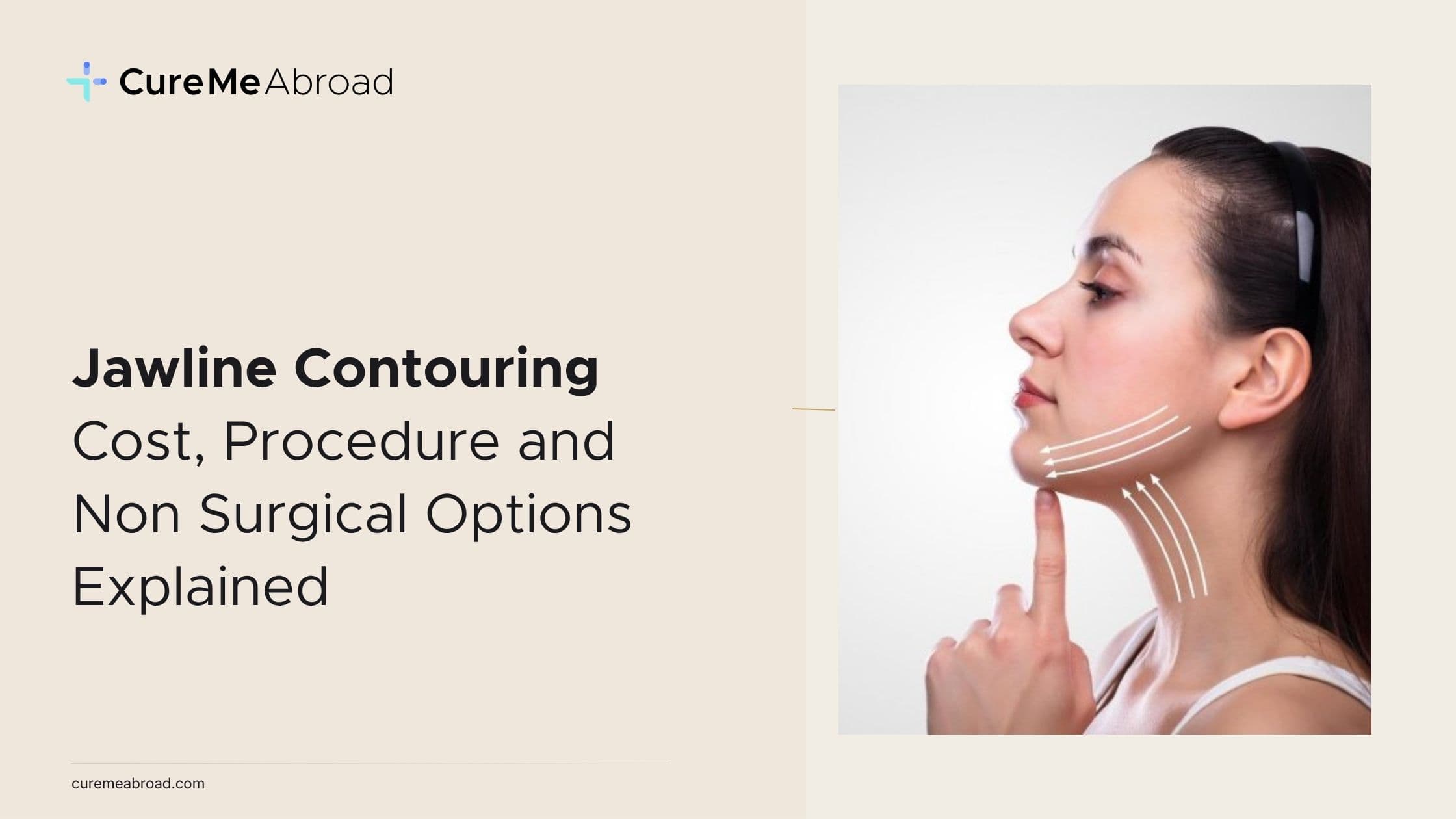
A well-defined jawline is considered an icon of beauty, youth and attractiveness irrespective of gender. It gives a sharper appearance to the face. In the process of ageing, the shape of the jawline is also changing. This justifies why the cosmetic industry is focused on rejuvenation of the lower third of the face, especially the jawline. Let's explore how to contour jawline, what the non-surgical jawline contouring options are, jawline contouring cost and whether it's right for you.
Non-Surgical Jawline Contouring
As the name indicates, the non-surgical jawline contouring procedure is a non-invasive treatment for reshaping the jawline. People looking for how to contour jawline without surgery, prefer this methofs. The technique is used to improve:
- Definition and flow of the Jawline
- Forward projection and structure
- Overall proportion and balance
- Neck–jawline angle definition
This is best suited for individuals who seek subtle enhancement cosmetic procedures for a natural look without any surgery.
Surgical vs Non - Surgical Jawline Contouring:
| Feature | Surgical Jawline contouring | Non-surgical Jawline Contouring |
|---|---|---|
| Procedure involved | Reshaping jaw bones, using implants, liposuction and lifting | Botox, filler, fat-dissolving injections, PDO threads |
| Suitable for | Asymmetry of the jaw, fat, saggy skin, and weak bone | Early sagging and subtle enhancement. |
| Anaesthesia | General anaesthesia | Numbing cream or local anaesthesia |
| Time taken | 2-5 hours | 30 minutes-1 hour |
| Recovery time | 2-4 weeks | Can resume normal activities on the same day |
| Durability | Long-lasting or permanent | Temporary |
| Appearance | More structural and dramatic change | Subtle refinement |
How Does Your Jawline Age?
Key contributing factors include:
- Sagging of facial fat
- Loss of elasticity and firmness of skin
- Gradual reduction of the jawbone
- Less prominent jawline angle.
Together, these factors can reduce the jawline. This automatically will give a saggy or uneven appearance to the jaw. Such a jawline is often described as soft or w-shaped. people learning how to contour jawline hhas to have a realistic unerstnading about these changes too.
How to Contour Jawline?
Dermal Fillers
This can be described as a foundation of the jawline enhancement procedure. They work by adding a structural support or enhancement, defining continuity to the jaw, and helping to hide the shadow or dip caused by early sagging. Hyaluronic Acid (HA) or Calcium Hydroxylapatite (CaHA) are commonly used as the filling compounds. They are precisely injected into the mandibular border, jaw angle, or chin. Hyaluronic acid can provide volume and smooth contour, while calcium Hydroxylapatite is used to lift and stimulate collagen production. This offers an immediate result and lasts for at least 1-2 years, depending on the procedure. This is a favourite option for most people searching for how to contour the jawline without major surgery.
Hybrid Filler
More advanced procedure where hyaluronic acid and calcium hydroxylapatite are used together to improve the result of the contouring procedure. This offers a precise and durable result. This is mostly used in a 1:1 ratio. Filling is done as a Cannula-based retrograde fanning, which ensures a smooth movement through the underlying layer of skin. This method is safer to use around blood vessels and causes less discolouration and swelling after the procedure. This hybrid method allows for a sharply defined yet natural-looking jawline, with smooth transitions between facial compartments, which is considered an essential goal in modern aesthetic practice.
Neuromodulators
Botulinum toxin or Botox is an unavoidable part of jawline contouring. This plays a supporting role in the contouring process by helping in smoothing and gentle lifting. This work by masseter reduction helps in relaxing the chewing muscles and thereby softening the broad or bulky jaw area. This helps in achieving a slimmer and more contoured look.
The result of the procedure will start to be visible by the 2nd week and will last for almost half a year. This can be useful for individuals with prominent jaw width and lower face heaviness.
Fat Dissolving Injections
Fat dissolving injections are used for reducing the submental fat deposition and thus reducing the double chin appearance. The reduction of fat under the chin can help in attaining an improved jawline-neck transition and profile enhancement. The result of the procedure will start appearing slowly over several weeks. Multiple sections are required for a proper result to appear. These treatments are commonly recommended to patients exploring how to contour jawline definition while reducing excess fat.
For patients with more significant structural concerns involving jaw alignment or facial balance, non-surgical treatments alone may not provide the desired transformation. In such cases, procedures like double jaw surgery may be considered to correct functional and aesthetic issues involving both the upper and lower jaw. This surgical approach can improve facial symmetry, bite alignment, breathing function, and overall jawline definition when combined with a personalized treatment plan.
PDO Threads
This is a lifting procedure where threads are inserted beneath the skin to reposition and support sagging tissue. The thread comes with a thin needle, which is inserted from the starting point to the marked boundary in the jaw. Tiny barbs in the thread will be helpful in adjusting the jaw. The cosmetologist can lift the skin upward by adjusting the thread or pulling it.
This can improve the collagen stimulation, give a lifted appearance and help in defining the jawline. This will be useful to people who have sagging and stretched skin on their cheeks. The procedure is effective in patients with mild skin laxity and sagging issues
Surgical Technique Overview
For understanding your jawline issues and to know if the non-surgical jawline contouring can resolve your issues, it's always preferred to consult a cosmetic expert. He/she can suggest the best nonsurgical procedure for the problem and explain the expected jawline contouring cost based on your treatment plan.
The procedure always starts with a local anaesthesia or by applying a topical numbing cream. Later, as per the final decision in the assessment, the procedure will be done. Once they map the area to be adjusted or filled, appropriate injections will be given, or thread placement will be done. The non-surgical procedures are taking less time compared to surgical jawline contouring. Mostly, the procedure will be finished in an hour or less.
After Treatment
One of the biggest advantages of non-surgical jawline contouring over surgical jawline contouring is that its window for healing. You can resume your daily activities immediately after the procedure, most probably the same day, depending on the decision of your doctor.
But there will be mild swelling, light discolouration, tenderness, and a slight asymmetry for a temporary period of time. These will improve over time. Always follow experts’ suggestions.
Jawline Contouring Cost
The jawline contouring cost for the non-surgical jawline contouring varies depending on the technique used, products used, quality of the materials, accreditation of the clinic, and expertise of the practitioner. On average, the total jawline contouring cost can come around $850- $3000, depending on the number of sessions attended, treatment chosen, etc.
It is important to understand that the procedure is not permanent, and you may have to redo it after a year or two to maintain the profile. In order to maintain the result, different procedures have different maintenance time gaps. Fillers have to be refilled every 9-18 months, Botox every 3-6 months, and threads once a year. Patients should also consider the fee for consultation, post-surgery follow-ups, and touch-up sessions. When researching jawline contouring cost.
Who is an Ideal Candidate?
This is suitable for candidates who have the signs of early ageing or structural changes, have more fat deposition, reduced definition of the jawline, and reduced definition along the mandibular border without significant excess skin. This can be a good solution for those who have an adequate loss of skin elasticity. In all these cases, a common pattern is that a subtle support can help develop a contoured jawline.
This approach also benefits individuals with minor chin retrusion or imbalanced lower facial proportions, where strategic augmentation can improve overall harmony. Importantly, candidates often prefer gradual, natural-looking enhancement rather than dramatic alteration.
Because the results are temporary and adjustable, non-surgical contouring is frequently chosen by those who wish to evaluate aesthetic changes before considering permanent surgical options. It is also ideal for patients seeking minimal recovery time, allowing a quick return to daily activities while achieving visible yet understated refinement.
Interesting Results from Recent Research
If the treatment was chosen after a proper anatomical examination of the patient, the result of the procedure can be significantly enhanced. Use of combination approaches is also found to be promising. Combination treatments of hyaluronic acid with calcium hydroxylapatite, which improve both contour and longevity. Although the surgical methods are permanent, they can offer more economically friendly, trusted and reproducible results with minimal risks and recovery time.
Why does Expertise Matter?
The jawline is an area rich with more sensitive neurons and blood vessels. Side effects of this procedure can be mild swelling and bruises, but in rare cases, it can also cause nodules, symmetry, or overcorrection and, rarely, vascular compromises. The practitioner must be well experienced with the anatomy, procedure selection and procedures. So always choose the best clinic and experienced practitioner to ensure the safety and balanced results. Especially if you are investing in a higher jawline contouring cost, this is very important.
Conclusion
The non-surgical jawline contouring focuses on corrections rather than a complete transformation. By subtly enhancing structural support and contour, it restores definition and improves overall facial balance. For individuals searching for how to contour jawline appearance safely and effectively, modern non-surgical techniques provide customizable options with minimal downtime. The changes are not exaggerated, yet they create a noticeable improvement in profile and symmetry. When performed with precision, these treatments deliver a refreshed, more sculpted appearance—allowing individuals to look naturally defined while maintaining their unique facial identity.
CureMeAbroad helps you to get a better clarity about the complete procedure and to find the right clinic abroad.
FAQs
What are the available non-surgical jawline contouring options?
- Botox to reduce the bulkiness of the jawline and to slim the face, thus refining the jawline
- Dermal fillers for proper structure and definition
- Fat-dissolving injections that reduce submental fat
- PDO threads to elevate the saggy skin and to provide support.
Are non-surgical jawline contouring procedures painful?
The procedure will be done after application of a numbing cream or after injection of a local anaesthetic agent. You may feel like a pinching or mild stinging sensation as the procedure is done, but it can be easily tolerated.
Will there be bleeding?
The procedure involves the use of fine needles or cannulas. You may observe tiny droplets of blood coming from the injection sites or slight discolouration. These are temporary and resolve quickly.
Can I do face massaging after the treatment?
It is suggested to avoid any kind of massaging tools for at least 2 weeks post-surgery. Immediately applying pressure on the treated area can lead to the displacement of fillers, positioning of the threads placed, and may affect the proper settling. Always take expert opinion before restarting.
When can I return to work after non-surgical jawline contouring/
Mostly the next day of the procedure. There will be minimal discomfort and marks from the procedure, but they will reduce over time. Take care to avoid strenuous activities for at least 2 days of treatment.
Reference
- Fakih-Gomez, N., Verano-Garcia, A., Porcar Plana, C. A., Munoz-Gonzalez, C., & Kadouch, J. (2025). Jawline sharp contouring with hybrid filler. Aesthetic Plastic Surgery, 49(1), 334-340. https://link.springer.com/article/10.1007/s00266-024-04226-4
- Ugarte, A., Blevins, L. W., Wills-Kofford, J. C., & Soares, D. J. (2022). Dermal filler re-contouring of the aged jawline: a useful non-surgical modality in facial rejuvenation. Journal of Aesthetic Nursing, 11(2), 70-78. https://www.magonlinelibrary.com/doi/abs/10.12968/joan.2022.11.2.70
- Bertossi, D., Robiony, M., Lazzarotto, A., Giampaoli, G., Nocini, R., & Nocini, P. F. (2021). Nonsurgical redefinition of the chin and jawline of younger adults with a hyaluronic acid filler: results evaluated with a grid system approach. Aesthetic Surgery Journal, 41(9), 1068-1076. https://academic.oup.com/asj/article-abstract/41/9/1068/5864153
- Chen, J., Abousy, M., Chow, A., Girard, A., Jenny, H., Choi, J. W., & Yang, R. (2022). Surgical versus nonsurgical lower face contouring: layperson perceptions of attractiveness and personality traits. Journal of Craniofacial Surgery, 33(2), 552-556. https://journals.lww.com/jcraniofacialsurgery/fulltext/2022/04000/Surgical_Versus_Nonsurgical_Lower_Face_Contouring_.44.aspx?context=FeaturedArticles&collectionId=2&casa_token=CaZ-P057PyMAAAAA:HuEJAG9gUdNSmBqQUhFFfk5eYgbwEIp2yywcsokrQG0Rh2RFgr2C5-An-UD470JY3h4nOXkxVqMSBq8RvVLhlOK1qFI-gbdYlVQj