




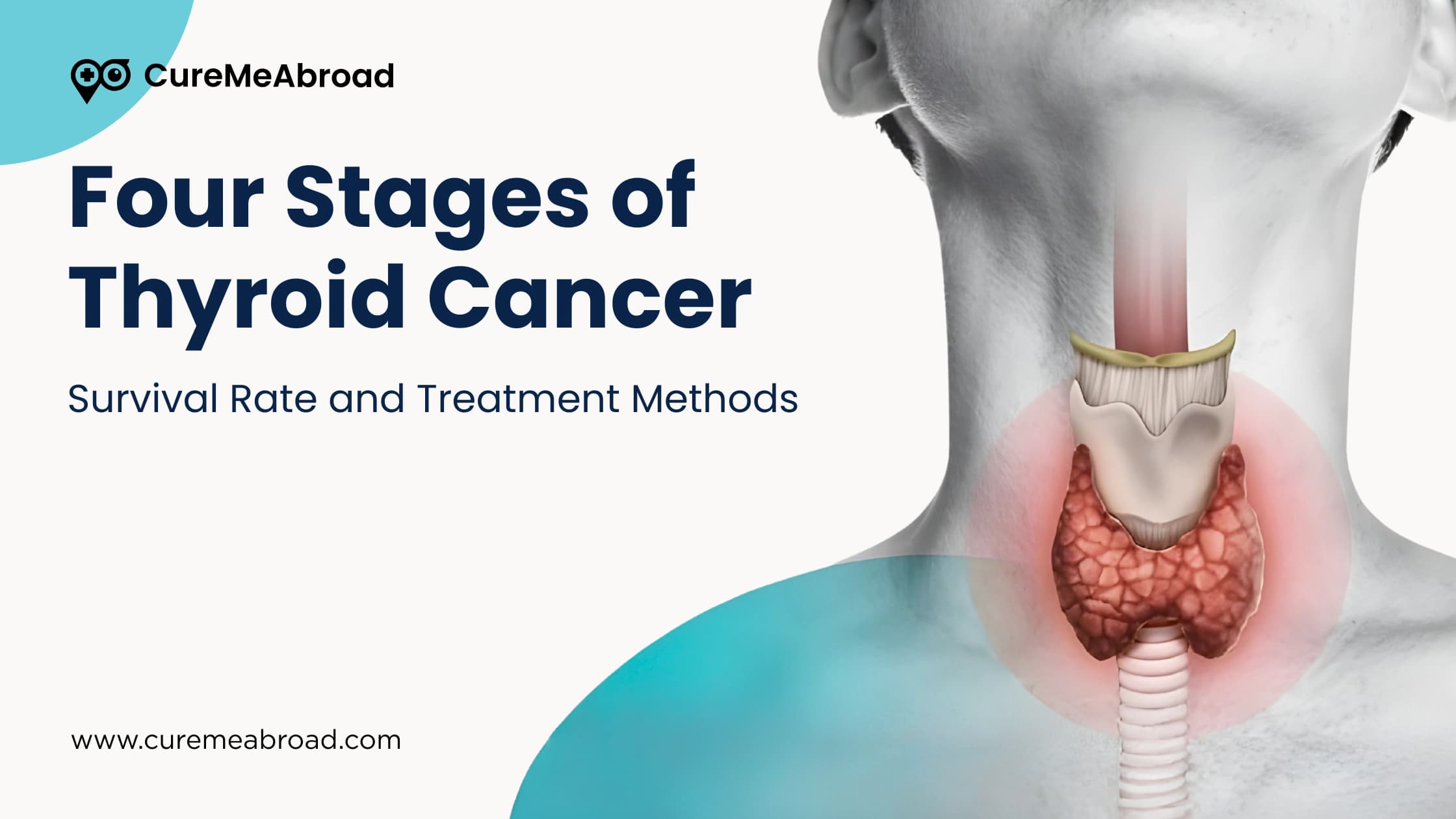
Thyroid carcinomas represent some of the most treatable forms of cancer, with very high survival rates, especially in cases of early detection. Modern diagnostic tools, trained oncological teams, and continuous development of surgical techniques have contributed a lot to the improved results. However, understanding the stages of thyroid cancer is still important as the stage of the disease will indicate the treatment options, the estimated survival time, and the requirement for follow-up visits.
We elaborate the four stages of thyroid cancer with their features, staging methods, survival rates, and treatment options in this comprehensive guide. The explanations are very clear and seem to be designed for patients, thus, they will not confuse you and they will actually help you to become more confident both in a situation when it is your own diagnosis and when you are assisting a family member to move on.
Clinical Classification of Thyroid Cancer
Before staging, it is a must to know how doctors classify thyroid cancer. Clinical classification helps to comprehend cancer behavior patterns, its aggressiveness, and the chances of spread.
- Papillary: Papillary accounts for one out of ten thyroid cancers. This kind of cancer grows extremely slow. Although papillary cancer of the thyroid frequently metastasizes to lymph nodes in the neck, the disease is very sensitive to therapy. Papillary thyroid cancer is curable in the majority of cases and very few mortality cases have been reported so far.
- Follicular: The follicular variant of thyroid cancer makes around 15% of the total thyroid cancer cases. The type of cancer can deeply affect your bones and organs like lungs. Once it is spread, the process is called metastasis, and the cancer is harder to treat.
- Oncocytic: This is one of the types of cancer of the thyroid, which accounts for 3-5% of all thyroid cancers. In addition, it is more likely to be metastatic than the papillary or follicular ones. Moreover, it has a worse prognosis.
- Medullary: It is the rarest type of thyroid cancer, and medullary cancer accounts for less than 5% of the total thyroid cancers. The origin of the disease in the family can be identified by one in four patients with medullary thyroid cancer. A defective gene may be the culprit.
TNM Classification
TNM classification is an anatomically based system that records the primary and regional nodal extent of the tumour, and the absence or presence of metastases. Each individual aspect of TNM is termed as a category:
- T category describes the site and size of the primary tumour.
- N category describes the regional lymph node involvement.
- M category describes the presence or otherwise of distant metastatic spread.
The "T" category describes the original tumor:
- T1 - Tumor having size of 2 cm, confined to thyroid
- T2 - Tumor with size 2-4 cm, still within thyroid
- T3 - Tumour of size > 4 cm or with minimal extension outside thyroid
- T4 - Tumour extending into surrounding tissues (muscle, trachea, esophagus)
The larger and more invasive the tumour, the more advanced the stage.
The “N” describes the extent of lymph node involvement:
- N0 - No lymph node spread
- N1a - Spread to lymph nodes surrounding the thyroid gland.
- N1b - Spread to distant neck nodes (e.g., upper neck or chest area)
Lymph node involvement is common, especially in papillary thyroid cancer, but the presence of lymph node metastases does not dramatically worsen survival.
The “M” category identifies spread to distant sites:
- M0 - No metastasis
- M1 - The cancer has spread (most often to lungs or bones)
Metastatic thyroid cancer constitutes stage 4.
Common Symptoms That May Lead to Diagnosis
For a long time, thyroid cancer may not show any symptoms. In fact, quite a few patients find out only when they have a regular check-up. Watch for:
- A lump in the neck that doesn't hurt
- Unchanging hoarseness
- Inability to swallow properly
- Breathing difficulty
- A cough that lasts a long time but there is no infection
- Swelling in the neck which can be seen
Though these symptoms may not necessarily mean cancer, having them checked out early significantly elevates the likelihood of the detection being at stage 1 or 2 which, in turn, makes the survival rate very high.
Thyroid Cancer Survival Rate
Papillary Thyroid Cancer Survival Rate
| Stage | 5-Year Relative Survival Rate |
|---|---|
| Localised | >99% |
| Regional | 99% |
| Distant | 71% |
Follicular Thyroid Cancer Survival Rate
| Stage | 5-Year Relative Survival Rate |
|---|---|
| Localised | >99% |
| Regional | 97% |
| Distant | 62% |
Medullary Thyroid Cancer Survival Rate
| Stage | 5-Year Relative Survival Rate |
|---|---|
| Localised | >99% |
| Regional | 94% |
| Distant | 50% |
Anaplastic Thyroid Cancer Survival Rate
| Stage | 5-Year Relative Survival Rate |
|---|---|
| Localised | 45% |
| Regional | 14% |
| Distant | 5% |
Understanding the Numbers
These figures are solely concerned with the stages of cancer when the diagnosis was made. They are not valid in case the cancer spreads, grows, or recurs after treatment. These statistics don't capture everything. Survival rates are broken down by how far the cancer has spread, but your age and overall health, the type of thyroid cancer you have, how the cancer responds to treatment, and other factors may also influence your prognosis.
The people diagnosed with thyroid cancer today may have a better prognosis than these statistics indicate. As time has gone by, treatments have been made better. These numbers reflect only those individuals who received their diagnosis and treatment at least five years back.
Factors That Determine Thyroid Cancer Survival Rate
Survival rates might be different depending on the factors mentioned below:
- Patient Age: Younger patients (below 55) normally have a very good outcome even if there is lymph node involvement.
- Type of Thyroid Cancer: Papillary and follicular cancers are associated with long survival, whereas anaplastic has short survival.
- Tumor Size and Spread: The survival of those with small tumors is high. The spread of cancer to lungs or bones will decrease the overall survival.
- Genetic Mutations: Certain mutations (such as BRAF) may suggest a higher risk of cancer coming back.
- Response to Initial Treatment: Patients who obtain good results from radioactive iodine therapy and have undetectable thyroglobulin levels are the ones who will likely have the best outcomes.
- Quality of Surgical Treatment: Surgeons with more experience are known to have less complications and better clearance of the cancer.
Treatment of Thyroid Cancer at Different Stages
Different stages of thyroid cancer treatment will imply different treatment methods for the cancer, changes depending on the stage, subtype of the cancer, and the factors of the patient like age, other diseases, and metastasis.
Treatment at Early Stages (1 - 2)
Treatment of early-stage thyroid cancer is possible in stages 1 - 2.
- Thyroidectomy or Lobectomy: Often, Stage 1 cancers require the removal of half the thyroid, called a lobectomy. Larger tumors and those with other risk features may require total thyroidectomy.
- Radioactive Iodine (RAI) Therapy: Used following surgery to kill any remaining cancer cells. Normally indicated for tumors over 4 cm or if cancer was in lymph nodes.
- Thyroid Hormone Suppression Therapy: Levothyroxine is administered as hormone replacement and for TSH suppression to potentially prevent feeding the cancer.
- Active Surveillance: Less than 1 cm in diameter is when cancers are considered microcarcinomas, and some patients with these can forgo immediate surgery for close monitoring.
Outcome: The majority of early-stage patients are able to return to normal life with few complications in the long term.
Treatment at Advanced Stages (3 - 4)
Advanced stages may require the combination of treatments.
- Total Thyroidectomy: Indicated for large tumors or those extending into adjacent structures.
- Lymph Node Dissection: Surgical removal of affected lymph nodes to control the spread and prevent recurrence.
- Radioactive Iodine Therapy: Used more aggressively in Stage 3 disease, provided that the cancer type is iodine-avid.
- External Beam Radiation Therapy: For cancers that do not take up iodine, or when surgery cannot remove the whole tumour.
- Targeted Therapy or Chemotherapy: For metastatic cancers or aggressive subtypes such as medullary and anaplastic TKI drugs include sorafenib and lenvatinib.
- Tracheal or Esophageal Reconstruction: If cancer invades the windpipe or food pipe.
Outcome: Stage 3 cancers are operable with a fair to good chance of long-term survival. Stage 4 cancers require specialized care and continuous follow-up, but modern therapies offer increasing hope.
Follow-up for Thyroid Cancer
After the treatment of thyroid cancer, you are scheduled follow-up appointments regularly. In these appointments, the doctor will inquire about your general well-being and examine you to confirm that there are no signs of cancer.
Your doctor makes decisions regarding the follow-up period, the dosage of your medicine, and the absence of cancer on the basis of your blood test and scan results to:
- Determine the follow-up period
- Determine the dosage of the medication
- Confirm that there is no cancer.
At first, your appointments may be every few months and later on, they may be every six months or every year.
Additional Helpful Information
Risk Factors of Thyroid Cancer
- Family history of thyroid cancer
- Radiation exposure in childhood
- Iodine deficiency
- Certain genetic mutations
What To Do If Thyroid Cancer Recurs?
If thyroid cancer returns, the most vital thing is not to lose control; recurrence is more common than what people generally think, particularly in the case of papillary thyroid cancer, and the treatment options are very advanced.
The very first thing that you should do is to make an appointment with your endocrinologist or oncologist for a follow-up examination. They will check your blood work (especially thyroglobulin or calcitonin levels) and advise imaging like ultrasound, CT, or PET scans. After the doctor has located the area, they may advise revision surgery, further radioactive iodine therapy, external beam radiation, targeted therapy (TKIs), or immunotherapy.
Conclusion
Even though thyroid cancer is among the rapidly increasing cancers in the world, it is still one of the least lethal ones. Familiarizing oneself with the four stages of thyroid cancer, the survival rate at each stage, and the possible treatment options gives the patients a sense of control over their situation and lessens their fear.
Frequently Asked Questions
Can thyroid cancer be cured?
Yes. Thyroid cancers in the majority of cases, mainly papillary and follicular, are very curable if intervention is done at an early stage.
What kind of thyroid cancer is the most aggressive?
It is anaplastic thyroid cancer which is the most aggressive and the least common type.
How quickly does thyroid cancer metastasize?
The majority of thyroid cancers are of a very slow nature. There are some aggressive kinds, however, that may become metastatic in a short time.
Does thyroid cancer shorten lifespan?
In the very beginning stages, thyroid cancer barely has any negative impact on life expectancy. A lot of stage 3 patients still live long and healthy lives.
References
“Thyroid Cancer Survival Rates.” American Cancer Society{: rel="nofollow"}
“Thyroid Cancer.” Cleveland Clinic{: rel="nofollow"}
“TNM Classification of Malignant Tumours | UICC.” UICC{: rel="nofollow"}
Luis, Pacheco-Ojeda, et al. “Differentiated Thyroid Carcinoma Long‐Term Prognostic Factors.” International Journal of Surgical Oncology, Jan. 2024{: rel="nofollow"}