

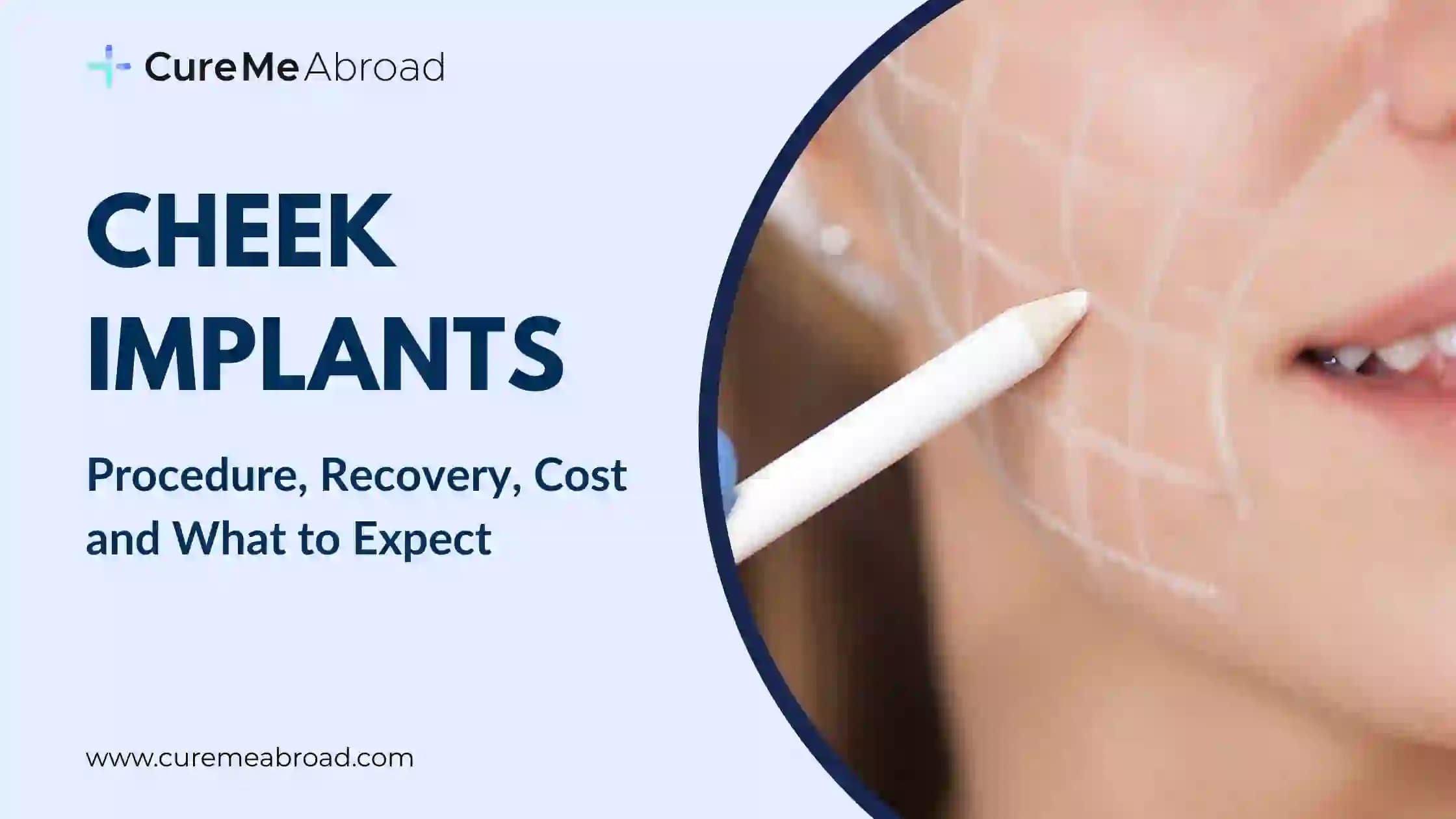
When you look at your face in the mirror your face looks flat or less lively as years go by? Most in their age of 30s and 40s feel the same. Cheeks lose plumpness from age or genes. This drags down your whole look.
Cheek implants are special inserts put right over your cheekbones to make cheeks fuller and higher. People choose them for a more defined face and fresh look that stays for years. This is not like fillers that fade fast.
In the US, average cheek implants cost around $10,000-$12,000. This covers the doctor's fee ($3,800 to $8,800), anesthesia, room fees, and implants. But it changes by city and doctor skill.
This Blog will walk you through surgery steps, healing time, costs by state, and what to expect in Cheek Implants.
Cheek Implants Procedure: A Step-by-Step Guide
The cheek implants procedure is an outpatient surgery. It usually takes between 30 to 90 minutes. Board-certified plastic surgeons perform it in facilities. The process has standardized steps. These steps ensure precise implant placement and natural-looking results.
Step 1: Giving Anesthesia
Before the surgeon starts you will receive anesthesia. This is for your comfort. Commonly it is general anesthesia. This keeps you asleep throughout the procedure. Some surgeons use twilight sedation. This is sedation or local anesthesia with sedation. The choice depends on the case complexity and your preferences. A certified anesthesiologist monitors your signs. This is practice in surgical centers.
Step 2: Making the Incision
The surgeon makes an incision. It is usually 1 to 2 inches long. Most often the cut is made inside your mouth. It is along the upper gumline. This is called the intraoral approach. It leaves no scars on your face. Some surgeons use entry points. These are under the eyelid or within the natural cheek crease. The choice is based on implant placement and access needs. Many US surgeons favor the intraoral method. It stays hidden.
Step 3: Creating the Pocket
The surgeon uses instruments like a periosteal elevator. They gently lift the tissue and periosteum. This is the covering over the bone. A pocket is formed directly over your cheekbone. This pocket is custom-sized. It matches the cheek dimensions. These were selected during your consultation with the help of 3D imaging. The fit needs to be snug to hold the cheek implant securely without putting pressure on surrounding structures.
Step 4: Placing and Securing the Cheek Implant
The sterilized cheek implant is carefully positioned into the pocket. It is typically made from medical-grade silicone. It can also be polyethylene or ePTFE. The surgeon confirms placement and symmetry. Then the cheek implant is secured to the bone. Tiny titanium screws are used. This fixation is a technique to prevent the cheek implant from shifting over time. It ensures long-term stability.
Step 5: Closing the Incisions
Incisions are closed with sutures. Absorbable ones are used inside the mouth. Removable stitches are used for external cuts. These come out in 5 to 7 days. Surgeons often apply adhesives or tapes. These promote healing. The area is rinsed with antibiotics. This reduces infection risk. Drains are rarely needed.
Step 6: Recovery and Discharge
After the procedure you will be moved to a recovery area. Medical staff will monitor you for 1 to 2 hours. Then you will be discharged. Same-day release is the norm for outpatient settings. You will receive instructions on managing pain. These include medications and applying ice packs. You will be advised to keep your head elevated. You will follow a liquid diet if your incision was inside the mouth. You cannot drive for 24 hours post-anesthesia. So arranging a ride home is required.
Recovery Timeline for Cheek Implants After Surgery
When you get cheek implants it takes some time to recover. Most people can go back to their life in about 1 to 2 weeks. At first your cheeks will be swollen and bruised. This will get better over time. You will start to see the result of your cheek implants in about 4 to 6 weeks.
Days 1 to 3: The Few Days
These are the toughest days where your cheeks will be very swollen and bruised. It will hurt a lot, like a bad bruise. You can take pain medicine like Tylenol to feel better. Put an ice pack on your cheeks for 20 minutes on and off. Try to keep your head up when you sleep. This helps reduce swelling. If the doctor made a cut inside your mouth, only eat soft or liquid food and rinse your mouth with saltwater after meals. Do not drive or do anything that stains during this time.
Days 4 to 7: Starting to Feel Better
The swelling will start to go down. The bruise will turn yellow and fade. Many people can go back to work. Only if it is not too physical. Do not wear makeup or touch your face too much. You can start using compresses instead of ice packs if your doctor says okay. stitches in your mouth they might fall out on their own. Your face might feel a little stiff when you smile. That is normal. You can take walks but do not go to the gym or stay in the sun too long.
Weeks 2 to 4: Getting Back to Normal
Most of the swelling should be gone by now and you can cover up any remaining puffiness with makeup. Most people return to work and social activities. If you had stitches outside your mouth, the doctor will remove it. Keep your mouth clean if the doctor made a cut inside. You can start exercising but do not do anything too rough. Your scars will start to fade and any numbness in your face will start to go
Weeks 4 to 8: Final Shape Emerges
Almost all the swelling is gone at this point. Your cheeks will start to look natural and enhanced. When your doctor says it is okay, you can go back to workouts and play sports. The tissue around your cheek implants settles in. Your results feel stable.
Long-Term: 3 to 6 Months
Your cheek implants will fully settle into your face. Most doctors want to see you for a year to check on your progress. The results of your cheek implants are permanent unless you decide to change or remove them.
Recovery Tips
- Keep your head up much as possible in the first week
- Use ice packs at first. Then switch to warm compresses
- Stick to soft or liquid food if you have a cut in your mouth. Rinse after meals.
- Avoid makeup, sun and pressure on your face until your doctor says it is okay
- Listen to your body and rest when you need to and do not rush back into activity before you are ready
What Is the Cost of Cheek Implants in the US?
The cost of cheek implants in the United States is something people want to know. Cheek implants usually cost between $7,000 and $16,000 for the thing. The surgeon's fee for cheek implants is around $3,800 to $8,800. The total cost of cheek implants depends on a few things: where you live, the type of cheek implants you want and other costs like anesthesia and facility fees, for the cheek implant procedure. You have to pay for cheek implants yourself because cosmetic cheek augmentation is not covered by insurance.
Breaking Down the Costs
- The surgeon's fee runs about $8,795 nationally based on 2025 data
- If you're only getting malar implants, expect around $4,453 for the surgeon's work
- Submalar implants cost roughly $4,710
- Anesthesia will cost $500 to $1,500
- The surgical facility charges is $1,500 to $3,000
- The implants will cost around between $1,000 and $2,000 depending on the material and customization
How Location Affects Pricing
| State | Average Total Cost |
|---|---|
| California | $11,222 |
| New York | $9,742 |
| Florida | $8,755 |
| Texas | $8,107 |
| Alabama | $7,384 |
Where you get the procedure makes a big difference. Coastal cities and major metropolitan areas charge significantly more than smaller markets or Midwest locations. The reason is understandable, urban centers have higher rent, higher demand, and surgeons who can command premium fees. Prices have climbed about 5 percent since 2023, driven by increased demand and general inflation affecting medical supplies and operating costs. Some sources report median costs reaching $11,857 in certain markets.
What to Expect in Cheek Implants
Getting cheek implants has three main parts. Each has its timeline. Know this to get ready for the changes.
Before Surgery:
Talk with the surgeon about face bones, skin, goals. They use photos or 3D to pick implant size. Check health, meds, tests. Stop smoking, blood thinners 2-4 weeks prior. Plan 1-2 weeks off. Get ride home.
During Surgery:
No food hours before. Get sleep or numb meds. Takes 30-90 min. Cut inside mouth, place implant on cheekbone, screw in, stitch up. Rest 1-2 hours, go home.
After Surgery:
Days 1-2 swell most. Ice, head up, soft food. Week 1 down 50%. Desk work ok. Week 4 sees 80% results. Week 6 normal look. Numbness fades months. Permanent. Check at 1 year.
So far we have gone through about cheek implants, how the procedure works, recovery time, and costs from $7,000 to $16,000. Surgery takes 30 to 90 minutes. You need one to two weeks to get back to most daily stuff. choose a board-certified plastic surgeon. This keeps you safe and gives natural results.
Visit CureMeAbroad. Find top hospitals and skilled surgeons for cheek implants. Book a consultation today. Talk about your goals. They help you get the look you want.
FAQ's
What is the average cheek implants cost in the US?
Total costs run $7,000 to $16,000. This covers doctor fees, anesthesia, room charges, and implants. Prices change by place. Coastal cities cost more than Midwest spots.
How long is recovery from cheek implants?
Most folks go back to desk work in 1 to 2 weeks. Swelling hits hard the first 3 days. Full look shows up around 4 to 6 weeks.
Can cheek implants look natural?
Yes. Skilled doctors use the right size and place them just so. They check 3D plans to fit your face. This gives a soft boost that looks real.
Who is a good candidate for cheek implants?
Healthy grown-ups with flat cheeks or uneven faces. Or lost fullness from age. Non-smokers with real goals do best. They want changes that last.
What are the risks of cheek implants?
Swelling, bruises, numb feeling for a bit. Rare stuff like infection or shift happens. Good surgeons cut risks with the right steps and screws.
Cheek implants vs. fillers: which is better?
Implants last forever with just one surgery. Fillers need repeats every 6 to 18 months. Pick implants for changes that stay. Fillers work for quick, short-term fullness.
Reference:
American Society of Plastic Surgeons. Cheek Augmentation Procedure Steps.
https://www.plasticsurgery.org/cosmetic-procedures/cheek-augmentation/procedure
Phoenix Liposuction. (2024). Cheek Implants: Procedure, What to Expect.
https://phoenixliposuction.com/blog/cheek-implants-procedure-what-to-expect/
Cosmetic Surgery Journals. Cheek Implant Surgery Recovery Tips.
https://cossurgeryjournals.com/cheek-implant/cheek-implant-surgery-recovery-tips.php
RealSelf. (2023). How Much Do Cheek Implants Cost Now?.
https://www.realself.com/surgical/cheek-implants/cost
American Society of Plastic Surgeons. Facial Implants Cost.
https://www.plasticsurgery.org/cosmetic-procedures/facial-implants/cost
CareCredit. (2025). Cheek Implant Cost and Procedure Guide.
https://www.carecredit.com/well-u/health-wellness/cheek-implant-cost/