




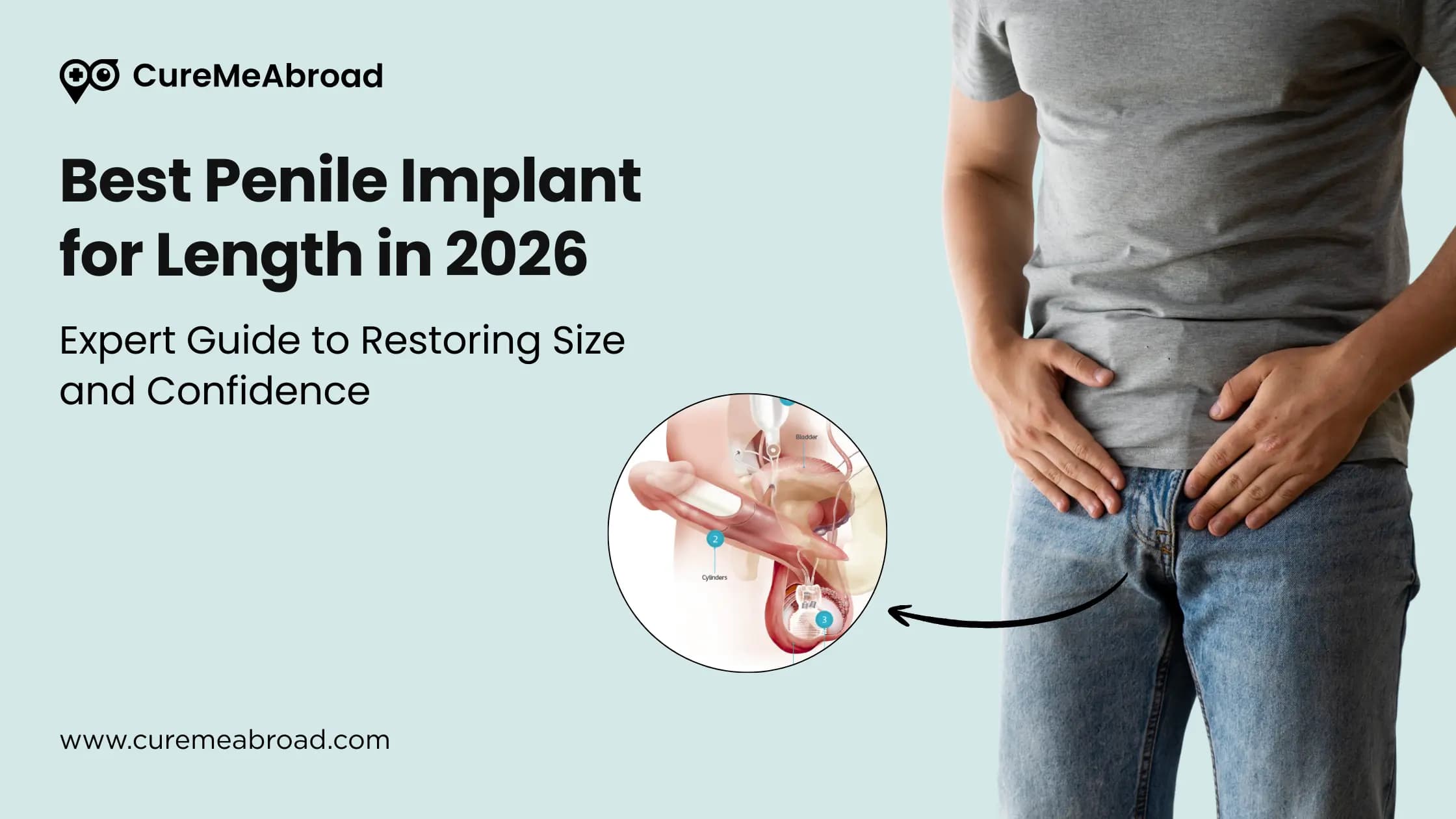
The best penile implant that maximizes length is not just about the size but also includes aspects such as confidence, function, and quality of life. Penile implants, i.e., penile prostheses, are the devices that can be the last resort to male erectile dysfunction treatment and thus offer a permanent solution to these patients.
Present-day advanced implants do not merely provide the means to the erection of a penis but are conceived to revive or maintain the original penile size, facilitate spontaneity, and be indistinguishable to both partners in terms of the naturalness of the sensation. We will delve into how different kinds of implants operate and which ones are the best penile implant choices for length in this detailed guide, along with the factors that lead to the results.
What Kind of Penile Implant Is Most Suitable For You?
Penile implants are the devices put in the penis surgically, which help men with ED to get and keep an erection for the performance of sexual intercourse. Such a procedure is generally the last resort after failure of medications, vacuum erection devices, or injections.
Penile implants can be split into two main categories:
Inflatable Penile Implants: air or fluid-filled systems that are capable of producing a more lifelike erection.
Malleable (Semi-Rigid) Penile Implants: Metal rods that give the penis the ability to maintain its firmness but at the same time be a bit flexible.
There is a smaller cohort of patients that opt for the implantation of a malleable or semi-rigid penile implant (AMS Tactra or Coloplast Genesis). However, this may be the best option for some patients who prefer a more straightforward device or have a history of complex abdominal surgery or kidney transplantation. The implant may be bent into the desired position for sexual function or concealment. Although it may not inflate and deflate, it has been designed to be soft to the touch and strong in function. Due to its simpler design, surgery and recovery are faster after malleable penile implant placement compared to the inflatable penile implant.
Most patients prefer to receive a 3-piece inflatable penile implant (AMS 700 or Coloplast Titan) since it is most naturally appearing and has the ability to become the most flaccid and most rigid. It is composed of a pump that is placed in the scrotum and a fluid reservoir hidden in your lower abdomen. There is sufficient space in the scrotum to accommodate the pump and the testicles do not need to be removed. The pump is hidden in the scrotal skin and is pressed to fill the cylinders with fluid. This creates a confident erection that can be achieved whenever, wherever, and for as long as one desires. After sexual activity, the release button on the pump can be pressed routing the fluid back to the reservoir and returning penis to a non-erect position. The inflatable implant requires a slightly longer surgery and recovery and higher risk for complications, but does result in higher rates of patient and partner satisfaction.
What to Look for While Choosing the Best Type of a Penile Implant for Yourself?
You need to take into account many factors before deciding to get a penile implant. Some among them are:
- Your penile size and concerns about length loss
- Your overall health status
- Your age and the age of your partner
- The total cost of the procedure, including consultation and maintenance.
- Previous abdominal and reproductive surgeries
- Your body type and whether or not you have a noticeable suprapubic fat pad Whether the penis is circumcised or not
Models of Best Penile Implant for Length
Semi-Rigid Penile Implants
Semi-rigid or malleable penile implants are mostly made of two penile rods implanted in the electrode chambers of the penis. Such implants are usually categorized by the following brand names:
AMS Tactra
They come in 14-23 cm, 16-25 cm, and 18-27 cm variations with different diameters. AMS offers these semi-rigid or malleable implants with different penile implant size options to accommodate different anatomical variations in men. In the past, people have called them “Boston Scientifics Tactras”.AMS Spеctra
These implants provide additional size options including 12, 16 and 20 cm in length with different diameters. They also come with “real tip” extenders that can also help to increase sizes.
Inflatable Penile Implants
Inflatable penile implants are optimized for inflation and deflation for the sole purposes of simulating a more natural erection. You can find two major types of inflatable implants in the market, which are two-piece and three-piece systems. These types also include:
AMS Ambicor
The Ambicor 2-Piece is manufactured as a two-component system for comfort and ease of use. Sizes are available in 14 cm, 16 cm, 18 cm, 20 cm, and even 22 cm lengths.AMS 700 LGX
This is a 3-piece system that is very durable and can provide a firmer edge, more length, and robust expansion. This penile implant is available in 12 cm, 15cm, 18 cm, and even 21 cm lengths.AMS 700 CX
AMS 700 CX offers multiple penile implant-size options, too, just like AMS 700 LGX. The implant provides more rigidity and girth expansion to achieve a firm erection. It is available in 12 cm, 15cm, 18 cm, 21 cm, and even 24 cm sizes.AMS 700 CXR
The inflatable penile prosthesis is fabricated as an alternative for those with small implant needs and those with fibroids, deep scarring, or narrower organs. You can find these in 10 cm, 12 cm, 14 cm, and 16 cm, and 18 cm sizes.
Choosing the Right Surgeon and Facility
A skilled urologic prosthetic surgeon is the one who can make a three-piece penile implant the best for length.
Consider the following:
- A board-certified urologist with a subspecialty in prosthetic urology.
- High surgical volume (>50 implant surgeries per year).
- A hospital with low infection rates and availability of the latest implant models.
It is very important that you talk with your surgeon before the operation about your goals (function, appearance, size) and also you can ask to see the results of the patients who had similar procedures.
Cost of Penile Implant
The cost of a penile implant isn’t cheap in most countries. However, in countries like Turkey and Thailand, the cost is often cheaper than other places, costing between $8,000 - $12,000 USD.
In the United States, the surgery can cost up to 20000 USD, which is significantly high for many patients. The same thing can be said about the cost in Western and Northern Europe.
How Long Does a Penile Implant Last?
Penile implants typically last 15 to 20 years. Keep in mind, though, that a penile implant is a mechanical device, and it can break.
With time, they can be subjected to wear and mechanical failure, like all the other medical devices.
The life expectancy of a penile implant has numerous variables. Patients should inquire about how long the implant may last at the time of surgery from their surgeon.
A surgeon might recommend surgery to replace the implant with a newer model if they placed it three to seven years previously. However, after ten years, the mechanical survival percent of an inflated penile implant is 78.2-85%
The long-term survival of many types of these implants has not been thoroughly studied. However, some types have an 80% survival rate after nine months after surgery.
However, this is rare, and can be corrected with another minor surgical procedure. In available figures, 75% of original implants would remain in place for at least 15 years without needing to be revised or removed.
Penile Implant Hardness
During the procedure, your surgeon will insert two cylinders, a reservoir and a pump to create an inflated penile implant.
The cylinders are joined through tubes to a different reservoir situated beneath the muscles of your stomach. The reservoir is filled with fluid, and the entire system is linked to a pump also. It is located between your testicles, behind the loose skin of your scrotum.
You push the pump in your scrotum to inflate the implant (prosthesis). When you squeeze the pump your testicles do not have any pressure on them. The pump pushes fluid from the reservoir into your penis' cylinders inflating them to the desired amount of “hardness”.
You can continue your erection for as long as you desire even after an orgasm. To end the erection and allow the fluid to return into the reservoir, you push a valve on the pump to deflate your penis.
Although the hardness of the inflatable prosthesis can only be increased to a certain degree, buckling force shows a good correlation with hardness.
Potential Complications and Risks
Possible risks from penile implant surgery include the following:
- Infection (rare with antibiotic-coated implants)
- Mechanical failure over time
- Pain or swelling following a surgery
These risks are minimized with experienced surgeons and adherence to post-operative care instructions.
Manufacturers are concentrating on biocompatible materials, more intelligent pump systems, and better length-expansion technology by 2026. Besides that, research is deeply involved in the development of regenerative tissue and co-therapy for ED with the correction of the curvature.
When these breakthroughs come to completion, the users will be able to experience the function that is even more natural, the improvement of the size and indwell long-term happiness.
Frequently Asked Questions
Which is the best penile implant for length restoration?
The AMS 700 LGX and Coloplast Titan Touch are generally considered the best penile implants for length due to their ability to extend and retain their natural size.Could penile implants make the penis longer?
Basically, they are one-to-one restorers of the natural length that has been lost by ED or fibrosis and do not add any extra size on top of the original dimensions. Anyhow, such models as the LGX allow slight length extension while being operated.Are the results permanent?
Definitely. Implants are a permanent option for ED and usually can last for 10–15 years.To what extent will the erection be visually and tactilely normal?
Inflatable types achieve very natural hardening and visual normality; the patient's feeling and orgasm remain completely normal.Is the cost of penile implants borne by the insurance?
Most health insurers are willing to cover the cost of implant surgery that is medically necessary to treat ED, especially when the condition is caused by surgery or diabetes.