




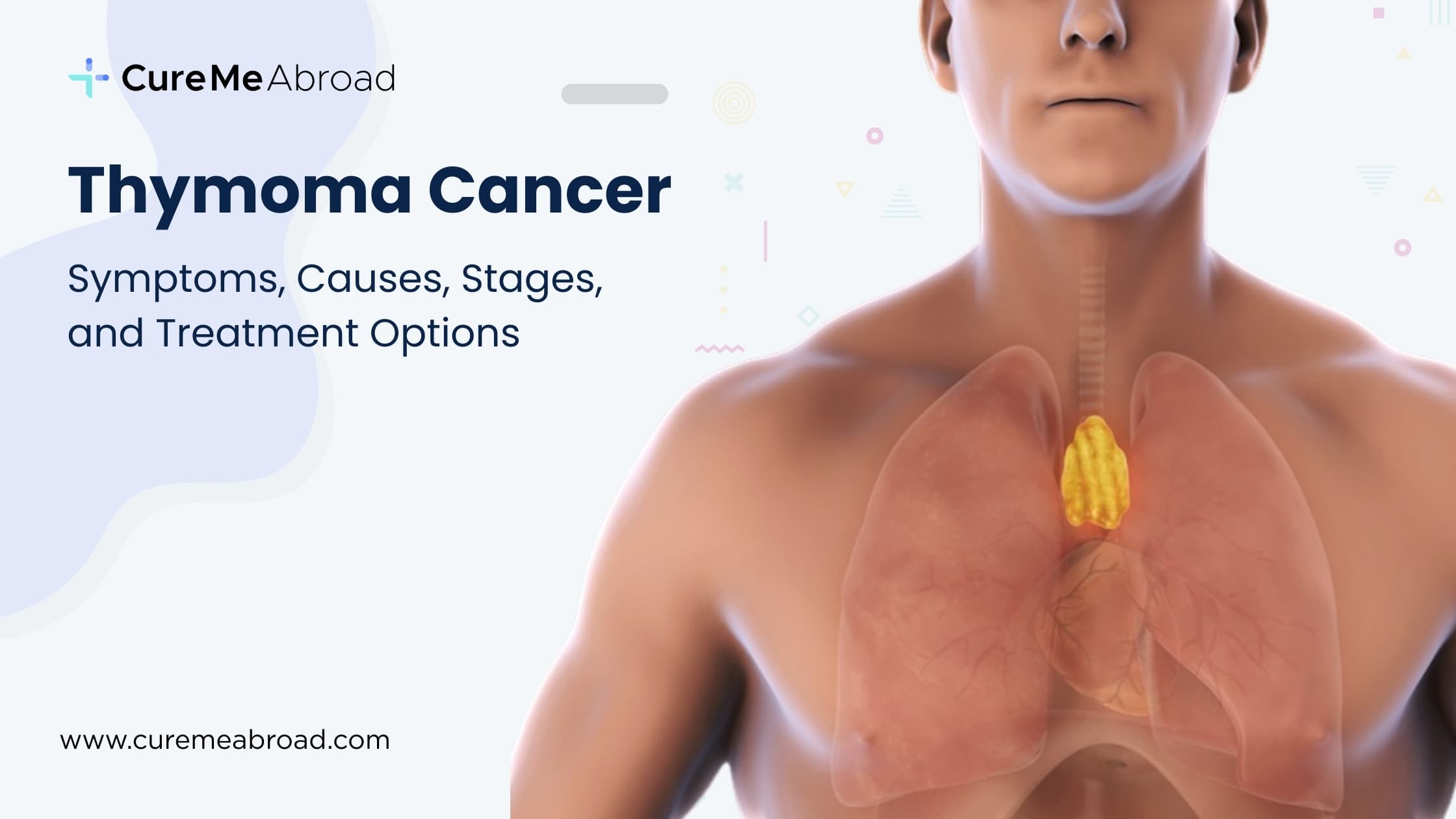
Thymoma is an uncommon growth of the thymus gland, a gland located in the anterior mediastinum or the portion of the chest behind the breastbone. Thymomas are mostly found by chance when chest imaging studies are done for some other reason. The majority of thymomas are non-cancerous and can be treated successfully. Thymomas are also known to be associated with autoimmune diseases, especially myasthenia gravis.
This review aims to cover the symptoms, causes, diagnosis, staging, management, and prognosis of thymoma.
What is Thymoma?
Thymoma is a type of cancer that originates in the thymus gland, which is located in the upper chest. The thymus gland plays a major role in the development of the lymphatic system. It helps in the production and maturation of T-cells.
Thymoma and thymic carcinoma are two major types of cancer found in the thymus. Thymic carcinoma is a much more common and aggressive one compared to thymoma. These are both extremely rare forms of cancer, but, in terms of biology and tumor development, are two very different cases. Thymomas, being less aggressive and slower-growing, contrast starkly with the highly aggressive, rapidly dividing, and metastasizing thymic carcinomas.
The thymus tissue is made up of two main cell types, epithelial cells and lymphocytes. If one of these cells starts to grow without control and excessively, it may result in a tumor.
At the molecular level, abnormalities in epithelial cells cause thymoma and its more aggressive variant thymic carcinoma. Lymphocytes misbehaving leads to other diseases such as Hodgkin disease and non-Hodgkin's disease, which result from lymphocyte disorders.
Cancer of the thymus, usually referred to as thymoma or thymic carcinoma derive from the epithelial cells. Hence, these tumor types are often called thymic epithelial tumors. These neoplasms occur in the thymus gland, which is located behind the sternum. Although the two tumor types differ in behavior, their origin cells are quite similar. Their name is a location reference rather than an indication of their mode of spread as they originate from the same layer of tissue. Thus, they are grouped together under one term by specialists.
Causes and Risk Factors
There are no known causes and risk factors for thymomas. However, there appears to be an association between thymic cancers and some autoimmune paraneoplastic syndromes, specifically myasthenia gravis (MG). Approximately 30 to 65 percent of patients with thymomas also have MG, although not all patients with MG have thymomas, as stated by the American Cancer Society.
Thymoma is also associated with other autoimmune conditions, such as Good syndrome (GS) and pure red cell aplasia (PRCA).
In the United States, thymic cancers are more prevalent among individuals of Asian and Pacific Islander descent. They are also more likely to occur with increasing age.
Thymoma Cancer and Autoimmune Diseases
Thymoma is frequently found in association with autoimmune diseases. Myasthenia gravis (MG) is the hallmark autoimmune disease. Approximately 20% of patients with thymoma have symptoms of MG. It is difficult to explain the mechanism of the induction of autoimmune diseases by thymomas. However, a brief explanation has been given.
The negative selection of autoreactive T cells in the thymus is dependent on the presentation of autoantigens by the medullary thymic epithelial cells and dendritic cells. Thymomas have a cortical epithelial cell function and are populated with immature T cells, which normally inhabit the cortex of the thymus. However, they lack the medullary epithelial cell function, which is the negative selection of the developing T cells. Immature T cells produced in thymomas are then exported out of the thymus, which probably leads to autoimmune disease in thymoma patients.
Symptoms of Thymoma Cancer
Most patients will not have symptoms at the time of initial diagnosis with thymoma or thymic carcinoma. The following are symptoms you should check with your doctor about:
- A persistent cough.
- Shortness of breath.
- Chest pain.
- A hoarse voice.
- Swelling in the face, neck, upper part of the body, or arms.
How to Diagnose Thymoma Cancer
A doctor's physical exam and medical history review are used to rule out other causes of the symptoms. During the evaluation process, some patients may also ask what level of eosinophils indicate cancer when blood test abnormalities are present alongside ongoing symptoms. While eosinophil counts alone cannot confirm cancer, doctors may use them together with imaging scans, biopsies, and laboratory testing to better understand the underlying condition. He or she will likely use one or more of the following methods to make a diagnosis and determine whether there is evidence of a tumor:
Physical Examination
Physically examining the patient and taking a thorough health history, which includes examining the body for signs of general illness (e.g., lumps or other abnormalities), as well as obtaining a detailed account of the patient’s health behaviors and history of disease and disease treatments.
Chest X-ray
This is an X-ray of the organs and bones inside the chest. An X-ray is a type of energy beam that can pass through the body and onto film, creating a picture of areas inside the body.
CT Scan
A CT scan, or Computed Tomography, is a test done with a machine and computer to create a series of imaging slices of a specific body part. The scans are produced using a CT scanner and consist of multiple X-ray imaging angles or slices created by a computer connected with an X-ray device. Oftentimes, a type of contrast dye is injected into your vein or swallowed to make the organs/tissues show up clearer than without contrast.
PET scan
A PET Scan (positron emission tomography scan) is a test that looks for cancer cells inside the body. A small amount of radioactive glucose (sugar) is injected into your vein, and the PET scan will spin around your body to take an image of where you are using the glucose. The cancer cells will appear brighter on the PET scan image than other cells due to the fact that they are more active and have a greater demand for glucose than normal cells.
MRI
MRIs (magnetic resonance imaging) are a way to diagnose internal organs in our bodies, like the inside of the chest, using magnets and radio frequencies with the help of computer technology to create many detailed pictures. They are also called NMRI or nuclear magnetic resonance imaging.
Biopsy
A biopsy is where a doctor will take a sample of the body's tissue cells by needle so that a pathologist can evaluate them, looking for cancerous growths.
Types Of Thymoma Cancer
Over the years, many thymoma classifications have been proposed, used, and eventually replaced by new or alternative systems. Many systems have tried to base their classification on the histology and presumed histogenesis of the normal thymus, while other systems took a simpler approach, such as dividing thymomas into limited numbers based on biological behavior. While no classification system is optimal, the WHO system is now the recommended classification.
| Official Terminology | Key Histopathologic Features |
|---|---|
| Type A thymoma | Formed of bland spindle or oval epithelial cells with few or no lymphocytes |
| Type AB thymoma | Made up of Type A-like spindle cells and lymphocyte-rich areas resembling Type B thymoma |
| Type B1 thymoma | Similar to a normal functional thymus, abundant immature T lymphocytes with sparse epithelial cells |
| Type B2 thymoma | Increased polygonal epithelial cells with a prominent lymphocyte population; moderate aggressiveness |
| Type B3 thymoma | Mainly composed of epithelial cells with mild to moderate atypia and sparse lymphocytes |
| Metaplastic thymoma | Biphasic tumor with epithelial and spindle cell components; considered a distinct low-grade entity |
| Micronodular thymoma with lymphoid stroma | Multiple epithelial nodules surrounded by prominent lymphoid stroma rich in B cells |
Stages in Thymoma and Thymic Cancer
Thymoma and thymic cancer share the same stages, ranging from stage 1 to stage 4.
- Stage 1 thymoma is restricted to the capsule that encloses the thymus gland. The tumor has not spread to other parts of the body.
- Stage 2 thymoma is where the tumor has spread from the thymus gland to the surrounding fatty tissues or the lining of the chest cavity.
- Stage 3 thymoma is where the tumor has spread to the lung, the sac that encloses the heart, or the large blood vessels that bring blood to the heart.
- Stage 4 thymoma is divided into two stages. Stage 4A thymoma is where the tumor has spread around the lungs or heart, while stage 4B thymoma is where the tumor has spread to the blood or the lymphatic system.
Treatments For Thymoma Cancer
Surgery for Thymoma
Surgery for thymoma involves the removal of the whole thymus. This is referred to as a thymectomy.
For small tumors, a thymectomy is performed using surgical robots. This is a minimally invasive procedure. This procedure involves the surgeon making three to four incisions around and below the patient’s breast.
For larger tumors, a sternotomy is necessary. This is a procedure where the surgeon cuts through the breastbone to open up the chest. Patients undergoing sternotomy stay in the hospital for days. Recovery may take a few weeks.
Chemotherapy for Thymoma
Chemotherapy works by attacking the fast-growing cells, such as cancer cells. One of the ways thymoma patients can benefit from chemotherapy is when it is given before surgery. It helps shrink the tumor so that it will be easier for the surgeon to operate successfully. In cases where patients cannot be operated on, chemotherapy and radiation therapy can be used as the treatment.
Radiation Therapy
Radiation therapy for thymoma involves the use of high-energy rays to kill cancer cells. Radiation therapy is generally administered to a patient after surgery for thymoma. Patients will get radiation therapy with chemotherapy if they cannot have surgery. There are various types of radiation therapy that patients may have for thymoma.
Proton Therapy For Thymoma
Proton therapy is one kind of radiation therapy. It offers more accuracy in killing the cancer cells compared to conventional radiation therapy.
Proton therapy involves the use of protons, which are positively charged particles found in the nucleus of an atom. Proton therapy involves the use of proton beams that have a low initial dose of radiation, the so- called "entrance dose". As the dose penetrates the target site, it becomes stronger, and the tumor is directly hit with the highest dose of radiation before the beam stops. After the tumor, there is no "exit dose".This makes it possible to target the tumor more precisely, usually to within one millimeter, and to deliver a stronger dose of radiation.
Immunotherapy
Immunotherapy is a form of cancer treatment that uses the patient’s own immune system to attack and destroy the cancerous cells. Substances naturally present in the body or laboratory-made substances are used to direct and restore the body’s immune response against cancer cells. This type of cancer treatment is also known as biologic therapy.
Clinical Trials
For certain patients, a clinical trial can represent the most effective treatment option available. Clinical trials form an essential component of the cancer research endeavor. Clinical trials are organized for the primary purpose of establishing whether new cancer therapies are safe and effective or if they have superiority over the existing standard therapies.
Most of the cancer treatments currently considered standard were initially experimental treatments that were tested in clinical trials. Patients enrolled in clinical trials may be treated with the existing standard treatment or may have the opportunity to receive a new treatment for the first time.
Moreover, patients in clinical trials benefit future cancer patients. In fact, clinical trials that do not lead to the development of new effective treatments can still be very valuable in that they provide crucial answers and, hence, facilitate the progress of the research process.
Thymoma Cancer Prognosis
A thymoma patient's prognosis will be affected by several factors, including:
- The stage of the tumor at diagnosis. Patients with localized cancer have a better prognosis.
- The nature of the tumor cells, even though the stage of the cancer has a much bigger effect on the prognosis, the cell type (histology) still has an effect.
- The age and general condition of the patient. In general, younger and healthier patients can be given more treatments than older ones; thus, their prognosis is better. However, it is worth stressing that as further information is obtained about the response of thymoma tumors to the treatment, the prognosis has been getting better.
Thymoma cancer is incredibly rare, but it is one of the most curable cancers of the chest area if it is diagnosed and treated properly.
Education is a potent weapon for a patient diagnosed with thymoma. Learning about the disease, recognizing the symptoms at the earliest stage, keeping regular check-ups, and managing autoimmune diseases are very beneficial.
Frequently Asked Questions
Can Thymoma Be Recurrent After Treatment?
Yes, thymoma has the potential to return after it has been treated and can return many years after the initial treatment has been performed.
What is the reason for the association of thymoma and Myasthenia Gravis (MG)?
The thymus has a function in the immune system regulation. In patients with thymoma, the abnormal development of the thymus might result in a setting where the immune system loses its tolerance, thereby causing an autoimmune disease such as MG. It is estimated that from 33% to 50% of patients with thymoma develop MG.
Is it Possible to Cure Thymic Cancer?
The possibility to cure thymic cancer depends on how much the cancer has spread at the time of diagnosis. If the cancer has already spread to other parts of the body, then it becomes a lot more difficult to cure.
What is the Reason for the Shrinking of the Thymus With Age?
The thymus shrinks with age because of the gradual replacement of thymic tissue by fat. Nevertheless, it has been shown that the thymus is capable of producing thymocytes throughout a person's life.
References
“Thymoma and Thymic Carcinoma Treatment.” Cancer.gov, 11 Jan. 2023, www.cancer.gov/types/thymoma/patient/thymoma-treatment-pdq.
“Thymoma (Thymic Carcinoma).” Cleveland Clinic, 31 Dec. 2025,
my.clevelandclinic.org/health/diseases/6196-thymoma-and-thymic-carcinoma.
Yano, Motoki. “Autoimmune Diseases Associated With Thymoma.” Journal of Visualized Surgery, vol. 6, Jan. 2020, p. 6, doi:10.21037/jovs.2019.10.04.