




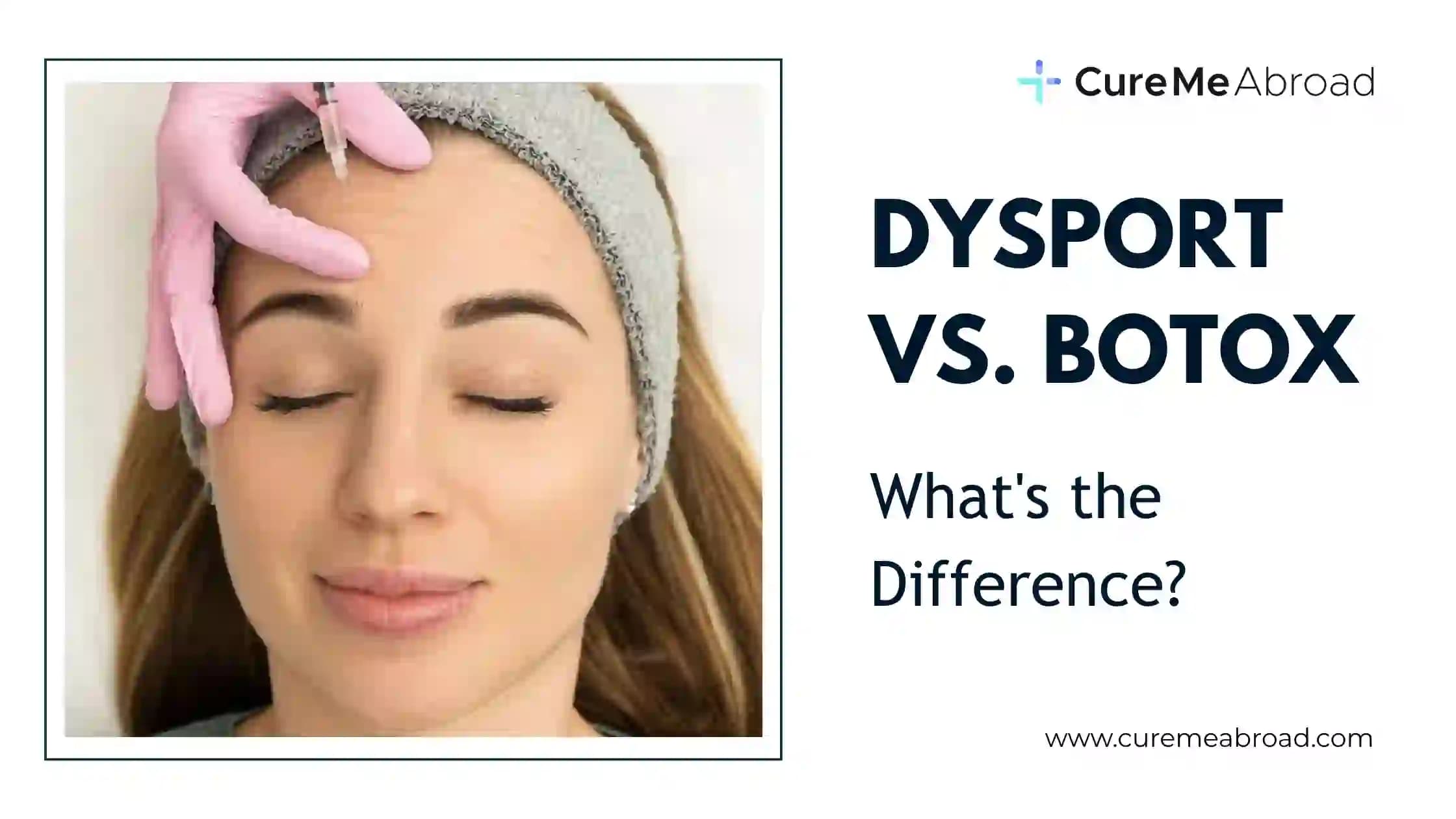
Most people walk into a consultation already having googled both names. They've seen the before-and-afters, read a few forums, and maybe even asked a friend who's had one or the other done. And yet the question still remains: are they actually different, or is it just clever marketing?
Turns out, there are real differences between dysport vs botox, and those differences can actually change your experience depending on what you're treating and what you're hoping to get out of it. Here's what you should know before you book. Keep reading this blog to find out everything about dysport and botox.
What Are Dysport and Botox?
At their core, both are injectable treatments that come from botulinum toxin type A. A small, controlled amount goes into a targeted muscle; it stops contracting the way it normally would, and the skin above it softens. That's the whole mechanism, and both products use it.
Botox has been part of cosmetic medicine since 2002 when the FDA approved it. Over the years it picked up approvals for things beyond wrinkles too, including chronic migraines, heavy sweating and overactive bladder. It's the name most people know even if they've never had an injectable in their life.
Dysport came along later, earning FDA approval in 2009, though doctors in Europe had been using it well before it crossed the Atlantic. For cosmetics, it's mainly approved for frown lines between the brows. Patients tend to gravitate toward it for how fast it works and how it looks on larger areas of the face.
Dysport vs. Botox: Key Differences
The ingredient list overlaps, but the way each product behaves once it's inside the tissue is where things get interesting.
| Feature | Botox | Dysport |
|---|---|---|
| Active ingredient | OnabotulinumtoxinA | AbobotulinumtoxinA |
| FDA cosmetic approval | 2002 | 2009 |
| Spread after injection | Stays in place | Moves outward |
| When you see results | 5-7 days | 2-3 days |
| How long it holds | 3-6 months | 3-4 months |
| Unit equivalence | 1 unit | 2.5-3 units |
| Strongest use case | Smaller, precise spots | Broader facial areas |
| Price per unit | $12-$20 | $4-$8 |
| Has lactose | No | Yes |
Dysport fans often say it looks more natural on the forehead because of how it spreads. It covers ground without requiring a needle at every centimeter. Botox devotees like that it stays exactly where the provider puts it, which matters a lot around the eyes and other delicate areas.
How Dysport and Botox Work
Your facial muscles move constantly throughout the day. Every squint, every smile, every look of surprise creases the skin above those muscles. Young skin bounces back. Older skin eventually stops bouncing and the crease just stays there. Both of these treatments target that process at the source.
They block acetylcholine, a chemical that carries the signal from a nerve to a muscle telling it to contract. No signal means no contraction, and no contraction means no crease forming. The skin above relaxes and the line softens or disappears depending on how deep it already is.
Where the two products differ is in their molecular behavior post-injection. Dysport molecules are smaller and spread more freely once they're beneath the skin. That's helpful for big areas where even coverage matters. Botox molecules hold their position better, which is exactly what you want when you're working around the eye or trying to hit one specific muscle without affecting anything nearby.
Plenty of providers will use both in a single session, one on the forehead and one around the eyes, pulling the best quality from each product.
Onset of Results: Which Works Faster?
Dysport wins here, and it's not particularly close. A lot of patients see something starting to happen within the first day or two. Botox takes longer; usually most of the first week goes by before any real change becomes visible.
| Timeline | Botox | Dysport |
|---|---|---|
| First signs of change | 3-5 days | 1-2 days |
| Visible improvement | 5-7 days | 2-4 days |
| Full effect settled | 7-14 days | 5-10 days |
If you've got a big event in 4 days, Dysport gives you a fighting chance. Botox might still be warming up. For regular maintenance appointments with no hard deadline, the gap matters much less since both are fully settled by the two-week mark.
How Long Do Dysport and Botox Last?
Both generally hold for 3-4 months. Botox has a longer ceiling though, sometimes reaching 5 or 6 months in patients who respond well to it. Dysport tends to taper off closer to that 3-4 month point.
What shortens or extends results:
- How fast your metabolism runs
- How much muscle activity there is in the area being treated
- The exact dosage your provider uses
- Whether you come back regularly or wait until everything has worn off completely
People who treat consistently, returning before the product fully fades, tend to keep better results over time. The muscle stays in a slightly more relaxed baseline state and lines don't snap back as sharply between sessions.
How Lifestyle Factors Affect Your Results
Dysport vs botox results both come down to the same daily habits.
- Sun exposure: UV breaks product down faster; daily SPF directly affects how long results hold
- Intense exercise: Frequent hard cardio shortens duration for both products
- Smoking: Hurts circulation and skin quality in ways that work against either treatment
- Sleep and stress: Raised cortisol speeds up how fast results wear off
- Skincare: Retinoids and moisturiser between sessions extend what you paid for
Combining Dysport or Botox with Fillers and Other Treatments
- With fillers: Injectables handle movement, and fillers handle volume. Works well together, just not in the same area on the same day
- With laser or microneedling: Leave at least two weeks between these and any injectable treatment
- With skincare: Retinoids, vitamin C, and SPF actively keep results going longer
- Before your appointment: Skip fish oil and vitamin E supplements a few days prior
Dysport vs Botox: Cost Comparison
Dysport's per unit price is lower, which sounds like an obvious win until you factor in that it takes roughly three Dysport units to match one Botox unit. Most of the time the total cost balances out.
| Treatment Area | Botox Units | Botox Cost | Dysport Units | Dysport Cost |
|---|---|---|---|---|
| Frown lines | 20 units | $240-$400 | 50-60 units | $200-$480 |
| Forehead | 10-30 units | $150-$600 | 30-80 units | $120-$640 |
| Crow's feet | 24 units | $288-$480 | 60-70 units | $240-$560 |
| Full face | 50-80 units | $600-$1,600 | 150-200 units | $600 to $1,600 |
Certain clinics do pass along a small saving with Dysport even after the conversion, particularly for larger treatment areas. It varies by location and provider, so ask directly rather than assuming.
Cosmetic treatments aren't covered by insurance. If you're using Botox for a medical condition like migraines, that's a different conversation, and partial coverage may be on the table depending on your plan.
Dysport vs Botox: Side Effects and Safety
Both products have been studied and used for long enough that the safety picture is pretty clear. When a qualified provider does the injecting, serious problems are genuinely uncommon.
Common Side Effects
- Bruising or swelling around injection points
- Redness that clears up within a few hours
- A mild headache on day one
- Some tenderness in the treated area
Less Common Side Effects
- Drooping of the eyelid if product travels near the eye muscle, a slightly higher risk with Dysport because of how it diffuses
- Minor unevenness if the dosing wasn't precise
- Brief weakness in muscles close to the treated area
Who Should Sit This One Out
- Anyone who is pregnant or nursing
- People with conditions like myasthenia gravis or ALS
- Anyone who has had a reaction to botulinum toxin before
- People with milk allergies need to avoid Dysport specifically since it uses lactose as a stabilizer
Run through your medication list with your provider at the consultation. A few things can increase bruising or interfere with how the treatment works.
How to Prepare for Your Dysport or Botox Appointment
Whether you go with dysport vs botox, what you do beforehand affects both the treatment and how long results last.
- Avoid blood thinners: Skip aspirin, ibuprofen, fish oil, and alcohol at least 48 hours before
- Skip hard exercise the day before: Increased blood flow means more bruising
- Come with a clean face: No heavy makeup or skincare products on the day
- Be upfront about medications and allergies: Anything relevant needs to come up before treatment starts
Procedure: What to Expect
You're in and out in 10-20 minutes. No sedation, no real recovery, nothing keeping you from going straight back to normal life.
Your provider starts by looking at how your face moves and where the lines are forming. The area gets cleaned, a very fine needle goes into the muscle at the mapped points, and you feel a short pinch with each one. The whole injection part usually wraps up in a few minutes. Before you leave, they check that everything looks even and sits where it should.
After you leave, keep your head upright for the first four hours, skip any hard exercise that day, leave the treated area alone without rubbing or pressing on it, and avoid alcohol for 24 hours.
| Timeframe | What's Normal |
|---|---|
| Day of treatment | Small raised spots and redness are gone within hours |
| Days 1-3 | Early softening visible for Dysport patients, possible light bruising |
| Days 3-7 | Botox starting to show; Dysport results are more defined |
| Days 7-14 | Both at full effect |
| Months 3-4 | Fading begins; good time to schedule next session |
Dysport vs Botox Before and After Results
Give it 2 weeks before forming any strong opinions. The full effect takes time to settle and day 3 isn’t representative of where you'll end up.
Realistically, you can expect the lines that appear with movement to look noticeably softer, your overall face to look more rested and your expressions to stay natural if the dosing was right. What won't happen is static lines from sagging or volume loss disappearing, any kind of structural change, or results that stick around permanently.
A lot of first-timers feel slightly underwhelmed at first. That reaction usually flips once they see the 2-week result. The treatments are designed to look like nothing happened, just a more rested version of you.
Who Should Choose Dysport vs Botox?
| Choose Dysport If... | Choose Botox If... |
|---|---|
| You want to see results quickly | You want pinpoint control over the result |
| You're treating the forehead or larger areas | You need the broader list of medical approvals |
| Botox felt slow for you in the past | You have a milk allergy or lactose sensitivity |
| Your provider suggests it suits your anatomy | You want the most widely used and established option |
Some patients land on one and never look back. Others alternate or use both at the same time. Neither approach is wrong. Your anatomy, your timeline and your provider's read on what works for your face are what actually drive the right call.
Worth saying again: who does the injecting matters more than which product they use. An experienced, knowledgeable specialist will consistently outperform a less experienced one regardless of what's in the syringe.
Dysport vs Botox for Specific Skin Types and Ages
- 20s and early 30s: Both work for prevention at low doses. Slowing patterns from forming, not erasing anything
- 40s and 50s: Botox tends to give more controlled results on more established lines
- Thin or sensitive skin: Botox is the safer pick near delicate areas like the eyes
- Sun-damaged skin: Neither product fixes structural UV damage; manage expectations accordingly
How to Choose the Right Injector for Dysport or Botox
In the dysport vs botox decision, who does the injecting matters more than which product they use.
- Verify credentials yourself: Check board certification at certificationmatters.org, not just on their clinic page
- Ask about their volume: Someone doing this daily has judgment that someone doing it occasionally simply doesn’t have
- Look at real patient photos: Different ages and face shapes, not just their best results
- Trust the consultation: If they can’t explain their approach or rush you toward booking, find someone else
Dysport vs Botox Abroad: What It Costs and What to Look For
The dysport vs botox cost gap in the US looks very different internationally.
- Significant price difference: US pricing runs $12-$20 per unit. Turkey, Thailand, and Mexico often come in 40 to 60 percent lower at accredited clinics
- Check before booking: Surgeon credentials, facility accreditation, which brands they stock, and post-treatment follow-up
- Watch out for: Any clinic that cannot confirm which product brand they use or has no real patient photos
Conclusion
There's no version of the dysport vs botox conversation that ends with one being definitively better. They're both well-tested, both effective, and both used every day in clinics around the world. The faster onset and natural spread of Dysport work better for certain patients and certain areas. The precision and wider approval range of Botox fit better in others. A lot of people end up using both at different points.
Not sure where to start with cosmetic treatment abroad? CureMeAbroad connects patients with trusted clinics and qualified specialists, keeping everything clear and straightforward from consultation to care.
FAQs
1. Can I switch between Dysport and Botox whenever I want?
Yes. There's no reason to stay locked into one product. Your provider just adjusts the units and the approach based on what you're using that session.
2. Does one hurt more than the other?
Neither is particularly painful. The needles are very fine and most people describe each injection as a quick pinch that's done before they've fully processed it.
3. How does the unit conversion actually work?
The standard is roughly 2.5-3 Dysport units per 1 Botox unit. This is why comparing the per unit price without context gives you a misleading picture of actual cost.
4. Is there any benefit to starting younger?
Some providers recommend low doses in the late twenties or early thirties to slow how expression lines develop over time. It suits some people and not others. A good specialist will give you an honest read on whether it makes sense for you.
5. Which one is safer?
Both have strong safety records built up over decades of use. The main practical difference is the lactose in Dysport, which is relevant only for people with milk protein allergies.
Reference:
- Botox Cosmetic: MedlinePlus Drug Information: U.S. National Library of Medicine: 2024: https://medlineplus.gov/druginfo/meds/a619021.html
- Dysport vs. Botox: What's Better for Wrinkles?: Cleveland Clinic Health: 2022 https://health.clevelandclinic.org/dysport-vs-botox
- Dysport vs Botox: Key Differences and Effectiveness: Drugs.com, medically reviewed by Carmen Pope, BPharm :2025 https://www.drugs.com/medical-answers/dysport-botox-difference-3124590/
- Botulinum Toxin Type A (Cosmetic): American Society of Plastic Surgeons: 2024 https://www.plasticsurgery.org/cosmetic-procedures/botulinum-toxin
- How Much a Unit of Dysport Costs vs. Botox: RealSelf: 2024 https://www.realself.com/nonsurgical/dysport/cost