




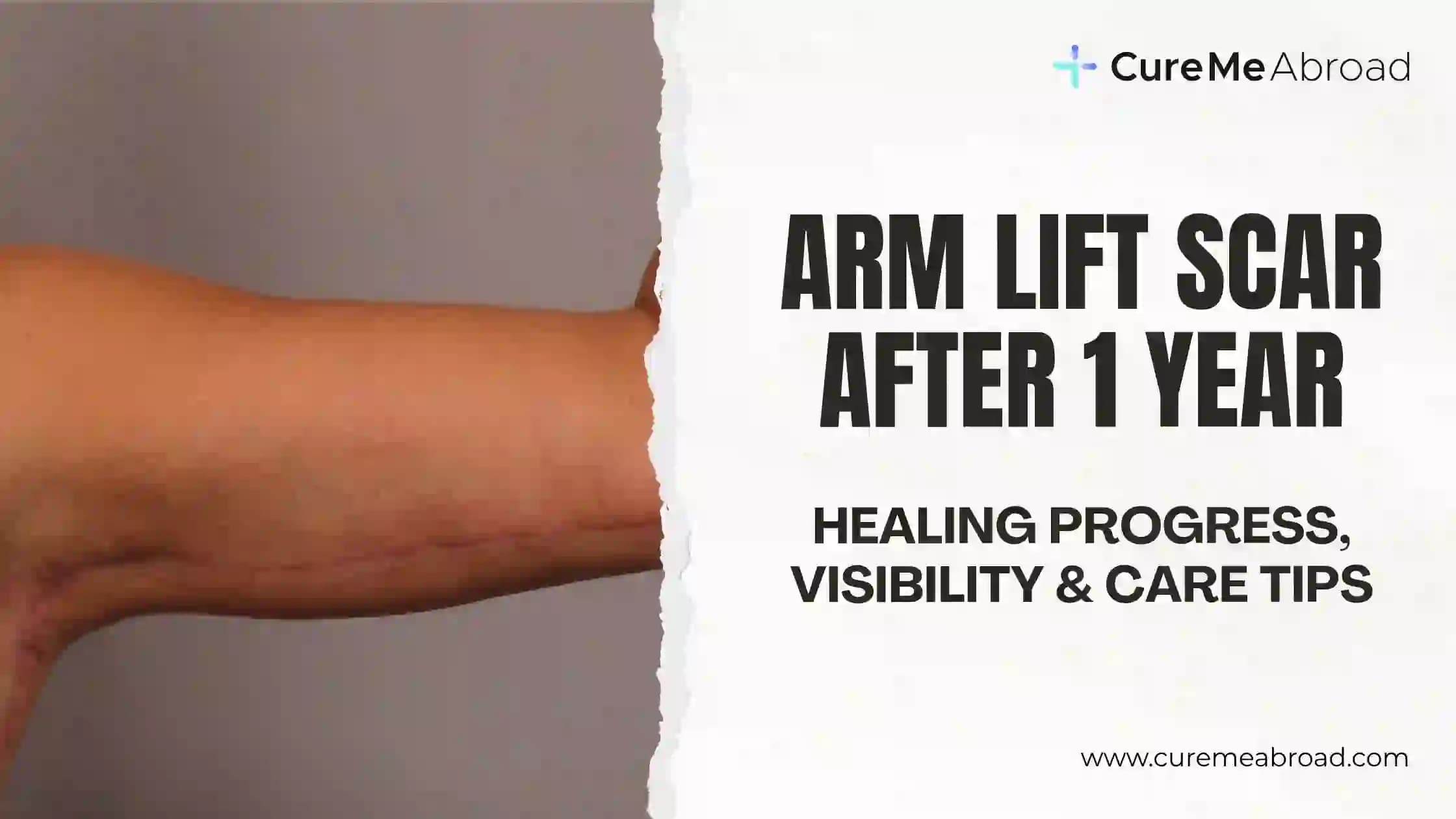
Brachioplasty, commonly referred to as an arm lift is one of the most sought-after procedures in body contouring in 2026. It has become more and more in demand by patients who want to change their bodies, particularly after weight loss and bariatric surgery. Even though the procedure is highly effective in eliminating saggy skin from the upper arm, resulting in an aesthetically appealing look, the linear scar is one major concern for almost every individual undergoing an arm lift procedure.
If you are entering your first anniversary from your arm lift procedure or considering undergoing an arm lift procedure and wish to have realistic expectations, this article aims to provide an extensive overview of what a 1-year arm lift scar looks like, how your body heals from an arm lift procedure, and how you can effectively reduce your scar.
Understanding the Arm Lift Scar: What to Expect
The incision for brachioplasty can extend from the axilla to the elbow on the medial, or inner, aspect of the upper arm. Some surgeons make the incision on the lateral chest wall, depending on the laxity. The resulting scar will be long, as it needs to be to remove the appropriate amount of skin. The resulting scar can be expected to be anywhere from 15 to 40 centimeters in length.
The patient needs to understand that the scar will not be removed. What can be expected to result from good healing and aftercare is a flat, pale, narrow scar. Although the scar can be noticeable, it will not have any effect on the quality of life.
The Scar Healing Timeline: Month by Month
The wound healing process after brachioplasty has three distinct biological phases. These include the inflammatory phase, the proliferative phase, and the remodelling phase. Understanding these phases is essential for patients to understand changes in the scar without worrying unnecessarily.
Weeks 1-4: The Inflammatory Phase
The wound is expected to be red in color, swollen, firm, and painful in the first month following brachioplasty surgery. In this case, the body is supposed to be producing collagen to heal the wound. In addition, the scar is supposed to look worse. It is essential to follow instructions from the surgeon on how to manage the wound. This is vital in ensuring that infection and dehiscence are prevented.
Months 1-3: The Early Proliferative Phase
It is perfectly normal that when the inflammation in the scar tissue subsides, it becomes thick, darker (pink to purple in lighter skin tones and hyper-pigmented in darker skin tones), and itchier. Itchiness is a good indication that the healing is going on perfectly. The nerve endings are regrowing in the scar tissue. This is a good indication. However, it is not recommended that you scratch.
Around 6 to 8 weeks after the procedure, most surgeons will allow permission for scar massage and silicone therapy to be initiated. These treatments have the highest level of evidence for scar improvement.
Months 3-6: Active Remodelling
This is where the most changes take place. The scar becomes less raised and softer as the initial collagen is dissolved and remodelled into a more orderly, less disorganised pattern. The redness also fades over time. If patients have adhered to silicone therapy and sun protection, they will notice an improvement in their scars over time.
Months 6-12: Maturation
At six months, patients will notice that their scars have significantly improved in colour and height. The scar will continue to mature over time. At twelve months, it is expected that the majority of biological changes will be complete, although some very minor changes can be expected until 18-24 months. At one year, it is considered to be a mature scar. It is pale, flat, and much less noticeable than it was in the early stages.
What Does a 1-year Arm Lift Scar Look Like?
A 1-year arm lift scar is usually:
Flat or even flush with the skin's surface
Pale pink, silver, or white in color, much lighter than it was at 3–6 months post-op
Softer in texture, no longer firm and cord-like as it was in early healing phases
Narrow, optimally measuring 2-4 mm in width, provided healing has proceeded without issues
Located on the medial arm, where it is hidden when the arms are at rest by the sides of the body
Again, it is worth noting that this is a general discussion and that there can be significant variation in the process of healing between individuals. In terms of individuals with darker skin tones, such as Fitzpatrick classifications of IV, V, and VI, there is the possibility that the hyperpigmentation response may result in a more obvious scar in the following year. In terms of individuals who tend to develop keloid scars, it is worth noting that even in the first year, the scars can continue to extend beyond the original incision site.
Factors That Influence 1-year Arm Lift Scar Healing
Genetics and Skin Type
Genetics, undoubtedly, plays a very vital role in the healing process. For example, individuals belonging to African, Hispanic, South Asian, or East Asian races are more prone to acquiring hypertrophic or keloid scars. On the other hand, elders have a slower rate of healing due to the reduced quantity of cells that are elastic in nature, making scars less noticeable.
Surgical Technique
An experienced board-certified plastic surgeon, employing a technique that is precise, tension-free closure, and layered suturing, ensures that the chances of developing wide scars are very low. Tension on the wound, which is the most common cause of developing wide scars, is a variable in the healing process. This has to be discussed in detail by the patient and their chosen surgeon before surgery. Tissue adhesives or dermal sutures that dissolve over time, minimizing suture scars on the skin, are commonly employed by surgeons in 2026.
Post-Operative Wound Care
Any form of infection, however minor, has the potential to drastically alter the end result of the healing process. Patients should take wound care in the first four to six weeks very seriously by avoiding water immersion in the affected areas. Infection in the wound should be reported to the surgeon immediately.
Sun Exposure
Ultraviolet rays cause PIH in scars by stimulating melanocytes in the scars. The patients should be instructed to apply a broad-spectrum sunscreen with a sun protection factor of at least 50 over the scars daily, including on cloudy days, for at least 12-18 months after the surgery. The patients in tropical countries such as those in South and South-East Asia should be instructed to take sun protection measures at all times of the year.
Nutrition and Lifestyle
Micronutrient sufficiency is essential for wound healing. Vitamin C is required for collagen synthesis, zinc is required for cell healing, and proteins are required for tissue synthesis. Smoking delays wound healing by compromising oxygen supply to healing tissue through vasoconstriction. The patients who smoke have a significantly poor outcome in scarring and should be advised to stop at least six weeks before and six weeks after the surgery.
Evidence-Based Scar Care Tips in 2026
The science of scar care has improved significantly over the last several years. These are evidence-based care strategies that are currently recommended by plastic surgeons in 2026.
Silicone-Based Therapy
Silicone sheets and silicone gel are considered the gold standard of non-invasive scar care. They are recommended by the International Advisory Panel on Scar Management. Silicone therapy hydrates the stratum corneum of the scar, regulates growth factors, and limits collagen overproduction. Silicone sheets should be used for at least three months, for a period of 12 to 24 hours a day, except when you are washing your body. Silicone gel is a good alternative when sheets are not feasible.
Scar Massage
Massage of scars for 5 to 10 minutes, twice a day, can also help to break adhesions in the scar, increase its flexibility, and desensitize the scar. Massage can be done firmly in a circular motion perpendicular to the scar using a fragrance-free moisturizing cream or a massage oil containing rosehip, vitamin E, or centella asiatica. It is best to start massage after your surgeon has issued you a clean bill of health, i.e., your incision has healed completely, usually after six to eight weeks.
Compression Garments
For patients with extensive scarring or a history of hypertrophic scarring, custom-fitted compression garments can be used over the upper arm. The compression garments can help to reduce the vascularity of scars and flatten hypertrophic scars due to mechanical pressure. The garments are to be worn for 6 to 12 months and are best used for patients with extensive skin removal due to weight loss.
Corticosteroid Injections
For hypertrophic scars or thick scars that do not respond to conservative management after three to six months, intralesional corticosteroid injections, specifically triamcinolone acetonide, are a highly effective treatment for scars. Corticosteroid injections have the ability to inhibit fibroblast activity and abnormal collagen synthesis in scars. Several injections are needed at regular intervals of every four to six weeks. Side effects include transient atrophy and hypopigmentation of the skin, which are more visible in patients with darker skin tones.
Microneedling & PRP Therapy
Microneedling, also termed collagen induction therapy, in association with PRP therapy, has demonstrated promising evidence in managing atrophic scars as well as hypertrophic scars. The therapy has the ability to cause micro-injuries in the skin by the needles used in microneedling. These micro-injuries induce controlled collagen synthesis in the scars. PRP therapy, which utilizes growth factors, improves the healing response in scars. The treatments need to be carried out in several sessions. The results can be observed after three to six months.
Topical Retinoids
Topical retinoids, such as tretinoin (retinoic acid), are useful in the improvement of the appearance of mature scars by promoting epidermal turnover as well as normalization of pigment in post-inflammatory hyperpigmentation. They are usually started after the completion of the healing process, which is after six months
Scar Revision Surgery: Is It An Option?
For those who are one year or more removed from their original procedure and their scar continues to be high and unsatisfactory in some way, scar revision is a possibility. This is done by surgically removing the original scar and re-closing the original wound in an ideal setting. It is important to remember that scar revision is not a guarantee. While a good outcome is probable, it is not a certainty.
When to Be Concerned: Warning Signs at 1-year
By the end of the twelfth month, most scars resulting from arm lifts should be well on their way to their final state. However, the following signs indicate that a consultation with your surgeon may be necessary:
A scar that continues to increase in size beyond the original incision site (which may be a sign of a keloid)
Persistent elevated, rope-like scarring that also presents with firmness and restricted arm mobility (hypertrophic scarring)
Darkening or PIH that has not significantly improved or has actually deteriorated
Any breakdown in the scarring, ulcers, or discharge
Numbness or pain in the scarred or tissues that persist
When emotional concerns about scarring significantly impair the quality of life
In such cases, a multi-disciplinary approach to the problem, including your plastic surgeon, a dermatologist with special interest in scars, and in the case of emotional concerns, a psychologist or counselor, would be the most suitable option and should not be delayed.
A 1-year arm lift scar that is one year post-operative is an indication of notable healing progress. In the vast majority of patients, the scar is flatter, paler, and softer than it was at any previous stage of the healing journey. This is usually true for several months beyond this time. With appropriate scar management techniques such as silicone therapy, sun protection, scar massage, and medical interventions when necessary, the scar resulting from an arm lift can be minimized to a degree that ensures that patients can enjoy their results with confidence.
When you are nearing or have surpassed your one-year post-operative mark and are concerned about your scar's progress, the single most important step is to schedule a consultation with your plastic surgeon. When it comes to scar management in 2026, there is no shortage of options. The challenge is determining which ones are best suited to your individual needs and when to begin.
FAQ
What does a normal 1-year arm lift scar look like?
A normal 1-year arm lift scar is lighter, flatter, and less noticeable than in the early healing stage.
Is it normal for a 1-year arm lift scar to be visible?
Yes, a normal 1-year arm lift scar is permanent but lighter and easier to blend in.
Will my 1-year arm lift scar continue to improve?
Yes, a normal 1-year arm lift scar may continue to fade for 18 to 24 months.
Why is my 1-year arm lift scar still so dark?
Your normal 1-year arm lift scar may be darker due to heredity, skin type, or sun exposure.
How do I minimize my 1-year arm lift scar?
Silicone gel, massage, sun protection, and laser therapy can help minimize a normal 1-year arm lift scar.
Reference
American Society of Plastic Surgeons. (2024). Arm lift (brachioplasty): What to expect. American Society of Plastic Surgeons. https://www.plasticsurgery.org/cosmetic-procedures/arm-lift
Cleveland Clinic. (2024). Arm lift (brachioplasty): Procedure, recovery and results. Cleveland Clinic. https://my.clevelandclinic.org/health/treatments/arm-lift
Mayo Clinic. (2023). Scar care after surgery. Mayo Clinic. https://www.mayoclinic.org/healthy-lifestyle/adult-health/in-depth/scars/art-20046086
American Academy of Dermatology. (2024). Surgical scar treatment and management. American Academy of Dermatology https://www.aad.org/public/cosmetic/scars/stretch-marks
International Society of Aesthetic Plastic Surgery. (2024). ISAPS patient safety and recovery guidelines. ISAPS. https://www.isaps.org/patients/