




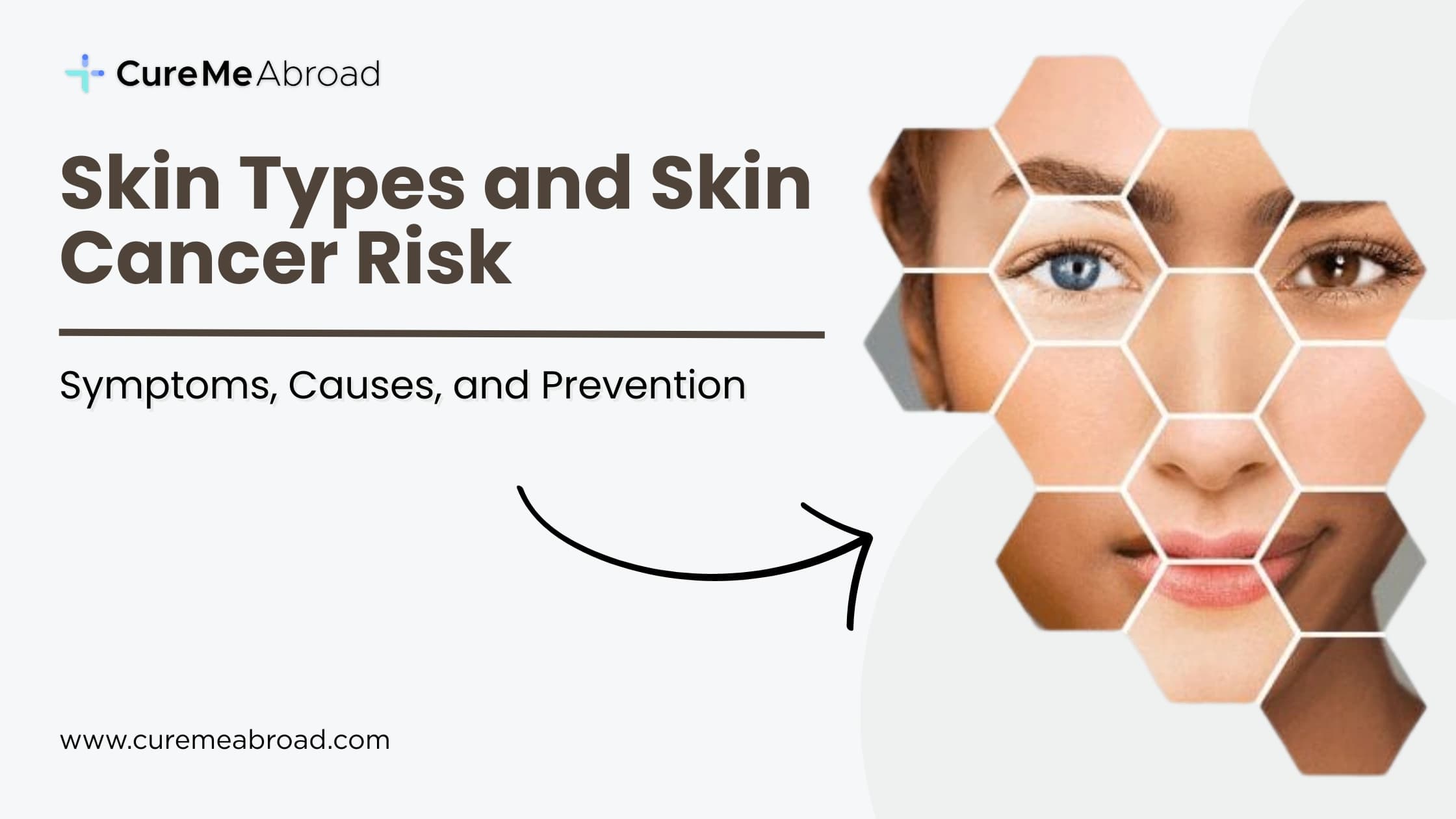
Skin cancer is the most prevalent type of cancer globally. The bright side is that it is one of the cancers that can be prevented as well as cured if discovered early. It is a common misconception that only fair, skinned people can get skin cancer; however, the truth is that skin cancer can occur in individuals of any skin type, be it fair or dark skin.
Knowledge about skin types and skin cancer will help the person recognize the symptoms of skin cancer in a manner that proper preventive strategies and treatments for skin cancer are implemented simultaneously.
This article will shed light on skin types and skin cancer, skin cancer types and symptoms, diagnosis and treatment of skin cancer, and prevention of skin cancer.
Understanding Skin Types
Your skin type or skin colour is determined by a pigment called melanin. Melanin is produced by a special group of cells called melanocytes. These are present in your skin as well as your eyes, where sometimes a melanoma can be developed when these cells are damaged due to UV radiation.
The greater the level of melanin your body produces, the darker your eyes, hair, and skin will be. Melanin works as a protection mechanism in your skin against the negative influences your skin receives from sun's UV radiation. This happens as a result of your melanin absorbing radiation and resulting in darker pigmentation and what we call a sun tan. This implies that black skin does not suffer much from the sun's negative radiation compared to white skin because white skin does not receive this protection from melanin. The quantity of melanin in your body varies in different ways, one being your genetic background and how much your ancestral background had exposure to sun's negative radiation.
The Fitzpatrick Skin Type Scale is the most popular method of categorizing skin into six types based on pigmentation and the reaction to ultraviolet (UV) radiation. The table below shows the different skin types and the typical features of each skin type.
| Skin Type | Common Characteristics | Response to Sun Exposure |
|---|---|---|
| Type I | Very light skin, often with blue or green eyes and blond or red hair | Consistently burns and does not develop a tan |
| Type II | Light or fair skin, typically with light-colored eyes | Burns easily and tans very little |
| Type III | Light to medium skin tone | May burn initially but gradually develops a tan |
| Type IV | Light brown or olive-toned skin | Rarely burns and tans with ease |
| Type V | Medium to dark brown skin | Seldom burns and tans deeply |
| Type VI | Deep brown to black skin | Does not burn and maintains a dark tan |
What is Skin Cancer?
Skin cancer is one of the cancers caused by the uncontrolled growth of cancerous cells in the skin. Normally, cells of the skin grow old and die, and new cells come to take their place.
Skin cancer is actually a cancer that starts from the uncontrolled growth of scaly cells on the skin. The scaly can grow into surrounding tissue and ultimately damage it. There are instances the cells may detach and spread to other parts of the body.
There are various forms of skin cancer. There are principally two types of skin cancer: basal cell carcinoma and squamous cell carcinoma. These two forms of skin cancer are the most common; nevertheless, they are usually quite treatable. Melanoma is the deadliest form of skin cancer. It is more likely to spread and, therefore, be more difficult to treat.
Individuals with Fitzpatrick skin types 1 or 2 are the most vulnerable to skin cancer relative to those with other skin types. However, individuals with darker skin can also develop skin cancer, as it is mostly overlooked in such cases of people with dark skin.
Types of Skin Cancers
Basal Cell Carcinoma
A Basal Cell Carcinoma (BCC) is a skin cancer that usually appears in parts of the skin that are normally exposed to the sun, such as the face. In fair skin, BCCs appear as a bump, skin-colored, or pink. In most cases, BCCs occur as a result of prolonged exposure to the sun or tanning. They occur in the head and neck, as well as the skin of the arms; however, BCCs may appear in most parts of the body, including the chest, abdomen, or legs. It is crucial to diagnose and treat BCC. In most cases, it can grow deep. When BCC grows, it may reach the nerves and the bones, leading to destruction.
Squamous Cell Carcinoma
Squamous cell carcinoma starts in the squamous cells of the outermost layer of the skin or epidermis. Squamous cells are the major component of the inner and outer layers of the skin. It is quite a common skin cancer. Skin squamous cell carcinoma is not a serious or life- threatening disease usually. Nevertheless, if they are neglected, tumorous cells can grow very large or spread to another part of the body. Cancer growth can also cause severe complications. Most of the time, squamous cell carcinoma of the skin presents itself on the sun, exposed skin. The areas that are generally damaged are the scalp, back of the hand, ears, or lips. It can, however, occur in any region of the skin. It can even occur within the mouth or at the base of the feet or even at the genital areas.
Melanoma
Melanoma is the most dangerous kind of skin cancer. It is also the rarest. It is the leading cause of death related to skin disease. Melanoma occurs when there are changes (mutations) in skin cells called melanocytes. These skin cells produce a pigment that gives color to skin and hair, called melanin.
Melanoma may occur on normal skin. Sometimes it may arise from moles. Moles present at birth can develop into melanomas. Larger moles present at birth may have a higher risk for the development of melanoma.
Melanoma can be classified into four major types:
- Superficial spreading melanoma accounts for the majority of cases. It typically appears as a flat lesion with an uneven outline and coloration in various shades of brown and black. The condition occurs most often in people with light skin.
- Nodular melanoma appears raised at the onset and is mostly dark blackish, blue or bluish, red in color. Some may not be pigmented (amelanotic melanoma).
- Lentigo maligna melanoma happens mainly to elderly individuals. It is the typical tumor of sun, damaged skin on the face, neck, and arms. The skin areas of concern are usually large, flat, and tan with some patches of brown.
- Acral lentiginous melanoma is the rarest type. It mostly develops on the palms, soles, or beneath the nails.
Skin Types and Skin Cancer Risks
Skin type 1 and 2 individuals face a higher risk of skin cancer. Hence, it becomes very essential to provide the skin with sun protection every day. This is because their skins lack the natural pigment called melanin that is produced in our skins when we are exposed to UV radiation and it acts as a protective mechanism against the harmful effects of the sun.
Even people with skin types 3 and 4 can get darker by spending time in the sun. The skin of these people gets sunburned first and then tans. However, the risk of skin cancer caused by too much UV radiation may be lower for people with skin types 3 and 4 as compared to those with skin types 1 and 2, but there is certainly a risk of skin cancer if the skin is not protected from UV exposure.
Common Symptoms of Skin Cancer Across All Skin Types
Skin cancer symptoms include:
- A new mole or a mole that has grown or changed size, shape or color. A mole that bleeds.
- Pearly or waxy bump on your face, ears, or neck.
- Flat, pink, red, or brown spot or Raised patch
- Areas of your skin that appear to be scars.
- Sores that have a crust on them, a dip in the center, or are bleeding.
- A wound or sore which fails to heal, or heals but recurs.
- A rough, scaly patch that may itch, bleed, and develop a crust.
What Causes Skin Cancer?
Skin cancer generally results from the damage of the DNA of the cells in the skin, which can be caused by exposure to the harmful ultraviolet rays of the sun for a prolonged period of time. Apart from this, there are a few other risk factors as well.
Exposure to Ultraviolet Radiation (UV)
Excessive exposure to UV radiation alters the skin and can result in the formation of non, melanoma skin cancers such as basal cell carcinoma (BCC) and squamous cell carcinoma (SCC) in addition to melanomas. However, certain types of melanomas, e.g., acral lentiginous melanomas, occur on areas of the body that are not typically sun- exposed. Both solar and artificial radiation from tanning booths can cause DNA damage in skin cells. Consequently, these cells begin to multiply.
Genetic & Family History
Some genetic mutations may be inherited and can make a person more prone to skin cancer. Having a first-degree relative with melanoma or any kind of skin cancer is a major risk-enhancing factor, especially when one is fair-skinned.
Compromised Immune System
Individuals with weakened immune systems, for example, organ transplant recipients or patients with certain medical conditions, are likely more susceptible to skin cancer. The reason is that such people have a compromised immune system and therefore, it is difficult for them to eliminate the cancer cells.
Environmental & Lifestyle Factors
Exposure to certain harmful substances such as arsenic and tar can increase the risk of developing skin cancer, particularly squamous cell carcinoma. However, not all chemically manufactured substances are potential risk factors for skin cancer.
Smoking leads to cancers involving the lip and oral skin and is rarely associated with melanomas or common types of skin cancers. Some types of infection by the human papillomavirus (HPV) are also associated with squamous cell carcinoma, most commonly found in the genital area.
Skin Types and Skin Cancer: Prevention Strategies
Preventing skin cancers involves a complete strategy to protect yourself against the destructive effects of ultraviolet rays. Sun damage occurs over a lifetime from your exposure to the sun by simply walking your dog, going from your car to the store, and retrieving your mail.
- Avoid going out in the sun as much as possible between 10 a.m. and 4 p.m., which is when the sun is strongest.
- Stay away from getting a sunburn or tanning and avoid UV from tanning beds.
- If you cover your body with clothes, you can protect it from the sun. A hat that provides broad, spectrum protection and sunglasses that block UV are good examples of accessories that can do that.
- Pick out a sunscreen that is broad-spectrum (UVA/UVB) and has a sun protection factor of at least SPF 30.
- When you are outside, doing some physical activities, put on a water-resistant, broad, spectrum sunscreen with a sun protection factor of SPF 50 or higher.
- One tablespoon of sunscreen is enough to cover your whole body and it should be applied 30 minutes before you go outside.
- Infants should not be exposed to the sun's rays directly. Sunscreen can be used on babies who are more than 6 months old.
- Check your skin for any changes all over your body once a month.
- Once a year, you should see a dermatologist or a skin expert for a professional skin examination.
Skin Cancer Treatments
Skin Cancer Treatment Skin cancers depend on their type, stage, and extent as to what treatments may be employed.
Radiation Therapy
Radiation therapy uses high energy beams that have been proven to destroy cancer cells. This type of treatment may be an option when surgery becomes an impractical choice or when skin cancers are in areas that may cause aesthetic or functional difficulties. Another option would be to combine radiation therapy with surgery when there may be a chance that some cancer cells may have been left behind.
Surgery
In treating skin cancer, surgery is, by far, the most prevalent method, and it entails the excision of the cancer cells together with a small margin of the healthy tissue around the area. Mohs micrographic surgery is a precise operation method where thin layers of tissue are removed and examined under the microscope until no cancer cells are detected. It thus preserves almost all the healthy tissues.
Cryosurgery
Cryosurgery is a technique in which cancer cells are killed by freezing them with the use of liquid nitrogen. The treatment mostly targets small, early, stage skin cancers. Curettage and electrodesiccation are a set of procedures where, first, the cancer tissue is scraped off and, then, the remaining cancer cells are killed with an electric current while at the same time bleeding is prevented.
To finalise it, skin cancer affects people regardless of their skin color. However, the degree of risk differs and it is therefore necessary that all skin types should receive the same care and protection. Knowing how your skin reacts when exposed to the sun, being aware of the symptoms, and taking preventive measures can very well lower the chances of getting the disease in its more serious forms.
Detecting the illness at an early stage is life, saving and alerted care based on full information is your best weapon against skin cancer.
Frequently Asked Questions
Can skin cancer occur in people who have dark skin?
Yes. While it is less frequent, melanomas in darker skin can be found at a later stage and can be more life-threatening.What type of skin tends to be most susceptible to skin cancer?
The fair skin types (I and II) are most at risk, but it is a possibility in any skin type.Is Melanoma Always Black or Dark In Color?
No. Melanomas may also appear pink, red, or skin-toned and unpigmented, especially on those with dark skin.Does sunscreen work on dark skin?
Definitely. It protects against the damage of UV rays, photoaging, and skin cancer for every skin type.Do skin cancers hurt?
In the early stages, skin cancers usually do not cause pain. When pain is present, the cancer may beHow frequently should you check your skin?
While monthly self-exams and an annual visit with a dermatologist are advocated for most people, others, suchCan skin cancer be cured?
Most skin cancers are highly susceptible to successful treatment if caught early, especially non-melanoma skin cancers.
References
Skin cancer. (2025, October 31). Cleveland Clinic.{: rel="nofollow"}
Types of skin cancer. (n.d.).{: rel="nofollow"}
Skcin - The Karen Clifford Skin Cancer Charity. (2025, April 25). Skin types and skin cancer. Skcin.org.{: rel="nofollow"}
Identify and protect your skin type. (n.d.). Cancer Institute NSW.{: rel="nofollow"}