




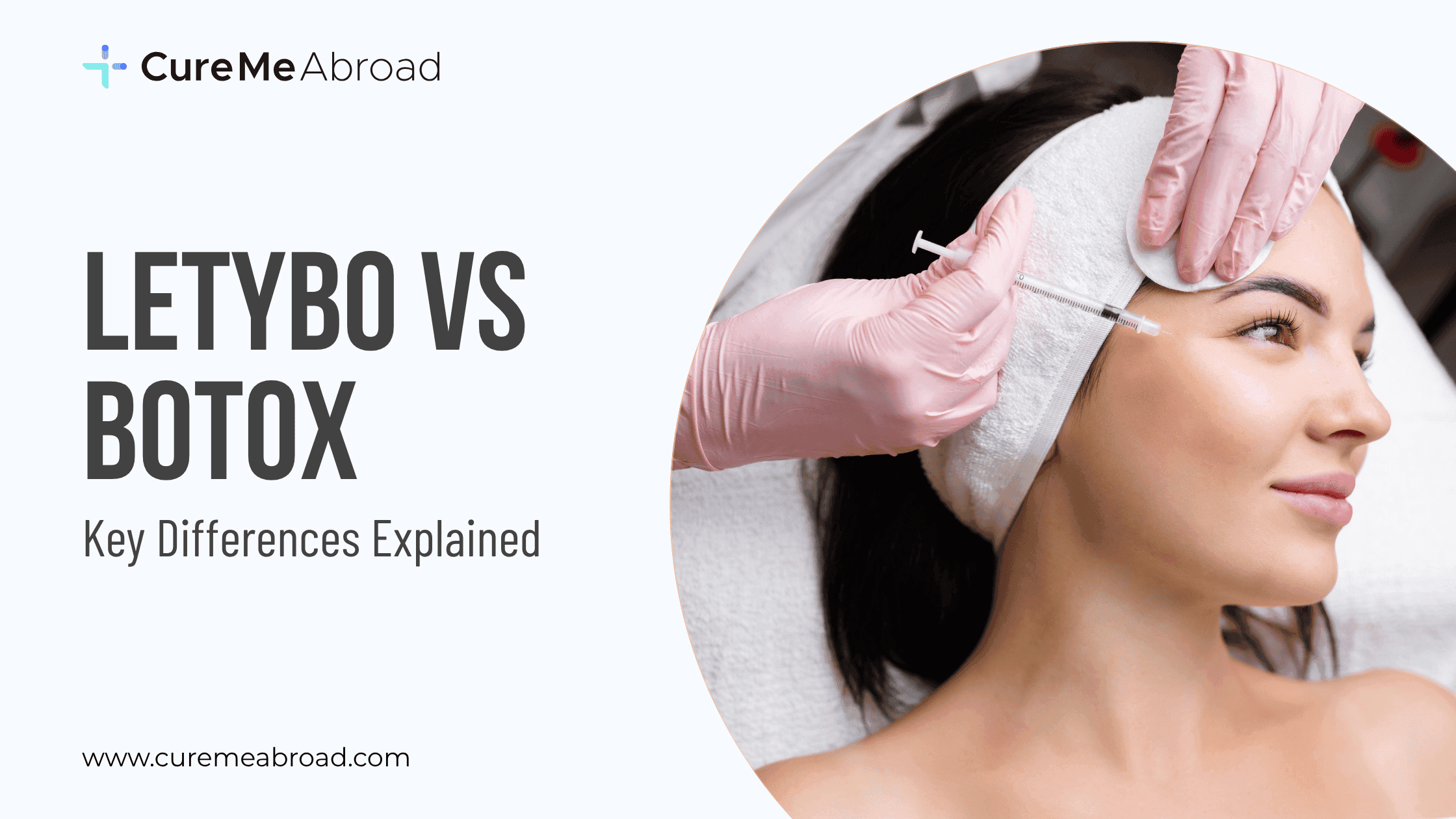
Two products. Same goal. Conspicuously varied price tags based on your location on the planet.
The go-to solution to wrinkle treatment over 20 years has been Botox. Then came Letybo, which is a more recently approved botulinum toxin in the EU, but has been in use in South Korea and elsewhere in Southeast Asia over years earlier. Patients are also questioning how well it works, how it compares when used clinically and whether the fact that they are actually seeing it cheaper at the clinics overseas is worth it or is it simply a tradeoff.
This guide provides the answers to those questions. It discusses what each product is, how the clinical results compare, what the actual results look like in practice, and the source of the real cost difference, such as why the same treatment cost 60-70% more in a private aesthetics practice in the US or UK than in an accredited clinic abroad.
What Is Letybo and What Is the Difference between Botox and Letybo?
Both Botox and Letybo are botulinum toxin type A. They act in a similar fashion: by inhibiting nerve impulses to certain muscles of the face, temporarily paralyzing them, they lessen the look of dynamic wrinkles - lines that appear on the face due to frequent contraction of the same muscle as a result of squinting, frowning, and smiling.
The distinction lies in the manufacture thereof and the origin thereof.
Allergan, now a subsidiary of AbbVie, manufactures Botox (onabotulinumtoxinA). It was approved to be used as a cosmetic in 2002 by FDA and has over 20 years of post-market safety history. It is the most researched neuromodulator worldwide.
Hugel, a South Korean biopharmaceutical company, produces Letybo (prabotulinumtoxinA-xvfs). Since 2014, it has been approved in South Korea and is used in Asia extensively, before being approved by the European Medicines Agency (EMA) in 2022. As of 2026, it is sold in Europe, a few countries in the Middle East and a few parts of Asia, but has not been FDA-approved to sell in the US market.
Both employ botulinum toxin type A that is highly purified. The distinction is in manufacturing process, protein complex and formulation and not in the underlying mechanism of action.
The mechanism of action
On injection into a muscle, either of the two products inhibits release of acetylcholine, the neurotransmitter which triggers the muscle to contract. The muscle relaxes. The skin that is on top of it, no longer pulled by the repeated movement, flattens.
The impact is short-lived. The majority of patients experience 3 to 6 months of results, and the nerve signals slowly recuperate and muscle activity recovers. Maintenance therapies should be done regularly in order to maintain results in the long run.
Clinical Evidence: What the Studies Show in Reality
It is here that patients are more likely to become nervous about newer products. Letybo is not new to South Korea, where it has been used since 2014 - more than a decade of practical use before it was approved in Europe. In 2022, the EMA approval mandated clinical evidence of the same standard as all botulum toxin approvals in Europe.
Letybo's Clinical Data
The clinical trials that were critical in approving the EMA of Letybo specifically tested it in the form of glabellar lines (the frown lines between the eyebrows). In a Phase 3 trial, Letybo demonstrated the primary endpoints: at Week 4 significantly higher percentage of patients had a responder score of none or mild, compared to placebo, as determined by both investigators and patients (Hugel, EMA assessment report, 2022).
A comparative study in the Journal of Cosmetic Dermatology (2021) did not find any statistically significant difference between prabotulinumtoxinA and onabotulinumtoxinA (Botox) regarding onset, peak effect, and duration in the glabellar lines.
What This Means In Practice
Both products work. Clinical literature supports the same efficacy of glabellar lines in the rightly dosed patients. Onset is comparable most patients will show visible results between 2 to 5 days with full effect after 2 weeks. Duration is similar at 3 to 4 months in the majority of patients with some going up to 5 to 6 months depending on the area of treatment and response.
The breadth of evidence is where Botox has a definite lead. It has been researched on dozens of indications other than cosmetics, has over 20 years of post-market data worldwide, and is offered in more countries. The clinical record of Letybo is good but more limited, with more publications on glabellar lines, and less on off-label use such as jaw slimming or hyperhidrosis than Botox has.
Letybo vs Botox: Side-by-Side Comparison
| Feature | Botox (Allergan/AbbVie) | Letybo (Hugel) |
|---|---|---|
| Active Ingredient | OnabotulinumtoxinA | PrabotulinumtoxinA-xvfs |
| Manufacturer | Allergan / AbbVie (USA) | Hugel (South Korea) |
| FDA Approved | Yes (cosmetic since 2002) | No (not yet US-approved) |
| EMA Approved | Yes | Yes (2022) |
| Years in Use | 20+ years globally | 10+ years in South Korea / Asia |
| Onset of Results | 2–5 days | 2–5 days |
| Duration | 3–6 months | 3–5 months |
| Approved Indication | Glabellar, forehead, crow's feet + more | Glabellar lines (EMA approval) |
| Clinical Evidence Volume | Extensive (20+ years, multiple indications) | Solid for approved indication, narrower breadth |
| Cost (US / UK clinic) | $300–$600 per area | Not widely available in US/UK |
| Cost Abroad (via Luxora) | $150–$300 per area | $80–$180 per area |
| Diffusion Profile | Well-characterised | Slightly different protein complex — emerging data |
| Best For | All areas, extensive track record | Glabellar lines, cost-conscious patients in approved markets |
Advantages and Disadvantages: An Unbiased View
Botox
Advantages:
- The most widely researched botulinum toxin product worldwide.
- FDA and EMA are approved to a variety of cosmetic and medical indications.
- Can be found in almost all countries where aesthetic medicine is practiced.
- Repeatable, documented performance in all areas of the face.
- It is trained and experienced by most injectors around the world.
Limitations:
- More expensive, especially in the US, UK and Western Europe.
- Brand premium is not a measure of better clinical results in most standard applications but rather the position of Allergan in the market.
- Temporary results - will need continual maintenance after every 3 and 6 months.
Letybo
Advantages:
- More than ten years of practical safety statistics in South Korea and Asia.
- FDA approved to use glabellar lines with a clinical trial to prove its effectiveness.
- Significantly reduce the price, especially in clinics in accepted markets overseas.
- Similar onset and duration as Botox on approved indications.
- An effective alternative to patients that are cost-sensitive and in a validated market.
Limitations:
- Not approved by FDA - not in licensed clinics of the US.
- Less broad approved indication than Botox.
- There is less published information on off-label applications and non-glabellar locations.
- There are a few injectors that were not in South Korea or Europe with limited hands on experience.
- The nature of diffusion continues to be described in the wider literature.
What Do Each of them Treat?
Botox: FDA Approved and Uses
EMA and FDA have granted Botox cosmetic approval in multiple areas of the face, and off-label in a variety of additional areas:
- Glabellar lines (brow wrinkles) — approved sign.
- Forehead lines - approved sign.
- Crow feet (lateral canthal lines) - approved indication.
- Brow lifting, lip lines, dimples on the chin - typical off-label applications.
- Jaw slimming (masseter reduction) - commonly performed off-label.
- Hyperhidrosis (excessive sweating) - approved medical indication.
- Treatment of migraine - approved medical indication.
Letybo: Uses Approved
- Glabellar lines - approved indication (EMA)
- Gaining off-label use in forehead and crow's feet in advanced clinics in accepted markets.
- The off-label application without glabellar area is practitioner-specific and is not supported by the same amount of published data yet.
When you think of Letybo, other than glabellar lines, the truth of the matter is that whether you inject it or not, the experience you have with the product is what counts as compared to Botox. Inquire specifically on their amount of Letybo treatments and how they feel it works in your area of treatment.
The Reality of the Cost: Why the Gap
In a private aesthetics clinic in London or New York, it would cost $300 to $600 in a single area treated with Botox. To get a complete three-area treatment (glabellar, forehead, crows feet), it costs between $900 and $1,800 a session.
Where it is available in qualified markets overseas, Letybo is priced at $80 to $180 per area in certified clinics. A three-area treatment: $240 to $540.
The difference cannot be attributed to the disparity in quality. It reflects:
- Manufacturing cost: Hugel has lower manufacturing costs as compared to Allergan, which has a decades-old brand structure.
- Market pricing: South Korea and southeast Asian aesthetic markets are very competitive with the prices remaining low even in the best clinics.
- Overhead: Istanbul, Bangkok, or Seoul have a lower structural cost of clinic compared to London or New York.
It is not whether Letybo is cheaper or not. It is. The question is, whether the clinical outcome is worth the travel cost in your particular situation - and in the case of many patients who have three or four treatment sessions per year, the calculation is easy in favour of travelling.
Where Patients are receiving such treatments in other countries
The world has the highest concentration of experienced Letybo injectors in South Korea - the product is in clinical use in South Korea since 2014. The Turkish and especially the Istanbul aesthetic medicine market is highly developed, and both Botox and Letybo can be found in JCI-approved and globally certified clinics. Thailand and UAE are also established destinations.
Which one Should you select?
The correct answer relies on four feasible factors.
Choose Botox If:
- You are in the US - Letybo is not FDA approved and not in licensed US clinics.
- You desire to have treatment in various parts of the face such as forehead, crows feet, jaw or lips - Botox has a wider approved indication and more experience in every zone among practitioners.
- You like the most well-documented product - 20+ years of worldwide post-market safety data are a true benefit provided that peace of mind is one of your concerns.
- Your injector has a low experience with Letybo - a more experienced injector using Botox will have a better predictable outcome compared to one with less experience using Letybo.
Choose Letybo If:
- You are in a nation where it is accepted EU, South Korea, some of the Middle East and Asia.
- The glabellar lines are your major concern - the approved indication where clinical evidence is best.
- The determining factor is cost - to patients with frequent maintenance needs, the 4060 percent price gap will translate to significant annual savings.
- You are going to South Korea, Turkey, or Thailand to get treatment, and you want a clinician with a large amount of hands-on experience.
Note on a combination of both
Patients are given Botox in their home market to provide consistency in areas that need accuracy (such as crows feet or lip lines) and Letybo in countries with the most evidence base (such as glabellar area). This isn't unusual. The products are not administered together during one session but the administration of different products at different times is clinically acceptable.
What to Expect: Recovery and Therapy
There is no difference between Botox and Letybo when it comes to the process of treatment.
The session is 10-20 minutes. The injector identifies target points, uses topical numbing cream when necessary (some patients do not use it at all), and injects tiny amounts of the drug into the target muscles. The needle is extremely fine and most patients report that it feels as a small pinching at best.
Slight redness or small raised marks at injection sites are common immediately after. These are usually resolved within 20-30 minutes.
Effects take 2 to 5 days to manifest and at 2 weeks full effects are evident. The majority of patients have a 2-week follow-up appointment to evaluate symmetry and the necessity of any touch-up.
Results should be maintained by maintenance every 3-6 months. The duration is subjective - the metabolism, muscle mass and the treatment area influence the duration of effects.
What to avoid during the first 24 hours of treatment: strenuous activity, alcohol, lying flat and pressure on the treated area.
Conclusion
Letybo and Botox are not as divergent as the marketing stories of each may imply. They are both botulinum toxin type A products that have similar mechanisms, onset, and duration, and clinical effects in glabellar lines.
The benefits of Botox include a longer clinical history, expanded clinical indications, and worldwide presence. Letybo has a cost advantage, and a good history in South Korea and Asia where it has more than 10 years of use.
In the US, Botox is the viable option to use by patients since Letybo is not accessible. Letybo at a certified clinic may be clinically reasonable to be compared with by patients who are thinking about receiving treatment in a foreign country, especially in Europe, the Middle East, or Asia.
The greater variable, irrespective of product, is the practitioner. The results of an experienced, qualified injector using Letybo will be better than an inexperienced injector using Botox.
When you are looking at aesthetic treatment in a foreign country, CureMeAbroad will match you with proven clinics that have both products, practitioner qualifications are verified and treatment plans are designed to meet your objectives.
Frequently Asked Questions
Does Letybo work as well as Botox?
In the case of glabellar lines, there is equal clinical evidence to support the same efficacy. In a comparative study, the Journal of Cosmetic Dermatology (2021) did not find a statistically significant difference in the onset, peak effect, or duration between prabotulinumtoxinA (Letybo) and onabotulinumtoxinA (Botox). In other regions, Botox enjoys a larger evidence base and experience among the practitioners in the world.
Why is not Letybo sold in the US?
Hugel is yet to get the FDA approval to the US market. The approval of FDA involves independent clinical trials that are done in accordance with US regulations, and this is not the same as the approval of EMA. The product can be approved by FDA in the future, but as of 2026 it is not offered in licensed clinics in the US.
What is the duration of action of Letybo vs Botox?
The average patient life of both products is 3-5 months. There are Botox patients who complain of a duration of 5 to 6 months especially when they have repeated Botox. The duration depends on the area of treatment, muscle mass, metabolism, and dose - the outcomes of different people in relation to the use of this or that product vary.
Is it safe to receive these treatments in other countries?
Yes, with the clinic being duly checked. Aesthetic medicine risks in foreign countries are associated with the qualification of practitioners and the authenticity of products, rather than with the geography. All the partner clinics are evaluated on practitioner qualifications and authenticity of non-counterfeit products through Luxora. There is more risk in using an unverified clinic based on the price of the clinic, anywhere in the world.
Is it possible to replace Botox with Letybo?
Yes. Patients are able to alternate botulinum toxin products. Usually, it is advisable to wait until the effects of the last treatment had completely elapsed before changing products to enable a proper evaluation of the baseline. Your injector will decide when to do it depending on your date of last treatment.
Is Letybo more or less harmful than Botox?
Injection discomfort does not show any significant clinical difference. Both are given by means of very fine needles in small doses. The ability to endure pain is personal and is much more affected by the method of the injector and the region being treated than the product itself.
References
European Medicines Agency (EMA) - Letybo (prabotulinumtoxinA): Assessment Report, 2022.
https://www.ema.europa.eu/en/medicines/human/EPAR/letyboLecouflet M, et al. — Comparative Study PrabotulinumtoxinA vs OnabotulinumtoxinA in Glabellar Lines - Journal of Cosmetic Dermatology, 2021.
https://pubmed.ncbi.nlm.nih.govAllergan / AbbVie - Botox Cosmetic (onabotulinumtoxinA): US Prescribing Information, 2023.
https://www.accessdata.fda.gov/drugsatfda_docs/label/2023/103000s5316lbl.pdfHugel Inc. - Letybo Clinical Overview and South Korea Approval Data, 2022.
https://www.hugel.co.kr/en/product/letyboAmerican Society of Plastic Surgeons (ASPS) - Botulinum Toxin (Botox) Procedure Statistics, 2023.
https://www.plasticsurgery.org/news/plastic-surgery-statisticsInternational Society of Aesthetic Plastic Surgery (ISAPS) — Global Survey on Aesthetic Procedures, 2023.
https://www.isaps.org/discover/isaps-global-statisticsJoint Commission International (JCI) - Accredited Organizations Directory.
https://www.jointcommissioninternational.org/who-we-are/jci-accredited-organizationsMayo Clinic- Botox Injections: Overview, Risk, and What to Expect, 2024.
https://www.mayoclinic.org/tests-procedures/botox/about/pac-20384658