




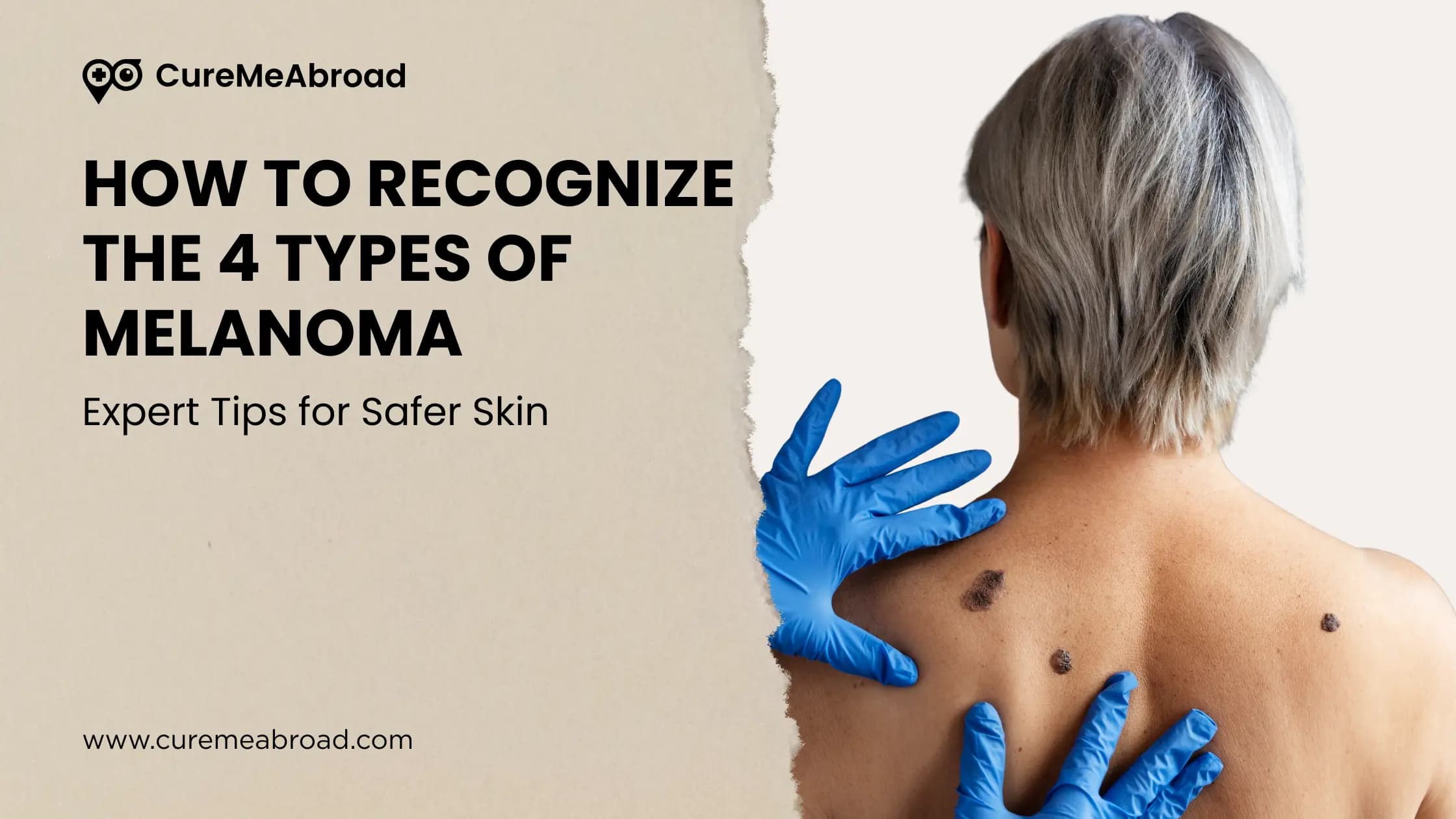
We all tend to check our skin daily while we are getting ready, doing our makeup, shaving, or just looking in the mirror. Even so, in this daily routine, a great number of people still fail to notice the small changes on their skin that could be the first signs of something serious. Generally, melanomas appear to be just one kind of a visually innocent single spot. Still, under that little spot, there might be one of the four melanoma types, which are classified based on their origin, aggressiveness, and capacity to metastasize.
The rise in melanoma cases, particularly among young adults and people who deliberately expose themselves to the sun or tanning beds, has been the frightening trend dermatologists have been warning about for a long time. Most people are unaware that melanoma is not one single disease. It is a cluster of 4 different types of melanoma that differ in their behavior, signs, and risk levels.
It is a great advantage to differentiate the 4 types of melanoma. We, through this extensive guide, clarify the 4 types of melanoma in a very simple and understandable manner. You will understand what they are, where they are, how fast they spread, who is the most vulnerable, and what you can do to protect yourself.
What not to acquaint yourself with the four forms of this complex disease, so that you can be informed, safe, and have control over your skin health?
What is Melanoma?
Melanoma is the most dangerous skin cancer that develops from the cells of the skin called melanocytes, which produce melanin. Melanin is a pigment that provides color to the skin. In some cases, these cells may alter their behavior, most often as a result of being harmed by the sun. Eventually, this harm may turn into cancer.
Just to put things in perspective, melanoma accounts for only 3% of the total skin cancer cases, but it is the one with the highest mortality rate among all types of skin cancer and is, therefore, more likely to spread (metastasize) to other parts of the body. Moreover, it is among the top five cancers in young adults aged 20-30 years and the main cause of cancer death in women aged 25 to 30.
Types of Melanoma
There are 4 main types of melanoma: superficial spreading, nodular, lentigo maligna, and acral lentiginous.
1. Superficial Spreading Melanoma: The Most Common of the 4 Types of Melanoma
Superficial spreading melanoma is the most common type of melanoma. It is responsible for approximately 70% of melanoma skin cancers.
- Growth: Typically, it grows (radial growth) and extends along the skin surface. Nevertheless, it can also penetrate the skin (vertical growth).
- Appearance: Most of the time, it is a flat and thin (less than 1 mm thick) skin with an irregular border. The colour of the lesion is not uniform and it can have different combinations of red, blue, brown, black, grey, and white. Moles turning into superficial spreading melanoma is one of the ways by which this cancer develops.
- Location: This cancer may appear anywhere on the body. However, in men, it is mostly located on the central part of the body, e.g. the trunk. Additionally, the disease is the most common for females in the area of the legs.
2. Nodular Melanoma: The Most Aggressive of the 4 Types of Melanoma
Nodular melanoma is the third most common type of melanoma skin cancer with a percentage of 15 to 20% of the total number of melanoma skin cancer cases.
- Growth: Nodular melanoma invades the skin layer by layer. It develops and metastasizes faster than the other four types of melanoma. It is usually considered the most aggressive one because it focuses on vertical growth.
- Appearance: It is a raised area or growth that is visually different from the skin. The growth may look like a mushroom with a stem or stalk. Usually, it is a black colored thing, however, sometimes it can be red, pink or the color of your skin.
- Vulnerability: Most of the time, this condition is brought to the doctor’s attention in the age group of 40's and 50's. Any part of the body can be the birthplace of this tumor.
3. Lentigo Maligna Melanoma: A Slowly Developing but a Quite Significant One of the 4 Types of Melanoma
Lentigo maligna melanoma is mainly a disease of the old. It accounts for the percentage that lies between 10 and 15 of the total number of skin cancer melanomas.
- Growth: This kind of melanoma spreads laterally over the skin surface for many years before it penetrates the skin vertically. It often comes from a tumor in situ called lentigo maligna which is the first stage of the tumor growth only in the top or outer layer of the skin (epidermis).
- Appearance: In most cases, it is a large flat tan or brown area with an irregular border of the skin. Eventually, it becomes darker and may have different brown and black shades.
- Location: Lentigo maligna melanoma typically comes from the sun-exposed body parts that are not protected by any means like the face, ears, and arms.
4. Acral Lentiginous Melanoma: A Rare but Significant Member of the 4 Types of Melanomas
Acral lentiginous melanoma is the tragic narrative that primarily unfolds in the dark-skinned population. These persons of the African, Asian, and Hispanic lineage are the ones to bear the brunt of it. Thereby, it is a non-UV-ray-related cancer. The acral lentiginous melanoma rate is a very small fraction of less than 5% of the total melanoma skin cancers.
- Appearance: An acral lentiginous melanoma is that piece of skin which has been stained and is generally of a dark brown or black color. It keeps on extending for a very long time along with the skin surface and just after that, it goes down into the skin.
- Location: Acral lentiginous melanoma is the most frequent type of melanoma which can be found in the sole of the foot, the palm of the hand, and the area under the nails. As a result of the fact that these are the parts of the body that people seldom look at, it is very difficult to differentiate acral lentiginous melanoma from other diseases and thus, the abnormal regions on the soles of the feet or under the nails are already on the skin and hence can not be seen easily.
Symptoms of Melanoma: The ABCDE Rule
The signs for melanoma include:
- Change in the appearance of a mole
- The brown mole or the skin spot that is becoming larger, most of the time with an irregular edge.
The ABCDE rule is a very good tool with the help of which you can keep in mind the features of melanoma that are different from common moles. Every letter in the rule stands for the following:
[Image of the ABCDE rule for melanoma diagnosis]
| Letter | Feature | Description |
|---|---|---|
| A | Asymmetry | The one half of the mole or skin spot changes the other half in shape. |
| B | Border | The edges are irregular, rough, notched, or faded. |
| C | Color | The color of each part of the skin spot is different and may be any of the following: brown, black, pink, red, white, or blue, as well as combinations of these colors. |
| D | Diameter | The spot is more than 6 millimeters long (approximately the size of the eraser of a pencil), however, melanomas can also be smaller in size. |
| E | Evolving | The mole or spot is changing in size, shape, color or behavior, for example, itching or bleeding. |
What Causes Melanoma?
Various factors may cause the risk of skin cancer to be increased:
- In case you spend a lot of time in the sun or use tanning beds
- Having light skin, hair, and eyes
- If you were sunburned badly in the past
- Skin cancer history in the family
- Unfavorable immune system, caused by an illness or certain medications
- Older age (although melanoma is one of the most frequent cancers in young adults too)
- If you have many moles or moles that appear to be abnormal.
Screening for all 4 Types of Melanoma
In a cancer check, the doctor physically looks over the body to find actinic keratoses (precancers), basal cell, and squamous cell carcinomas. Besides this, the skin is examined for any unusual moles that may be melanoma. If by any chance a dermatologist comes across a suspicious mole or growth, the decision could be to monitor it, or remove it. Besides, photos might be taken to facilitate the location of the lesions at a later time. If a mole or skin growth looks as if it is harmful, your doctor will definitely want to confirm it by a biopsy.
A skin biopsy is when a small part of skin is removed and later sent to the lab for a detailed examination under the microscope. In most cases, skin biopsies are done with local anesthesia.
Treatment Methods for all 4 Types of Melanoma
Main Treatment Methods are:
- Surgical excision
- Mohs micrographic surgery
- Immunotherapy
- Targeted therapy
- Chemotherapy
- Radiation therapy
- Sentinel lymph node biopsy
Knowing the 4 types of melanoma is a major step towards keeping your skin healthy for a long time. The four are different in their behavior, some being slow-growing, while others rapidly growing, but they all have one thing in common: the detection at the earliest stage makes the most significant impact on survival. Identifying abnormal changes with the aid of the ABCDE guideline and not missing skin checks or applying sunscreen will allow you to discover melanoma at its lowest and most treatable stage.
Being informed is a form of power and staying updated about the 4 types of melanoma means that you will be in a better position to respond quickly, make a decision without hesitation, and take action before the situation worsens. In case there is something on your skin that neither looks nor feels right, go by your intuition and seek a dermatologist’s opinion immediately.
Frequently Asked Questions
What are the four types of melanoma?
The four types of melanoma are superficial spreading melanoma, nodular melanoma, lentigo maligna melanoma, and acral lentiginous melanoma.
Which of the four types of melanoma is the most dangerous?
Nodular melanoma is generally considered the most aggressive type because it grows rapidly in a vertical direction, allowing it to spread more quickly than other forms.
Which type of melanoma is the most common?
Superficial spreading melanoma is the most common type of melanoma, accounting for the majority of melanoma cases.
Are all four types of melanoma caused by sun exposure?
No. Acral lentiginous melanoma is not typically associated with UV or sun exposure. It usually develops on the palms of the hands, soles of the feet, or under the nails.